
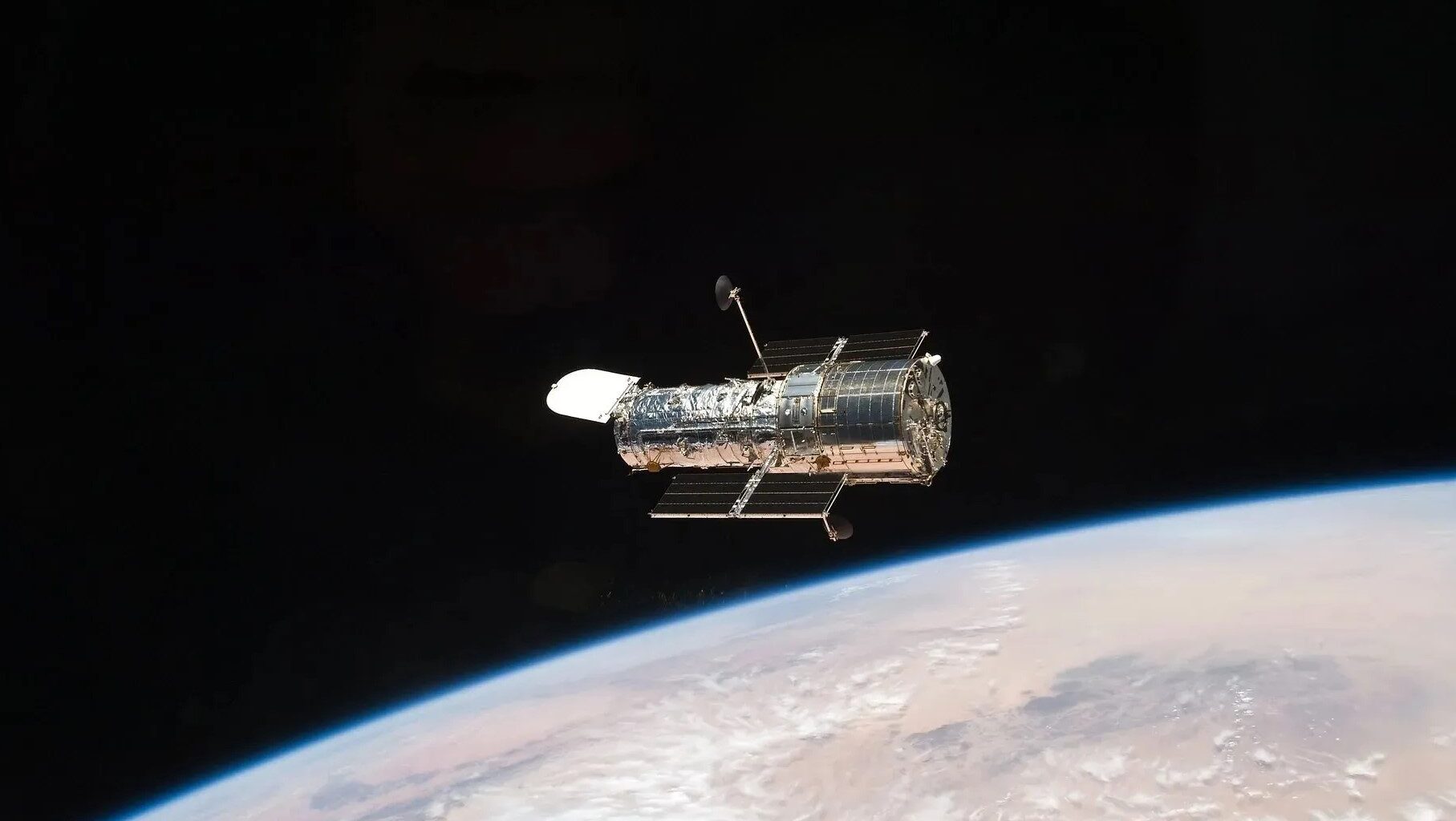
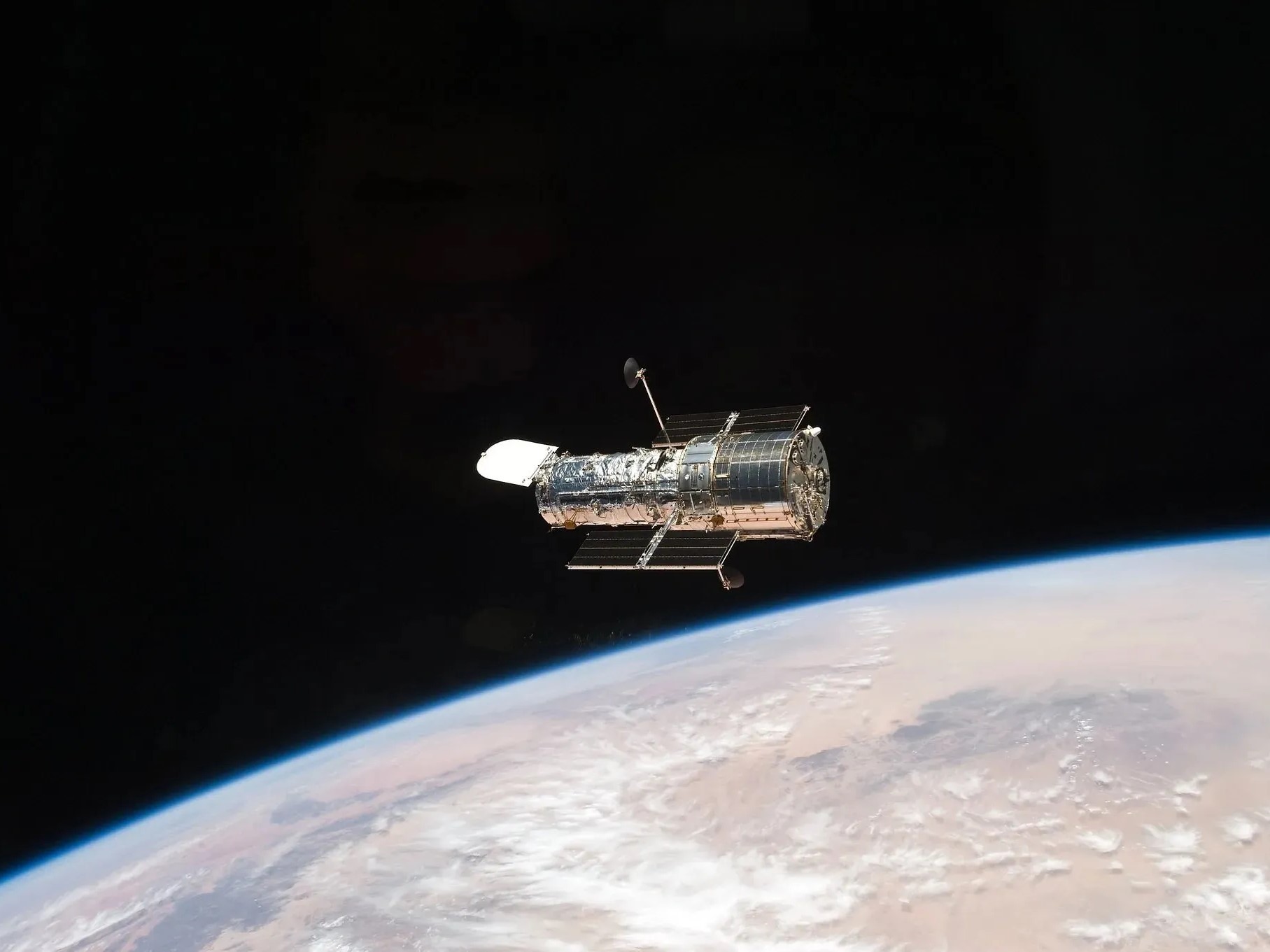
 An image of Hubble space telescope in orbit (Image source: NASA)
NASA’s Hubble Space Telescope collated images of protoplanetary disks — disks that may eventually form planets. The collection shows the disks of several stars, with some viewed in visible light and others in infrared light. The image could help scientists better understand how stars form.
This Hubble collection captures eight protoplanetary disks — four in visible light and four in infrared. When stars are forming, they pull in gas and dust. Some of that matter forms a rotating disk — the protoplanetary disk. The gas and dust in the disk continue to feed the growing star. The remaining orbiting gas and dust may eventually form planets.
In the visible light image above, the protoplanetary disks are the dark dust disks between the bright light. HH 390, though, is not viewed edge-on, and that is why its disk seems to be at the edge of the bright light.
The bright light in question is a reflection nebula. Reflection nebulae are regions of gas and dust lit up by the light of a star. Jets of gas are also visible in the image. HH 390 and Tau 042021 are found about 450 light-years away in the Taurus Molecular Cloud. The bottom stars are located almost 500 light-years away in the Chameleon I star-forming region.
The stars in the infrared image appear to be in earlier stages of their evolution than those in the visible light image. In these earlier stages, there’s a thick dust envelope that covers the stars. Infrared light can pierce through that dust envelope. The envelope is evidently absent in the visible light images because visible light cannot see through that thick dust.
The dark areas that appear central to the bright light are the protoplanetary disks. The shadows of the disk cast onto the surrounding cloud make the disk seem larger. The top right and bottom left stars lie in the Orion Molecular Cloud about 1,300 light-years away. The top left and bottom right stars lie in the Perseus Molecular Cloud about 1,500 light-years away.
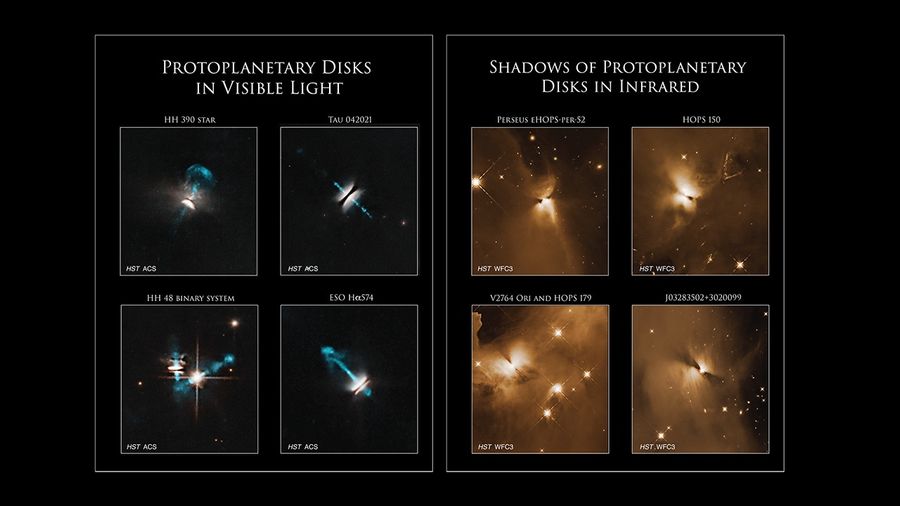 Hubble images of protoplanetary disks in visible and infrared light (Image source: several; see sources)
Image source — Left: NASA, ESA, and K. Stapelfeldt (Jet Propulsion Laboratory); Processing: Gladys Kober (NASA/Catholic University of America) Right: NASA, ESA, and T. Megeath (University of Toledo); Processing: Gladys Kober (NASA/Catholic University of America)
 Chibuike Okpara – Tech Writer – 354 articles published on Notebookcheck since 2024
I have always been fascinated by technology and digital devices my entire life and even got addicted to it. I have always marveled at the intricacy of even the simplest digital devices and systems around us. I have been writing and publishing articles online for about 6 years now, just about a year ago, I found myself lost in the marvel of smartphones and laptops we have in our hands every day. I developed a passion for learning about new devices and technologies that come with them and at some point, I asked myself, “Why not get into writing tech articles?” It is useless to say I followed up the idea — it is evident. I am an open-minded individual who derives an infinite amount of joy from researching and discovering new information, I believe there is so much to learn and such a short life to live, so I put my time to good use — learning new things. I am a ‘bookworm’ of the internet and digital devices. When I am not writing, you will find me on my devices still, I do explore and admire the beauty of nature and creatures. I am a fast learner and quickly adapt to changes, always looking forward to new adventures.