
It feels like every week I read an article or see some tweet espousing the “existential dread” of an AI takeover. And that always frustrates me because I haven’t seen much that proves AI can write or direct, or do anything but maybe help with visuals or a pitch deck.
Anyway, I’m not the only skeptic.
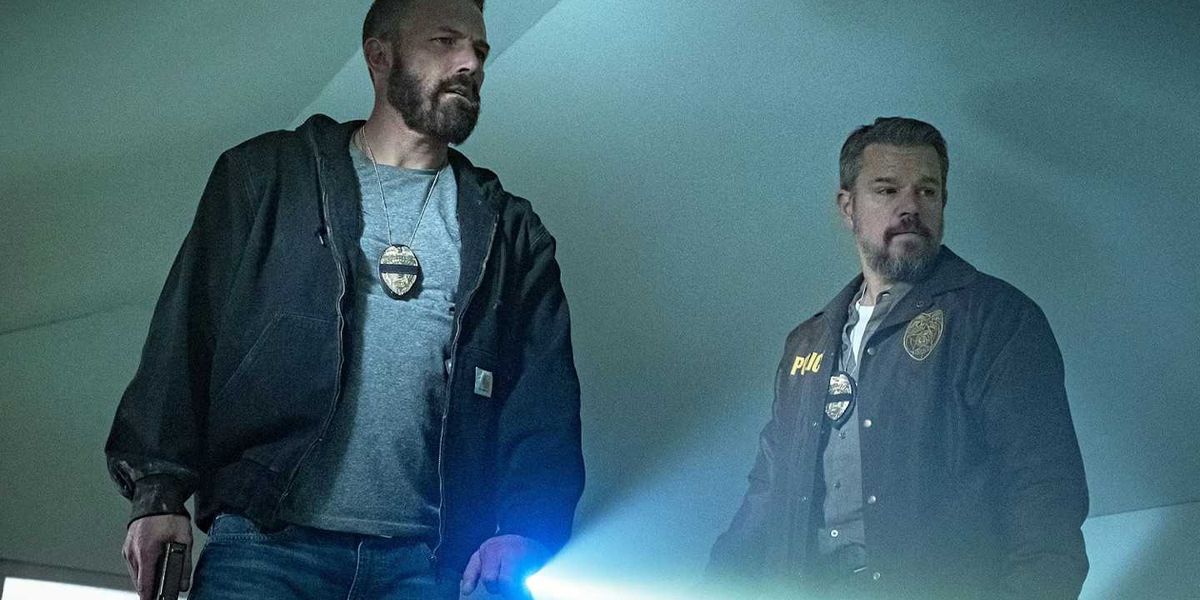
Ben Affleck and Matt Damon offered a grounded perspective on AI during a recent sit-down on The Joe Rogan Experience.
Let’s dive in.
– YouTubewww.youtube.com
The “Mean” Problem: Why AI Writing is “Sh*tty”
One of the things I love about long-form podcasts is that they get people to open up and have a conversation. And usually it’s a pretty honest one.
Hearing Damon and Affleck be honest about AI made me very happy.
Affleck doesn’t mince words when it comes to current AI. He thinks tools like ChatGPT or Gemini are impressive, but Affleck argues that by their very nature, they trend toward “the mean”, which is just the average.
AI cannot excel at anything because its whole model is being basic.
Great art exists at the edges. It’s specific, weird, and unpredictable. AI generates what is most likely to come next based on a massive dataset, which makes it a useful assistant for logistics (like drafting a letter or setting up a scene structure), but fundamentally incapable of writing anything truly meaningful.
Lived Experience vs. Algorithms
Here’s another thing AI cannot do: it has no life and no past. Damon talks about how this comes into play in Dwayne Johnson’s great performance in The Smashing Machine.
Damon recounts a powerful scene where Johnson’s character, suffering from an overdose, pulls a hospital sheet over his head. It’s a moment that felt so raw and real, it left Damon in tears.
When he asked Johnson how the scene came to be, the actor explained it was a fusion of two traumatic memories: his father’s struggles with substance abuse and the way his mother pulled a sheet over her head when diagnosed with stage three lung cancer.
AI can’t make that kind of stuff up because it has no life.
“No fu**ing AI can do that,” Affleck said. An AI can map a face and make it photorealistic, but it cannot reach into a “lived human experience” to create a performance that resonates with a stranger in a dark theater.
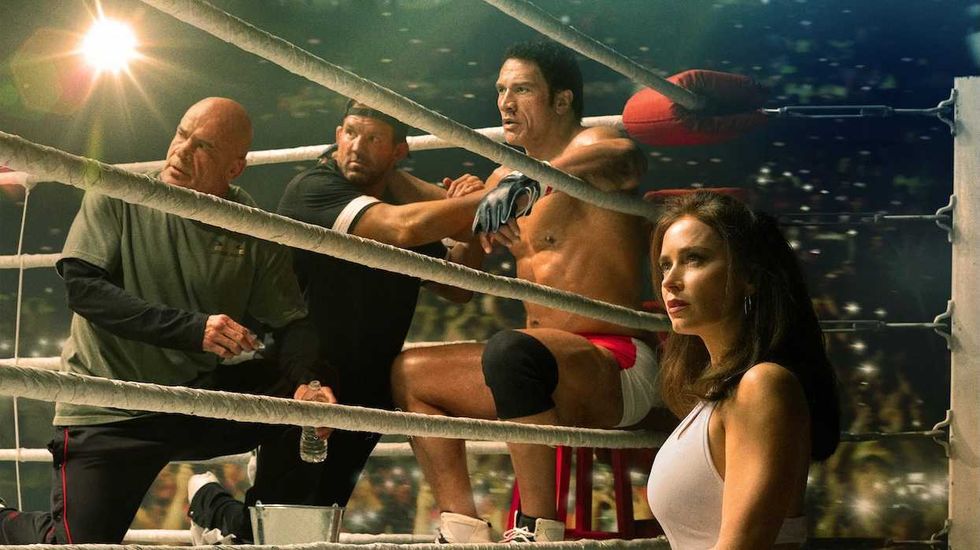 ‘The Smashing Machine’ Credit: A24
AI as a “Visual Effects Tool”
Here’s where Affleck and Damon think AI might excel. Instead of replacing actors, Affleck sees AI evolving similarly to electricity or modern VFX.
They point out that Hollywood has been “tiling” extras and using digital crowd-generation for years, from the orcs in The Lord of the Rings to the stadium in Invictus.
This is just a step forward in doing that, one that needs to be regulated and watched, but that’s about it.
There are positive uses for it. For example, instead of flying a crew to the North Pole, actors can perform in a studio while AI renders a hyper-realistic Arctic environment. That would allow the team to focus on the performance rather than the freezing temperatures.
But it’s not coming for the jobs any time soon.
The Plateau of the “Two-Year Revolution”
This was where I really felt like Affleck started cooking.
Affleck addressed the tech industry’s rhetoric, suggesting that much of the “AI will change everything in two years” narrative is driven by companies trying to justify massive valuations and capital expenditures.
He talked about how the massive leap in quality seen between early models is already starting to level off. Getting a model to be 25% better now costs significantly more in electricity and data, suggesting that the “exponential growth” may be hitting a plateau of diminishing returns.
These returns have not been what’s promised, and they’ve been so prohibitively expensive that we’re not seeing any great leaps any time soon.
Summing It All Up
When it comes down to it, I think Matt Damon summed it up the best. Audiences crave “real things made by real people”. Much like how we value a handmade table over a factory-produced one, we will continue to value the quivering lip of a real actress like Claire Danes or the authentic tears of a performer drawing from their own life.
AI is a tool to handle the “drudgery” of production, but it will never be the artist.
Let me know what you think in the comments.