
Support CleanTechnica’s work through a Substack subscription or on Stripe.
It is fashionable today to lambaste scientists as a bunch of nattering nabobs chasing research dollars so they can write boring reports no one will read. Science is a scam, some say, a deliberate attempt to clog the wheels of progress with scary prognostications that have no relevance to the main purpose in life — making money.
Those people who put personal gain ahead of science dismiss the idea that the Earth is getting hotter as the result of human activity. Doesn’t it say in the Bible that God gave humans dominion over the Earth? Doesn’t that mean anything humans do has the blessing of the Creator? And if something, somehow, does have a negative effect on the environment, why, we will simply engineer our way out of the situation so we can keep on doing what God put us on Earth to do — make money.
Engineering The Ocean
Many of those geoengineering solutions involve tinkering with the ocean, which absorbs a lot of the carbon dioxide in the atmosphere. But that creates a problem. Those of you who took chemistry in high school know that when carbon dioxide dissolves in ocean water, it turns that water acidic. Yes, it is a weak acid, but creatures that live in the ocean have adapted over millions of years to seawater that is less acidic.
The increase in acidity primarily effects crustaceans — animals that use the calcium found in ocean water to make the shells that protect them from predators. Below is a photo of a shell placed in acidic water and how the acid affects it over a period of 45 days.
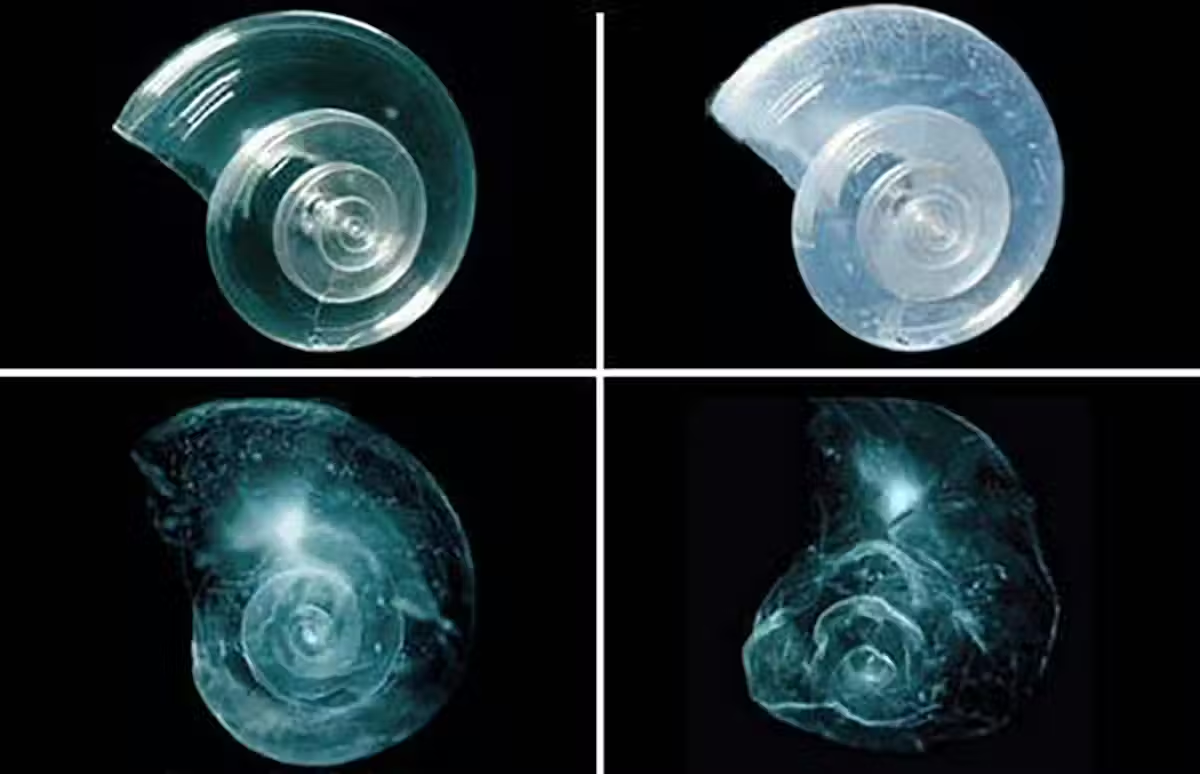 Credit: NOAA and Pacific Marine Environmental Lab, via The Conversation
Adapt Or Die
Rex Tillerson, the bozo who used to be the CEO of Exxon, liked to snarl that people would just have to adapt to changes in the environment. Rex was very wealthy but had no common sense. He did not understand that the adaptations he was talking about take tens or even hundreds of thousands of years to occur. The changes that he so blithely claims humans need to adapt to take place over a few decades — an infinitesimally short period of time in geological terms.
Some of the adaptations include more cooling for homes and buildings, or — as Jimmy Carter once suggested — putting on a sweater. The problem for whales, dolphins, coral, lobsters, and photoplankton is that they cannot just turn the thermostat up or down — or put on a sweater. They are helpless to affect the temperature, salinity, or acidity of the watery world they live in. If they cannot adapt because the changes happen too rapidly, they die.
So what? Let them die. Who cares about sea creatures? Douglas Adams, author of The Hitchhiker’s Guide To The Galaxy, once said, “Humans think they are smarter than dolphins because we build cars and buildings and start wars etc., and all that dolphins do is swim in the water, eat fish and play around. Dolphins believe that they are smarter for exactly the same reasons.”
A Geoengineering Study
 Credit: Advancing Earth & Space Sciences
In a study published January 14, 2026, in the journal Advancing Earth And Space Sciences, an international team of researchers examined all current geoengineering proposal to assess what their impact on the ocean would be.
Those strategies include photosynthesis enhancement, iron fertilization, or seaweed cultivation. “A fraction of the carbon they capture during growth can be stored in the ocean for hundreds of years, but much of it leaks back to the atmosphere once biomass decomposes,” the researchers claim.
Growing plants on land and sinking them in deep, low-oxygen waters where decomposition is slower can delay the release of the carbon contained in them — a process known as anoxic storage of terrestrial biomass.
Ocean alkalinity enhancement chemically converts carbon dioxide in seawater into other forms of carbon, allowing the ocean to absorb more from the atmosphere. This works by adding large amounts of alkaline material, such as pulverized carbonate or silicate rocks like limestone or basalt, or electro-chemically manufactured compounds like sodium hydroxide.
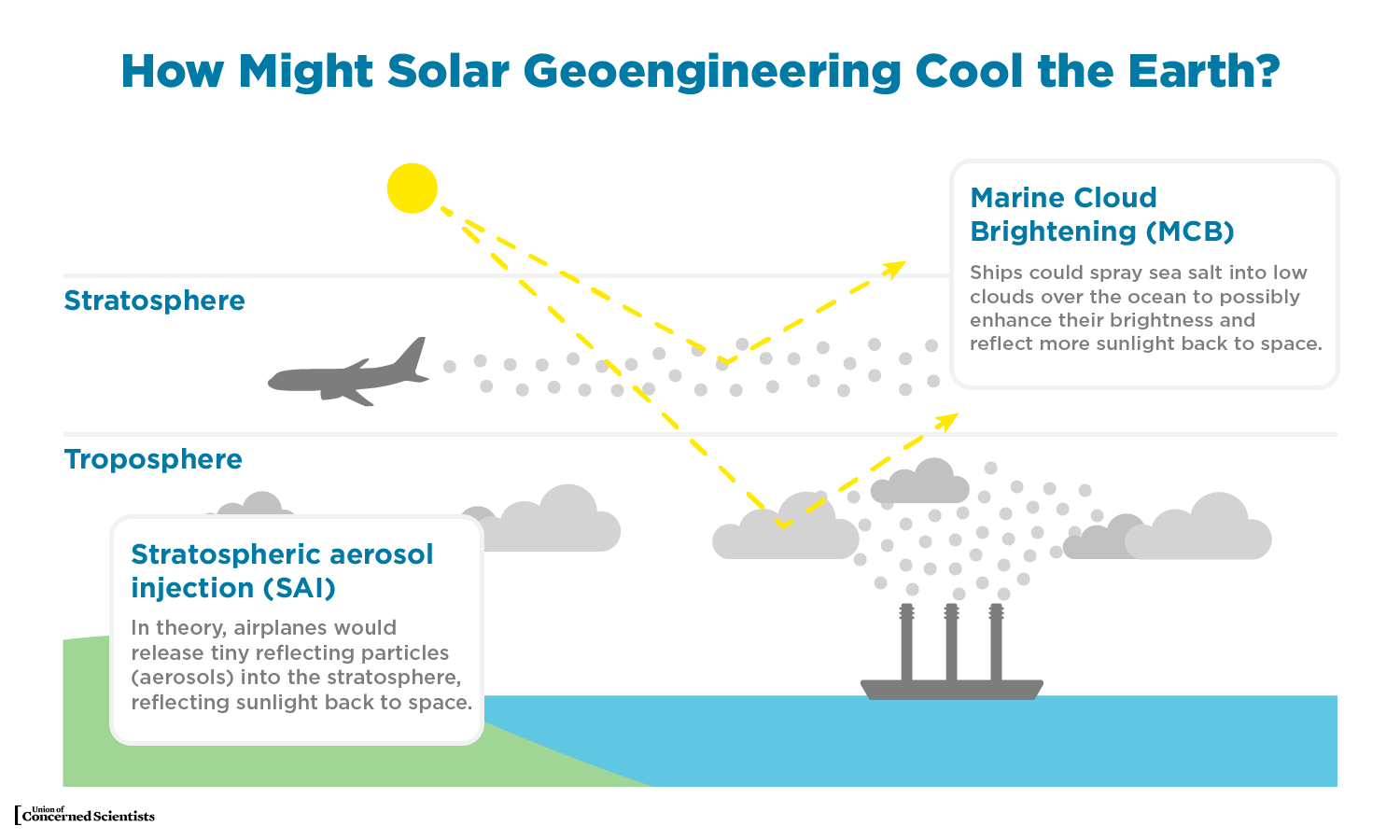
Then there are the methods more commonly known as geoengineering — mechanically altering the atmosphere to reflect a portion of the sunlight that strikes the Earth every day back into space. “The appeal of solar radiation modification is speed: It could cool the planet within years, but it would only temporarily mask the effects of still-rising carbon dioxide concentrations,” the researchers point out.
Risks And Rewards
Every strategy has risks and rewards, they claim. Adding more carbon dioxide to the ocean makes the water more acidic. Adding alkaline materials, such as pulverized carbonate or silicate rocks, could counteract the acidity of the additional carbon dioxide by converting it into less harmful forms of carbon.
“Biological methods, by contrast, capture carbon in living biomass, such as plants and algae, but release it again as carbon dioxide when the biomass breaks down — meaning their effect on acidification depends on where the biomass grows and where it later decomposes.”
But there are risks. “Fertilizing the surface in one area may boost plant and algae productivity, but at the same time suffocate the waters beneath it or disrupt fisheries thousands of miles away by depleting nutrients that ocean currents would otherwise transport to productive fishing areas.
“Ocean alkalinity enhancement doesn’t require adding nutrients, but some mineral forms of alkalinity, like basalts, introduce nutrients such as iron and silicate that can impact growth. Solar radiation modification adds no nutrients but could shift circulation patterns that move nutrients around.
“Shifts in acidification and nutrients will benefit some phytoplankton and disadvantage others. The resulting changes in the mix of phytoplankton matter: If different predators prefer different phytoplankton, the follow-on effects could travel all the way up the food chain, eventually impacting the fisheries millions of people rely on.”
Well, that is certainly food for thought, isn’t it?
The Least Disruptive Strategies
“Of all the methods we reviewed, we found that electrochemical ocean alkalinity enhancement had the lowest direct risk to the ocean, but it isn’t risk-free. Electrochemical methods use an electric current to separate salt water into an alkaline stream and an acidic stream. This generates a chemically simple form of alkalinity with limited effects on biology, but it also requires neutralizing or disposing of the acid safely.
“Other relatively low-risk options include adding carbonate minerals to seawater, which would increase alkalinity with relatively few contaminants, and sinking land plants in deep, low-oxygen environments for long-term carbon storage. Still, these approaches carry uncertainties and need further study.”
We Dare To Disagree
Further study? In a world that treats scientists as charlatans, when our leaders tell us sea levels are falling not rising; that the Earth is getting cooler, not hotter; and that harvesting the energy for the sun and wind is a greatest scam in human history? Against that backdrop, the researchers argue for a cautious, evidence-based path forward. Here is their summary, as presented in The Conversation:
Some scientists have argued that the risks of climate intervention are too great to even consider and all related research should stop because it is a dangerous distraction from the need to reduce greenhouse gas emissions.
We disagree.
Commercialization is already underway. Marine carbon dioxide removal startups backed by investors are already selling carbon credits to companies such as Stripe and British Airways. Meanwhile, global emissions continue to rise, and many countries, including the U.S., are backing away from their emissions reduction pledges.
As the harms caused by climate change worsen, pressure may build for governments to deploy climate interventions quickly and without a clear understanding of risks. Scientists have an opportunity to study these ideas carefully now, before the planet reaches climate instabilities that could push society to embrace untested interventions. That window won’t stay open forever.
Given the stakes, we believe the world needs transparent research that can rule out harmful options, verify promising ones, and stop if the impacts prove unacceptable. It is possible that no climate intervention will ever be safe enough to implement on a large scale. But we believe that decision should be guided by evidence — not market pressure, fear, or ideology.
In other words, a scientific approach is best for the Earth and for humanity. What a novel concept!
Sign up for CleanTechnica’s Weekly Substack for Zach and Scott’s in-depth analyses and high level summaries, sign up for our daily newsletter, and follow us on Google News!
Advertisement
Have a tip for CleanTechnica? Want to advertise? Want to suggest a guest for our CleanTech Talk podcast? Contact us here.
Sign up for our daily newsletter for 15 new cleantech stories a day. Or sign up for our weekly one on top stories of the week if daily is too frequent.
CleanTechnica uses affiliate links. See our policy here.