
By Craig Stevens, Christina Hulbe and Yingpu Xiahou* of 

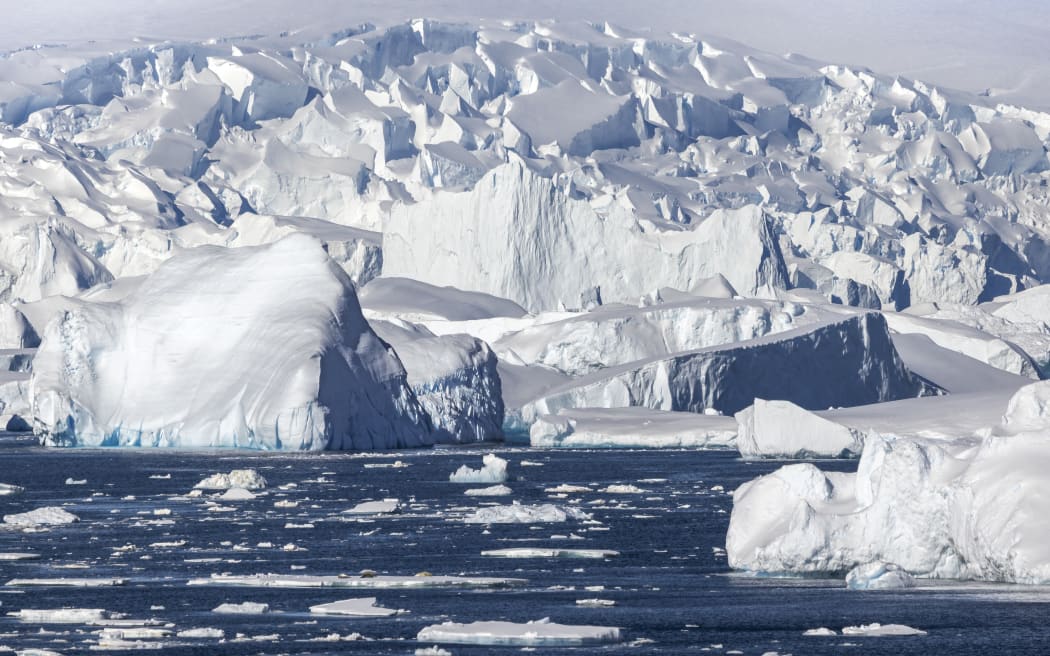
Iceberg and large fragments of drifting ice floating in front of the Antarctic Peninsula.
Photo: AFP / Claudius Thiriet
Beneath Antarctica’s Ross Ice Shelf lies one of the least measured oceans on Earth – a vast, dark cavity roughly twice the volume of the North Sea.
This hidden ocean matters because it is the ice sheet’s Achilles heel. The ice sheet is the continent’s enormous, kilometres-thick mass of land-based ice, while the ice shelf is the floating platform that fringes it.
If warmer water reaches the underside of the shelf, it can melt the ice that holds back millions of cubic kilometres of Antarctic ice, with consequences for global sea levels.
Yet almost everything we know about this cavity has come from brief snapshots at its edges. Until now, no one had captured a long, continuous record from its central heart. Our newly published study set out to change that.
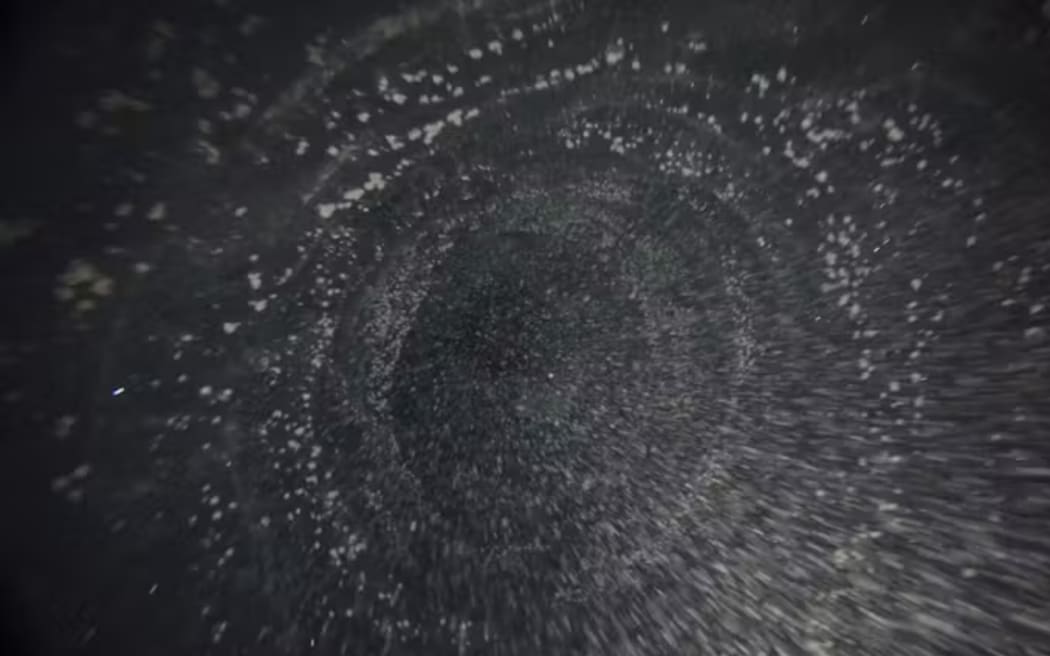
Looking downward in the borehole just before emerging into the ocean cavity. The white specks are sediment particles.
Photo: Stevens/NIWA/K061, CC BY-NC-ND
Inside Antarctica’s least-measured ocean
Ice shelves act as buttresses for Antarctica’s 30 million cubic kilometres of ice, built up over millions of years. The Ross Ice Shelf is the largest, among the coldest and most southerly, and perhaps the most sheltered from a warming ocean.
It spans both West and East Antarctica, where dozens of giant glaciers merge to form a wedge of ice 300 to 700 metres thick that flows northward, melting from below and calving the world’s largest icebergs.
When studying the ocean, snapshots are useful, but long time series are far more powerful. They reveal the rhythms of currents, eddies, tides and mixing, and how these interact with a warming climate. Beneath Antarctic ice shelves, where measurements are vanishingly rare, developing such records is essential.
Our study describes a four-year record of ocean processes beneath the middle of the Ross Ice Shelf, where the ice is 320 metres thick and the ocean below it 420 metres deep.
Most expeditions focus on the edges of ice shelves. We needed to understand what happens at their centre: so that is where we went.
The work was part of a large, multi-year project that began in 2016 with exploratory missions and ice-drilling trials and ended in 2022 when we finally lost contact with instruments suspended from the underside of the ice.
Once the drilling team reached the ocean – despite bad weather and the technical challenges of working in such a remote, extreme environment – we were able to deploy our instruments. These precision devices reported temperature, currents and salinity via satellite. We expected them to last two years before succumbing to cold or transmission failure. Instead, most continued to operate for more than four years, producing a uniquely long and remote record.
The new analysis shows that water properties vary systematically through the year, far from the open ocean and its seasons. The changes in temperature and salinity are subtle, but in a cavity shielded from winds and cold air even small shifts can have large implications.
Our work also reveals how variations in the central cavity align with changes in the Ross Sea Polynya – a wind-swept, ice-free area hundreds of kilometres away where high-salinity water forms. As Antarctic sea ice changes, this connection to the cavity will respond in ways we have not yet fully considered.
Perhaps most intriguingly, the data show persistent layering of water with different properties within the cavity. This unusual structure was detected in the very first measurements collected there in 1978 and remains today. While much remains to be learned, our results indicate the layers act as a barrier, isolating the ice shelf underside from deeper, warmer waters.
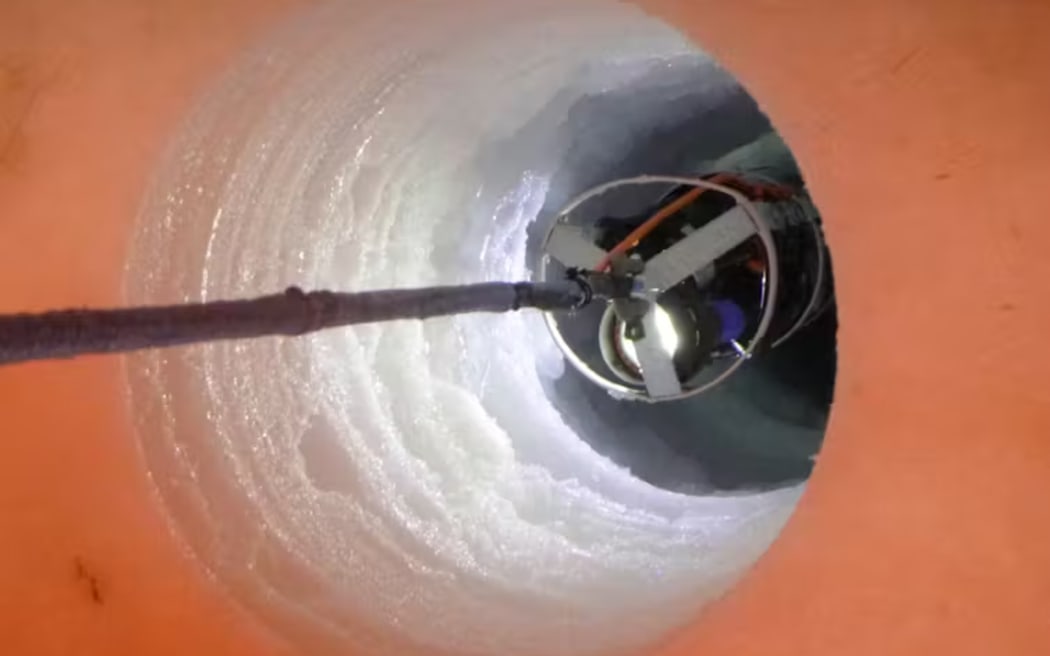
Instruments being lowered down the borehole.
Photo: Stevens/NIWA/K061, CC BY-NC-ND
What melting ice brings home
Much recent cavity research has treated the ice shelf as a middleman, passing ocean warming through to the ice sheet. Work like ours is revealing a more complex set of relationships between the cavity and other polar systems.
One of those relationships is with sea ice. When sea ice forms around the edges of an ice shelf, some of the cold, salty water produced as a by-product flows into the cavity, moving along the seafloor to its deepest, coldest reaches. Paradoxically, this dense water can still melt the ice it encounters. We know very little about these currents.
Changes to the delicate heat balance in ice-shelf cavities are likely to accelerate sea-level rise. Coastal communities will need to adapt to that reality. What remains less understood are the other pathways through which Antarctic change will play out.
Impacts from ice sheets unfold over decades and centuries. On similar timescales, changes around Antarctica will alter ocean properties worldwide, reshaping marine ecosystems and challenging our dependence on them.
In the near term, we can expect shifts in southern weather systems and Southern Ocean ecosystems. Fisheries are closely linked to sea-ice cover, which in turn is tied to ocean temperatures and meltwater.
Weather and regional climate feel even closer to home. A glance at a weather map of the Southern Ocean shows the inherent wobble of systems circling the globe. These patterns influence conditions in New Zealand and southern Australia and they are already changing.
As ice shelves and sea ice continue to evolve, that change will intensify. Ice shelves may seem distant, but through their ties to the atmosphere and ocean we share a common future.
* Craig Stevens is a Professor in Ocean Physics, University of Auckland, Waipapa Taumata Rau, National Institute of Water and Atmospheric Research (NIWA); Christina Hulbe is a Professor and Dean of the School of Surveying (glaciology specialisation), University of Otago; Yingpu Xiahou is a PhD Candidate in Physical Oceanography, University of Auckland, Waipapa Taumata Rau.
– This story originally appeared on The Conversation.