
The Irish originated the term boycott during the 1880s land wars, but now the Danes have taken the boycott digital.
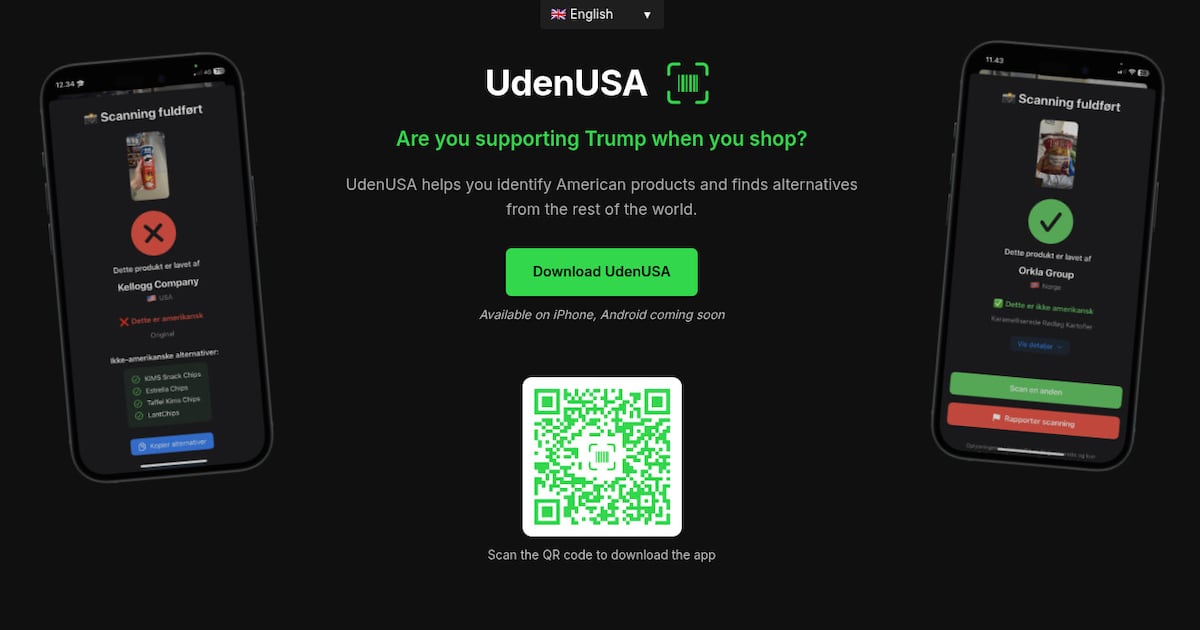
As Donald Trump steps up his campaign to take over Greenland, part of the three-country Kingdom of Denmark, 21-year-old Danish programmer Jonas Pipper has decided to push back with his app: UdenUSA or NonUSA.
He got the idea nine months ago after discovering a “Boycott USA” Facebook group with almost 100,000 members.
That was when Pipper realised there was “no tool to allow people to scan a product to know where it comes from”.
“It’s not because we necessarily say you have to boycott, we just create the opportunity to have more clarity [about product origin], and then it’s up to consumers what they want to do,” said Pipper to DRpublic television.
The app’s website, udenusa.uk, is more explicit in its politics, asking visitors: “Are you supporting Trump when you shop?”
“Every time you buy an American product,” it adds, “you indirectly support a system that works against many of the values we cherish in Europe.”
It is the most downloaded free app on the Danish Apple store.
As the US raises the stakes on Greenland, Pipper says interest has surged in the app he co-developed with programming partner Malthhe Hensberg on the small Danish island of Mors in western North Jutland.
The app is not without a few geeky touches. Users who scan a product using their camera phone are then confronted with the message: “Now hacking into the Pentagon … no, wait, don’t worry.”
Pipper is a part-time app developer, now on a sabbatical year from school and working in a local grocery store.
Danish economist Louise Aggerstrøm Hansen of Danske Bank has warned that the complicated nature of globalised supply chains means boycotts are not as clear-cut as they used to be.
Just 1.2 per cent of Danish food comes directly from the US, she said, while many US trademarked products are manufactured under licence in Denmark.
Even with such complications, Danish behavioural scientist Pelle Guldborg Hansen said people still turn to boycotts to overcome feelings of helplessness in the face of geopolitical developments.
“In this case it is about us and Greenland, and then you just want to do something with your anger – no matter how small,” he told DR. “More and more people see changing their consumption patterns as something they can do.”
A second, smaller boycott is already under way in Denmark against Icelandic musician Björk after she made a social media post backing Greenland’s push for full independence.
“Icelanders are extremely relieved that they managed to break from the Danish in 1944,” the singer-musician posted on Instagram.
In response, at least two Danish record stores have announced they have removed the musician’s records from sale.