
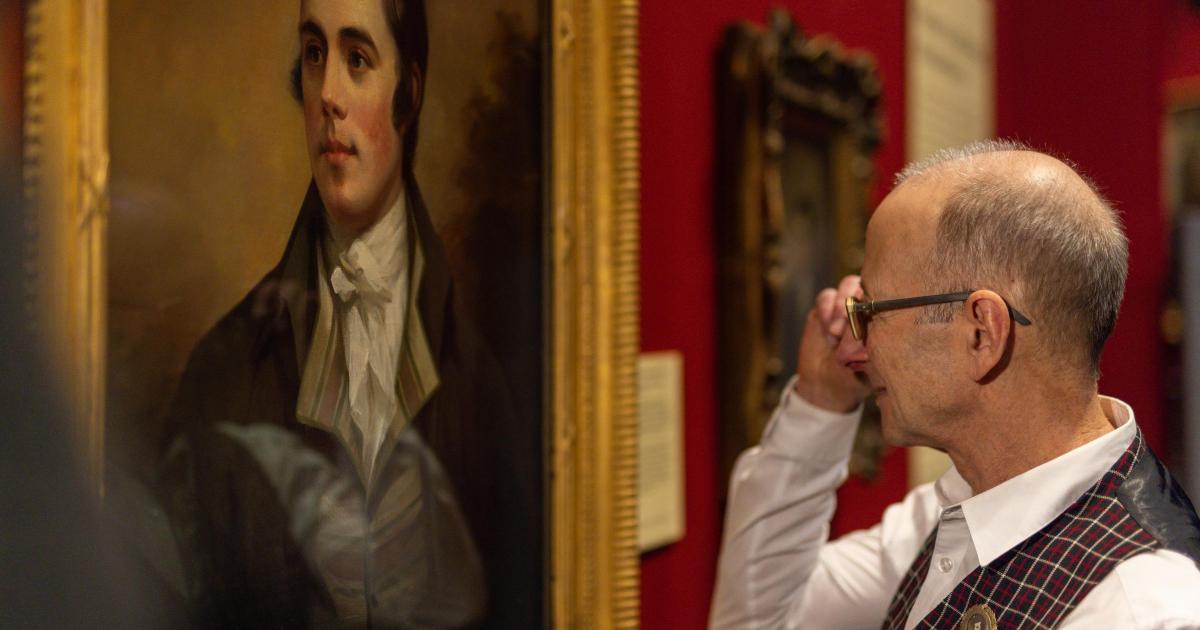
The painting was found during a house clearance in Surrey and consigned to auction in London in March 2025. With a starting price of between £300 to £500, the winning bid was £68,000. Long-term Burns scholar and enthusiast Dr William (Bill) Zachs, Director of Blackie House Library and Museum in Edinburgh, understood the potential significance of the painting and purchased the portrait believing it could be the elusive missing artwork.
The painting has since been cleaned, and examined by experts, who confirm that it is, indeed, the lost Raeburn portrait.
Commissioned in 1803 ─ at a fee of 20 guineas ─ by the publishers Cadell & Davies, the painting was to be engraved for future editions of Burns’s books, but, the painting has not been seen since. Its whereabouts remained a mystery for many decades. In 1924 TCF Brotchie, the Director of Glasgow Art Galleries and Museums, wrote that the painting’s discovery would be ‘an event bordering upon the sensational’. Lovers of Robert Burns and art experts alike have long debated the painting’s location. This resulted in much press and journal coverage over the decades, as various portraits of Burns were attributed to Raeburn. However, all were dismissed and the painting remained lost until now.
READ MORE:
Tam o’ Shanter ‘masterpiece’ to go to auction in Glasgow
Farmhouse where Robert Burns lived now available to rent
Robert Burns’ favourite inn is now home to a Michelin Guide restaurant
Book exploring Robert Burns-slavery connections up for leading literary award
The original 1787 portrait was painted by the Edinburgh-born artist Alexander Nasmyth as part of a marketing strategy for the second (Edinburgh) edition of Burns’ breakthrough book, Poems, Chiefly in the Scottish Dialect. This painting, which is now recognised across the world, is part of Scotland’s national art collection. For the first time, Raeburn and Nasmyth’s paintings will go on display side by side at the National gallery on the Mound in Edinburgh, to allow visitors to make their own comparisons of the two portraits.
Following the publication of the second edition of his poems, in 1787, Burns became a social phenomenon. The inclusion of an engraving of Nasmyth’s portrait made the poet an instantly recognisable celebrity. Burns had already achieved fame by the end of his short life, having passed away at just 37-years-old, but became a Scottish national icon in the 19th and 20th centuries.
Such was Burns’ popularity that in 1802 publishers Cadell & Davies decided to commission a new version of Nasmyth’s original 1787 portrait for use in future publications. By this time Burns’s close friend Alexander Cunningham was the custodian of the Nasmyth painting. He agreed to the proposal, advising that there was only one choice of artist, Henry Raeburn. One of Scotland’s most celebrated painters, Raeburn was a leading portraitist of the late 18th and early 19th centuries.
Over the years correspondence between Raeburn and Cadell & Davies, regarding both the commission and the delivery of the painting, has come to light. This proved the existence of the artwork, although with no clues as to where it ended up. One letter dated February 22, 1804 from Raeburn reads: ‘Nothing could be more gratifying to me than the approbation you express of the copy I made’.
Dr William (Bill) Zachs photographed with re-discovered portrait of Robert Burns by Henry Raeburn (left) and portrait of Robert Burns by Alexander Nasmyth, 1787 (right) (Image: Nick Mailer)
While the commission was to be based on the Nasmyth, Raeburn transformed the painting into a life-size portrait, using his considerable and instantly recognisable skills and expressive brushstrokes to bring Burns to life. Thin paint layers are applied in the artist’s characteristic direct manner using a warm palette of colours, capturing the essence of the poet effortlessly.
The painting has since been cleaned and examined, with several experts agreeing that this is the lost Raeburn portrait of Burns. The Raeburn attribution has been confirmed by: James Holloway, former Director of the Scottish National Portrait Gallery; Dr Duncan Thomson, former Keeper of the Scottish National Portrait Gallery; Helen Smailes, Senior Curator of British Art at the National Galleries of Scotland; Lesley Stevenson, Senior Paintings Conservator at the National Galleries of Scotland; and Dr Bendor Grosvenor, art historian.
William Zachs, owner of the painting and Director of Blackie House Library and Museum in Edinburgh, said: “This week at Burns Suppers in Scotland and around the world we toast the Immortal Memory of the poet. Now we have a new immortal visual memory – a once lost painting by Sir Henry Raeburn, the Scottish great portrait artist, that depicts Robert Burns not just as a genius poet but as a celebrated (and handsome) Scotsman whose significance would endure “till a’ the seas gang dry”.”
Lesley Stevenson, Senior Conservator (Paintings), at the National Galleries of Scotland, said: “Raeburn’s expressive, seemingly effortless brushwork, the characteristic warm palette, soft, atmospheric lighting and sensitive rendering of the instantly recognisable Robert Burns, are a joy. This is a significant discovery and one we can all celebrate.”
READ MORE:
The Glasgow schoolgirl who went viral after selling first painting aged 11
New art treasures venue on Edinburgh waterfront secures £56m funding deal
Historic Glasgow art group rescued from collapse holds first show in ten years
Dr Duncan Thomson, former Keeper of the Scottish National Portrait Gallery and curator of the last major exhibition on Sir Henry Raeburn at National Galleries of Scotland, said: “The rediscovery of this portrait of Burns, after having disappeared for two hundred years, is of enormous significance, linking the poet with Scotland’s greatest artist. Although Raeburn was working from an image made by another painter, the portrait has that wonderful freshness of observation that marks Raeburn’s work at its best. It is more than likely that Raeburn had seen Burns in his heyday in Edinburgh a decade earlier, and had observed that glowing eye that had so impressed the young Walter Scott. The result is a portrait that speaks in an entirely new way of the warmth, the sensuality and the profound intelligence that we find in Burns’s poetry.”
James Holloway, former Director of the Scottish National Portrait Gallery, said:”This is a once in a generation discovery: thrilling for lovers of both Burns and Raeburn.”
Professor Murray Pittock, Pro Vice-Principal University of Glasgow, said: “Raeburn’s portrait of Burns shines with the glow which is typical of the painter. It shows the now-dead poet moving into the realm of legendary icon, a transition he was to accomplish within less than a generation. In that sense the Burns we celebrate today is Raeburn’s Burns, though until now we did not know it.”
Professor Gerard Carruthers FRSE, Francis Hutcheson Professor of Scottish Literature at the University of Glasgow, said: “A lost likeness of Burns and a new Raeburn to boot: this really is two red letter days in one. There have been rumours of the portrait’s existence over many decades, but the recent detective work to authenticate has been simply outstanding.”