
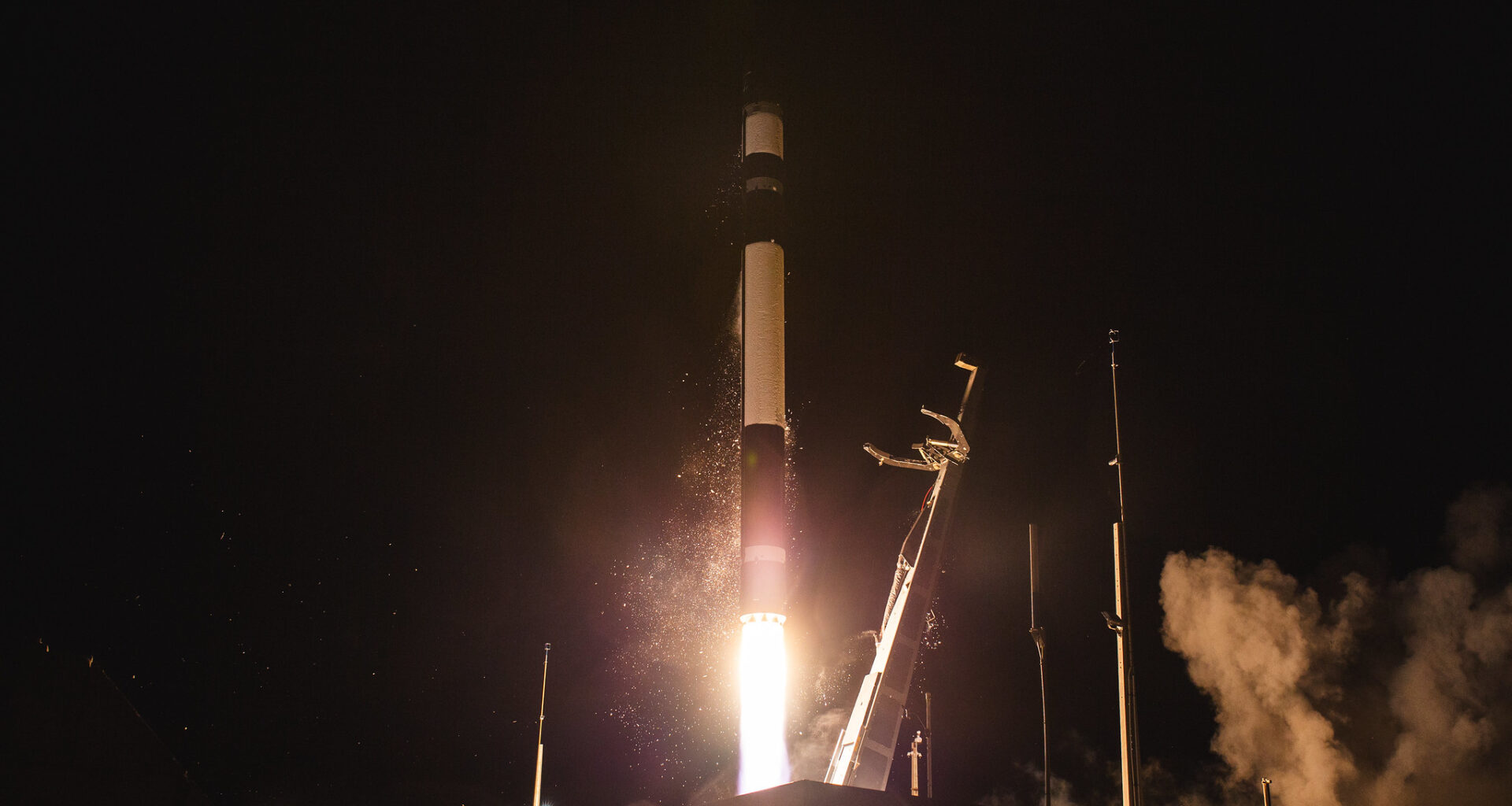
WASHINGTON — A Rocket Lab Electron launched the first satellites for a new constellation being developed by Open Cosmos that will use spectrum previously assigned to Rivada Space Networks.
The Electron lifted off from Rocket Lab’s Launch Complex 1 in New Zealand at 5:52 a.m. Eastern Jan. 22. It deployed two satellites into a circular polar orbit at an altitude of about 1,050 kilometers one hour and nine minutes after liftoff.
The satellites are the first in a constellation being developed by Open Cosmos, a U.K.-based satellite manufacturer and operator. The company released few details about the design of the spacecraft or the overall constellation, other than that it will be used for telecommunications.
“This launch is a major milestone for Open Cosmos and a critical step in our mission to provide secure, sovereign connectivity for Europe and the world,” Rafel Jordà Siquier, founder and chief executive of Open Cosmos, said in a company statement after the launch.
“These first satellites lay the groundwork for a resilient network designed to support governments, institutions and commercial partners with dependable space infrastructure when it matters most,” he said.
While Open Cosmos is headquartered in the United Kingdom, the company has operations in several European countries, including Greece, Portugal and Spain. It said the satellites will be licensed and operated in Spain.
The two satellites launched on Electron will be used for technology and operations demonstrations and serve as a proof of concept for the broader constellation. The company, which raised $50 million in 2023 to expand its Earth observation satellite business, has not disclosed plans for future launches of the telecommunications constellation.
The satellites will operate in Ka-band frequencies using spectrum filings from Liechtenstein. That country’s government announced Jan. 14 that it awarded those filings, previously assigned to Rivada Space Networks, to Open Cosmos.
“This decision underscores Liechtenstein’s commitment to making use of the frequencies allocated to us. We are pleased that, through this filing with Open Cosmos, we are putting them to good and effective use,” said Hubert Büchel, Liechtenstein’s minister for home affairs, economy and sport, in a statement.
The filings, deemed “high priority” in terms of coordination with other networks, had previously been assigned to Rivada, which planned a 600-satellite constellation called Outernet to provide secure communications using laser inter-satellite links.
However, in the fall of 2024, Liechtenstein’s Office for Communications rescinded Rivada’s license over what the company described as “a difference of opinion about the timing of the deposit of a performance bond.”
Rivada has yet to launch any Outernet satellites. It had a contract with Terran Orbital to build the spacecraft, but the manufacturer said in August 2024 — shortly before its acquisition by Lockheed Martin — that it had removed the contract from its backlog.
Rivada has a separate spectrum filing through Germany for Ka-, Q- and V-band spectrum, which the company said in late 2024 was intended to augment its Liechtenstein filing but could replace it if needed.
The mission was Rocket Lab’s first launch of the year. The company conducted 21 Electron launches in 2025, a total that included three suborbital flights of the HASTE variant of Electron. Rocket Lab said in a post-launch statement that it has a “busy manifest” of Electron launches in 2026 but did not provide a specific estimate.
“What a great way to start off the year, by welcoming a new customer and launching a mission tailored just for them,” Peter Beck, Rocket Lab’s chief executive, said in a statement. “Today’s launch is a great showcase of the benefits of flying dedicated on Electron: accurate constellation deployment, streamlined access to space, and the reliability of consistently delivering mission success for our customers.”
Related