

Whitebaiters are worried they could be held liable for stands they use but did not build on a waterway near Blenheim after the Marlborough District Council ordered their removal.
By Kira Carrington of Local Democracy Reporting
Retiree John Ward became aware of the takedown notice in October, when he found it nailed to the whitebait stand he used on Roses Overflow, which runs from the Ōpaoa River in Riversdale northeast to the Wairau River.
It was addressed “to the user of this structure”, and said that under the Marlborough Environment Plan, whitebait stands had to be temporary, and had to be removed by December 15.
Any failure to comply “may result in enforcement action or the removal of this structure”, the notice said.
Ward, who had been whitebaiting since he was 5, said he had stumbled across the deserted whitebait stand four years ago, while boating up the canal.
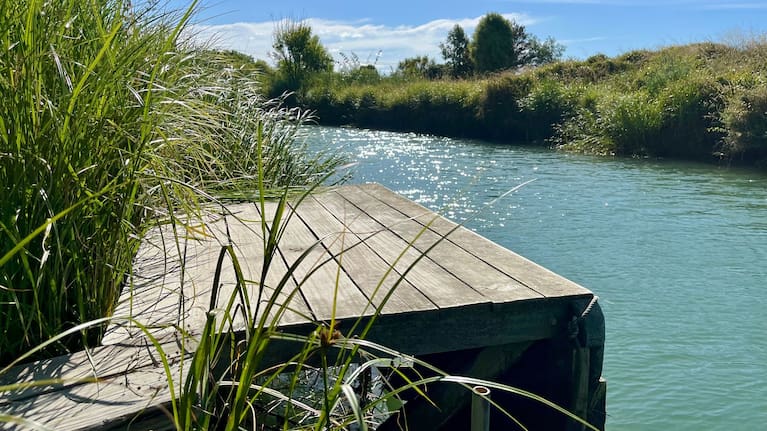
He described the discovery as “something from heaven”.
“I thought, ‘oh God, this looks a good bloody wharf. This looks nice and sturdy, this will be all right for whitebaiting’,” he said.
The wooden stand had a bench, a storage shed, and a short boarded path, and was only accessible with about a 2km tramp from the road through long thorny grass, or by boat.
The stand was one of 27 along Roses Overflow that had been deemed illegal by the council.
Under the Marlborough Environment Plan, whitebait stands could only be erected between August and December.
But that rule had never been enforced, Ward said. He estimated the stand he used had been on the canal for 40 years.
Ward said he did not think he should be held responsible for taking the stand down, since he did not build it.

Some whitebaiters freely used whichever stand was available when they showed up, Ward said. Some had been told where to find a stand by a fellow whitebaiter, others just stumbled across them.
Ward conceded some “idiots” had put nets on both sides of the river, which may have prompted the complaint.
He also knew people who fished on the Ōpaoa River who said they were unaware of the takedown order.
“There’s heaps of [stands] on the Ōpaoa … just like this, probably been there 40 years.”
Another whitebaiter, who LDR agreed not to name, said the stand they used was built by a friend who had since died.
“I reckon the stand’s about 20 years old. It’s still solid as heck and I just maintain it and use it,” he said.
He was one of many on the canal who felt they should not be held liable for stands they did not build, he said.
“Everyone out there has said that they’re not pulling the stands down. Because they never made the stands.”
While the council could remove the stands itself, under the Resource Management Act, Ward said removing the structures built into the riverbank would take a lot of time and effort.
“What a massive job that would be,” Ward said.
“They’ve got to come out by boat … and they’re going to have to completely wreck it [and] cart it all away.
“You can’t just put [the wood] up on the bank because the first flood, it’s all going to get washed down [the canal].”
The morning’s headlines in 90 seconds, including the search continues in Mt Maunganui, Australian police hunt a gunman on the loose, and record breaking Oscars run. (Source: 1News)
A council spokesperson said that while permanent stands were prohibited, the council generally only acted on complaints.
The council investigated the stands on Roses Overflow after receiving a complaint from a member of the public that the stands were preventing whitebait from moving along the canal, the spokesperson said.
Only Roses Overflow stands had been given takedown notices at this stage, the spokesperson said.
More stands would be investigated if further complaints were laid.
The council’s ecology and rivers teams had both said that keeping stands up year-round had adverse affects on the riparian margins along the canal, a key habitat and spawning area for native īnanga whitebait.
“Leaving structures in place year-round can interfere with [spawning] processes, affect water flow, damage vegetation, and increase erosion and sedimentation, all of which harm water quality and aquatic life.”
The spokesperson said there were concerns that abandoned or poorly maintained stands could create debris and flooding hazards, and detract from the natural beauty of the canal.
The council would only remove stands they deemed to be affecting flood capacity and river access, but the spokesperson could not say when the removals would happen.
“The costs of this would be within existing flood management funding and be undertaken during planned maintenance and project work.”
– LDR is local body journalism co-funded by RNZ and NZ On Air.