
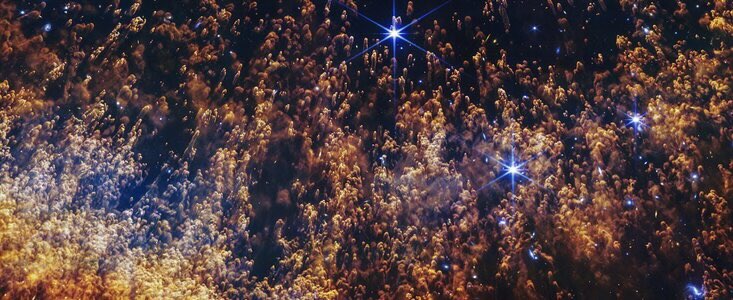
The James Webb Space Telescope has captured the clearest-ever infrared observation of the Helix Nebula, vividly displaying the death of a white dwarf star.
Since Karl Ludwig Harding first spotted the Helix Nebula sometime before 1924, astronomers and amateur stargazers alike have been observing it with ground- and space-based telescopes.
NASA, the European Space Agency (ESA), and the Canadian Space Agency (CSA) collaborated to create the James Webb Space Telescope (JWST), which has now produced the incredible images of one of the nebulae nearest to Earth, providing a clear look at the likely eventual fate of our own Sun.
James Webb Space Telescope’s NIRCam
The Near-Infrared Camera (NIRCam) aboard the JWST captured billowing gas coming off of the dying star in pillars resembling thousands of orange and gold comet tails. The images show hot gas shed from the dying star colliding with cold shells of dust and gas from previous sheds to produce the Helix Nebula. As the light, faster-moving material, newly shredded, meets the heavy, slower-moving material surrounding it, the effect is like that of oil moving through water, creating the nebula’s distinctive shape.
Before the new images, observations from the NASA/ESA Hubble Space Telescope provided the best view of the Helix Nebula. However, those images were more ethereal, lacking the clear definition of the recent JWST NIRCam views that show the cool-to-hot gas transition. Also visible in the image are a handful of brilliant stars, twinkling with diffraction spikes.
 A larger-scale image of the Helix Nebula from the Visible and Infrared Telescope for Astronomy (left) shows the full view of the planetary nebula, with a box highlighting the smaller field of view from the James Webb Space Telescope’s NIRCam (right). Credit:
NASA, ESA, CSA, STScI, A. Pagan (STScI)
White Dwarf Star
The star producing the dynamic action captured by Webb is a blazing white dwarf. Despite being the source of the activity, its location at the center of the Helix Nebula is outside of the JWST’s field of view. Intense radiation pouring out of the white dwarf provides the energy to light up the gas as seen in the imagery.
On display is hot ionized gas near the center of the nebula, surrounded by cooler molecular hydrogen, and protective pockets beyond that, allowing for the formation of complex molecules within dust clouds. While the layered interactions of hot and cold materials make for beautiful viewing, they are much more than that, producing the raw material from which planets will one day accrete.
James Webb Space Telescope Identifies the Cosmos
Images from the JWST can provide astronomers with precise data about distant objects by analyzing their colors. Intense ultraviolet light turned the hottest gas blue, while the cooler regions’ hydrogen atoms formed into molecules, producing a yellow color. Red at the outer edges indicates an even colder region as the gas thins and dust begins to form. Seeing a complete picture, the imagery reveals how, from the death of a star, new worlds are eventually born.

Despite being a part of one of stargazers’ most familiar features in the night sky (as it is located in the constellation Aquarius), new details are still forthcoming thanks to the JWST, illustrating how much more can be learned about even the most well-known elements of our night sky as more advanced tools become available, providing new insight into the most fundamental processes that produced the universe around us.
Ryan Whalen covers science and technology for The Debrief. He holds an MA in History and a Master of Library and Information Science with a certificate in Data Science. He can be contacted at ryan@thedebrief.org, and follow him on Twitter @mdntwvlf.