
Statistical analysis of everyday golfers is conclusive: in the vast majority of circumstances, you shouldn’t be hitting 3-wood off the tee. As we’ve previously written, average golfers may find the fairway slightly more often with a fairway wood, but the longer approaches into greens make it a bad trade-off.
RELATED: How we use a robot golfer to better understand the human golfer
But that assumes that you hit your 3-wood shorter than your driver. Is that always true? What about the golfers who can only hit fades with their driver, but when they use a 3-wood, they can turn the ball over and hit a draw? Given that a fairway wood has more loft than a driver, it can be easier to turn the ball over and hit a draw. And after all, in a previous MythBusters test, we found that with a driver, moving from a significant fade to a slight draw can increase distance by 20 yards.
Could a draw with a 3-wood travel further than a fade with a driver, making some golfers more justified in hitting fairway wood off the tee?
Our test
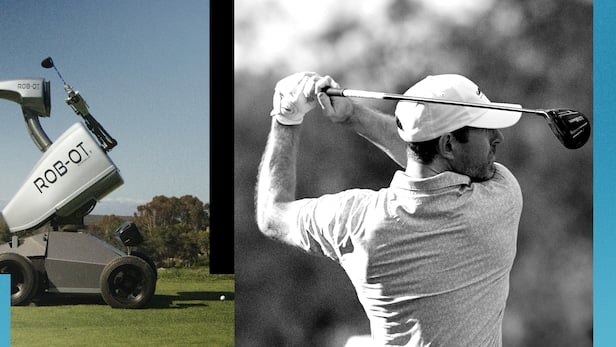
To help give more context on the trade-off of hitting 3-wood off the tee, we tested which goes further: a draw with a 3-wood or a fade with a driver. With the help of Golf Laboratories founder Gene Parente, we used the Golf Labs swing robot to hit a series of shots with a 10-degree driver and a 13-degree fairway wood, which is slightly stronger than a typical 15-degree 3-wood. Both clubs we used were 2025 releases from the same manufacturer and same family of clubs.
The robot had a 96mph clubhead speed with the driver (about the average for a male golfer) and 93.5mph with the fairway wood – slower simply due to the shorter length of the club. Shots with the driver faded about 17 yards (15.5 metres) from left to right, while those hit with the 3-wood drew about 12 yards (11 metres) from right to left. Using Foresight Sports’ QuadMAX launch monitor, we measured club and ball data.
What we found 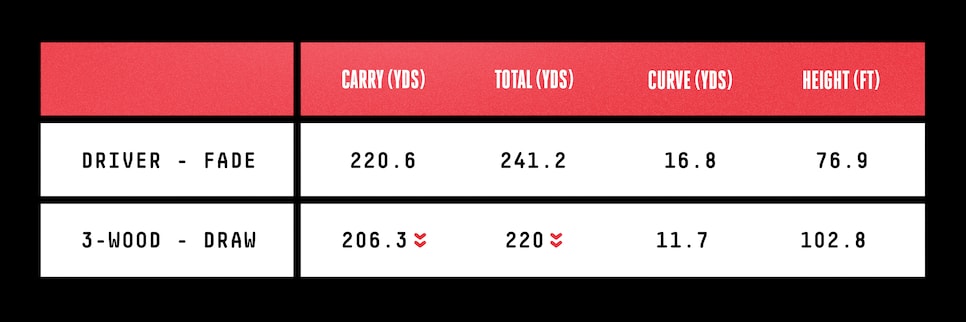
Even with the difference in ball flight, the shots with the driver travelled more than 20 yards (18 metres) further than the 3-wood. The fades with the driver carried 220.6 yards on average and rolled out to 241.2 total, while the draws with the fairway wood flew 206.3 yards and finished 220 yards.
This is due to a few factors. First, the shots with a driver took off with higher ball speed (138.6mph vs 134.9mph), in part due to the faster clubhead speed with driver. The drivers also flew lower (76.9 feet. vs 102.8 feet) and with less spin (2,935rpm vs 4,099rpm), as you’d expect from a club with less loft, resulting in a more penetrating trajectory and more roll once the ball hit the ground.
What it means
Just because you can turn the ball over with your fairway wood and not with your driver doesn’t mean the draw will result in more distance. In fact, our test shows that even a moderate fade with a driver will travel further than a slight draw with a 3-wood. Further, recall that we used a 13-degree fairway wood, which is less loft than a typical 15-degree 3-wood. So, the distance disparity between your driver and 3-wood might be even greater than the 20 yards that we showed.
What it doesn’t mean
To account for differences in technology, we tested two clubs from the same year and manufacturer. However, your bag might have a newer driver and older fairway wood, or vice versa, meaning that the distance disparity could be different depending on the technology.
Also, remember that we tested two different ball flights. If you hit a fade with both your driver and your 3-wood, the distance gap between the two could be even greater. You might spin the ball more than is ideal with your 3-wood, for example, resulting in a shorter carry.
The results would also be different if you hit a slice with your driver, which would result in a shorter carry distance than the moderate fade that we tested. That said, it’s unlikely that your typical ball flight with driver is a slice and then a draw with a fairway wood, so we didn’t test this scenario.
Takeaways
A typical fade with a driver will travel significantly further than a typical draw with a 3-wood, underscoring the statistical importance of hitting driver off the tee. In giving up more than 20 yards of distance for only marginally improved accuracy, golfers will score better hitting driver off the tee in most circumstances.