
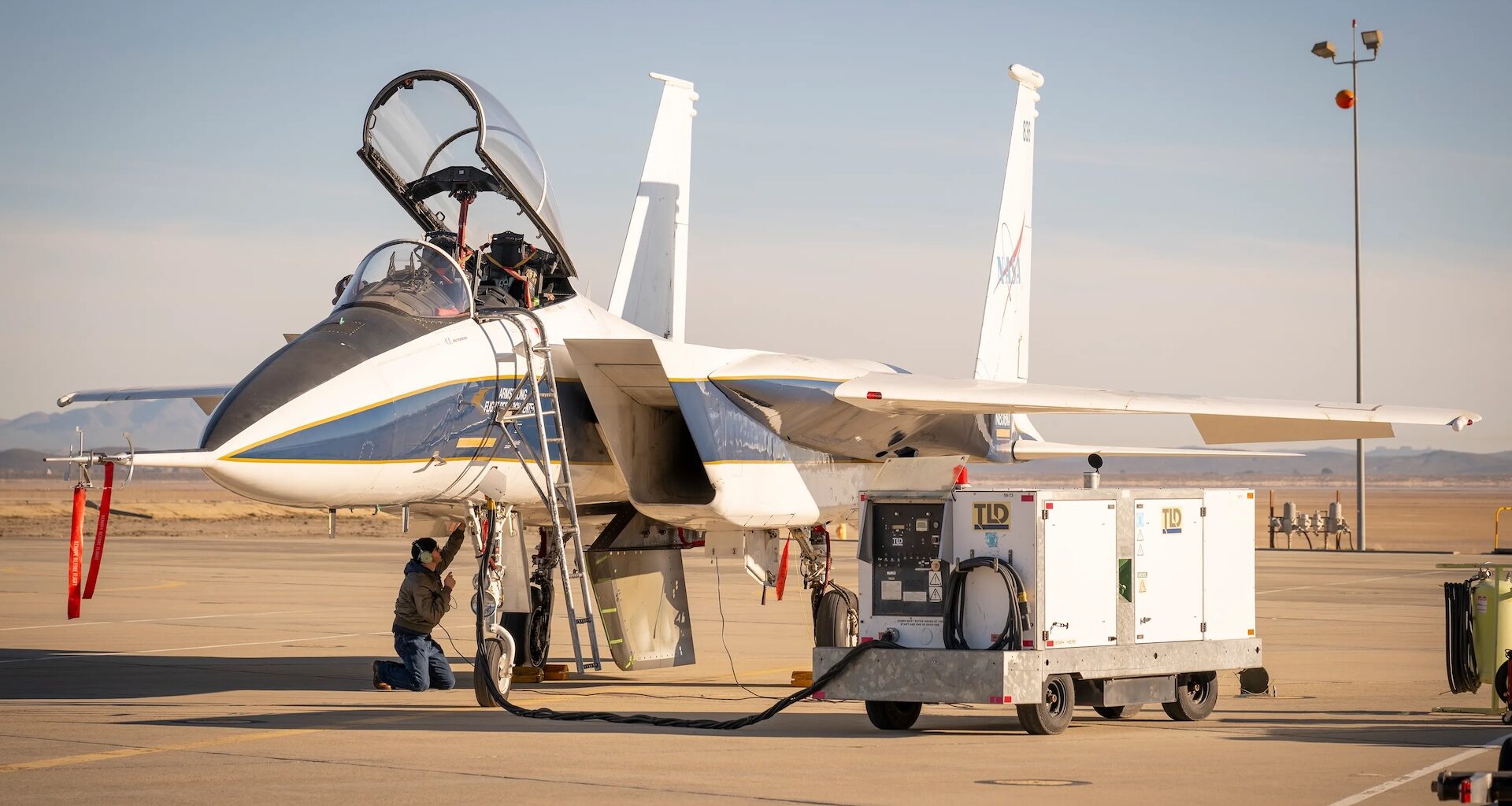
A team of NASA researchers successfully performed a high-speed taxi test that could help significantly boost aircraft efficiency. By improving how air flows across a wing’s surface, the test campaign would help save vast amounts of fuel and its associated cost.
The NASA team performed the test using a 3-foot-tall scale model of a wing, strapped to an F-15 jet.
The Crossflow Attenuated Natural Laminar Flow (CATNLF) test article reached speeds of approximately 144 mph (231 km/h), marking its first major milestone, the space agency said in a blog post.
NASA F-15 performs high-speed taxi test
For their test, the NASA team mounted a 3-foot-tall scale model of a wing to the underside of one of the agency’s F-15B testbed jets. The model, which resembles a fin, was mounted vertically rather than horizontally. This setup will allow NASA to test the design in real flight conditions.
The high-speed taxi test took place on Jan. 12. at Edwards Air Force Base in California. The F-15 research aircraft, with the 3-foot-tall test article attached, reached speeds of 144 mph (231 km/h) without taking off.
The CATNLF test is focused on increasing laminar flow, while reducing wind resistance, also known as drag. The test builds on previous research by NASA. Between 2014 and 2017, a computational study run by the agency showed that a CATNLF wing design on a Boeing 777 could lead to fuel savings of up to 10 percent. For an average Boeing 777, this could result in millions of dollars in savings each year.
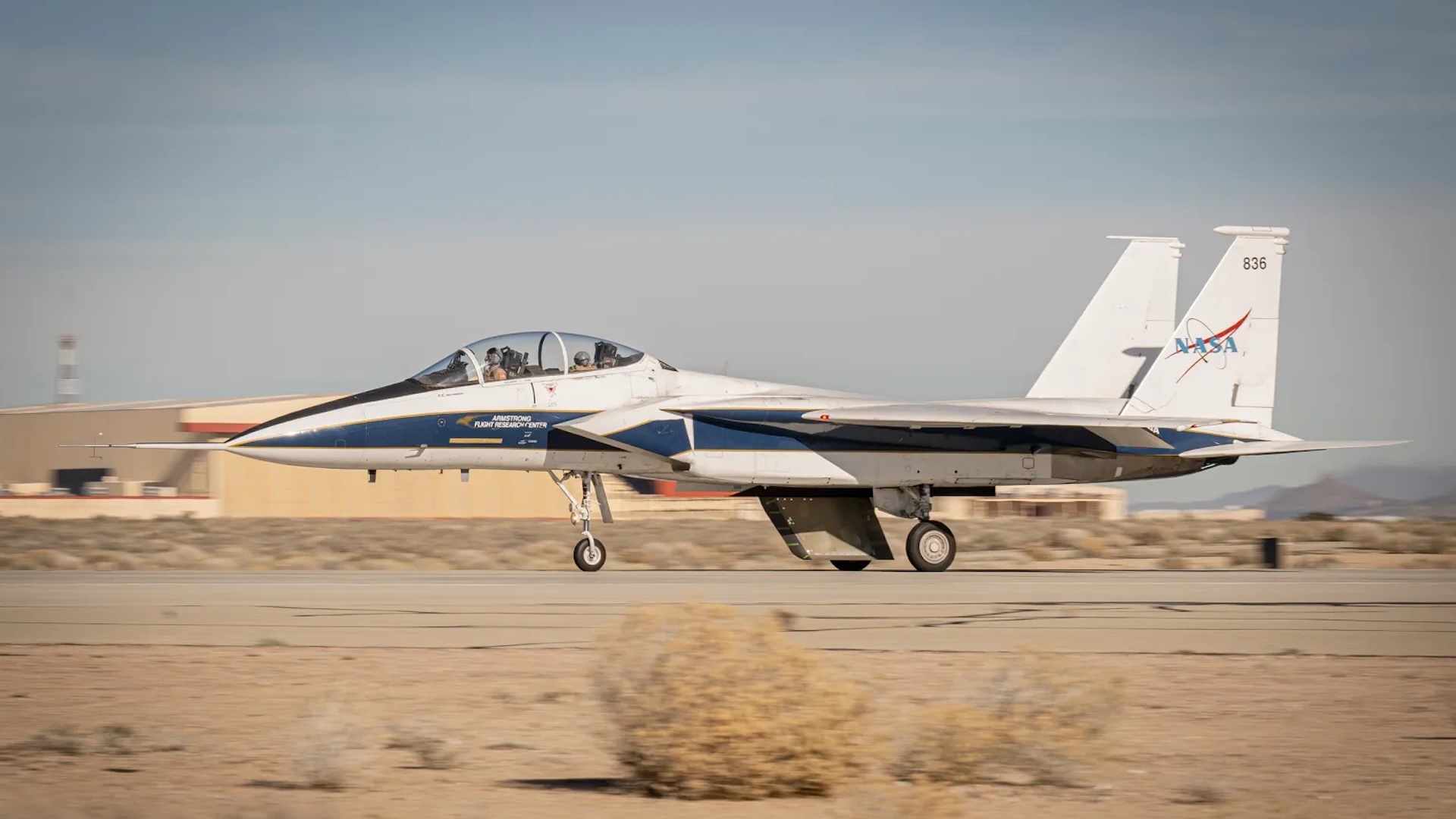 NASA’s F-15 research aircraft during the high-speed taxi test. Source: NASA / Christopher LC Clark
“Even small improvements in efficiency can add up to significant reductions in fuel burn and emissions for commercial airlines,” Mike Frederick, principal investigator for CATNLF at NASA’s Armstrong Flight Research Center in Edwards, California, explained in NASA’s post.
CATNLF specifically increases laminar flow, or smooth air motion, within the boundary layer—a thin cover of air that forms very near an aircraft’s surface, and causes friction and drag. By improving the flow of air, CATNLF enables more efficient aerodynamics, leading to less fuel burn.
In 2019, following successful wind tunnel testing, NASA Armstrong researchers developed an early prototype of the flight test scale model. Now, NASA will begin flight testing its design thanks to one of its F-15 testbed jets.
Subsonic to supersonic
By strapping their scale model, to the F-15B testbed aircraft, NASA is able to investigate the technology at a lower cost. Other alternatives would have included building a dedicated demonstrator aircraft, or retrofitting an existing aircraft with a full-scale CATNLF model wing.
As the space agency has successfully conducted its high-speed taxi test, it will now move on to flight testing. “In the coming weeks, CATNLF is expected to begin its first flight, kicking off a series of test flights designed to evaluate the design’s performance and capabilities in flight,” NASA explained in its post.
NASA believes its new technology could greatly improve efficiency in the commercial space, saving operators millions of dollars in fuel costs. According to the International Civil Aviation Organization, commercial aviation passenger numbers are expected to double over the next 20 years.
“Most of us fly subsonic, so that’s where this technology would have the greatest impact right now,” Frederick said. However, the space agency also noted that CATNLF could also lay the groundwork for similar capabilities in supersonic flight.