
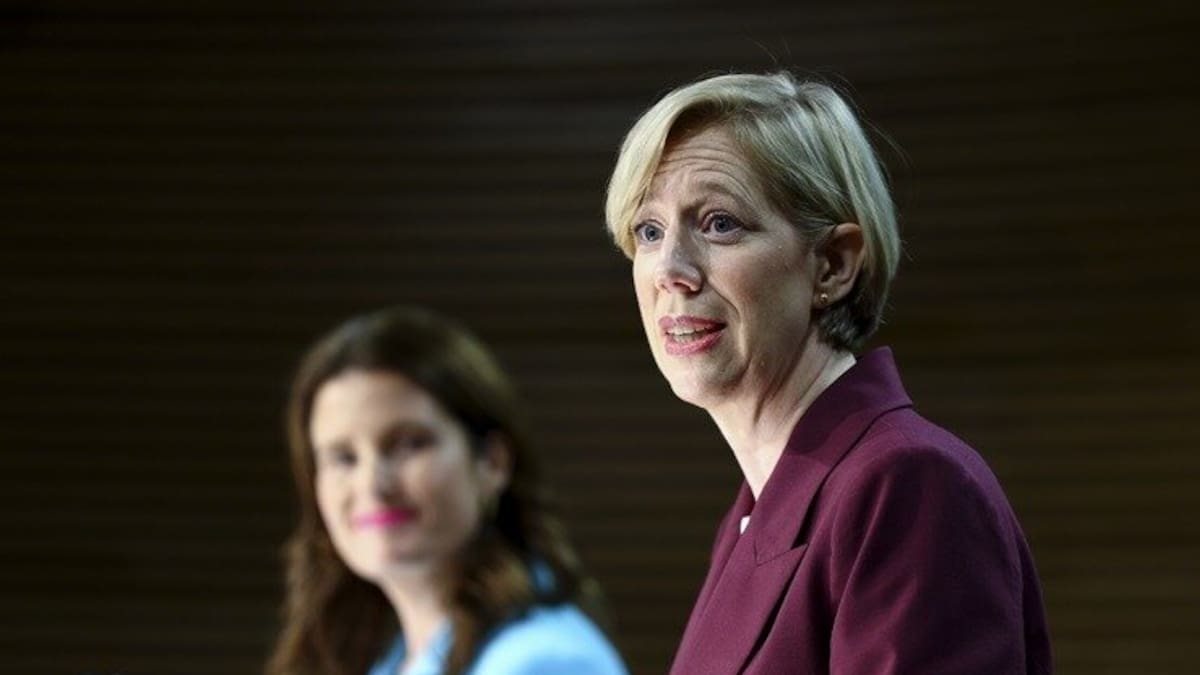
Winston Peters kicked it off with a “sharp stay in your lane” rebuke to the Reserve Bank Governor after she put her signature to a letter of support which asserted the principle at a time when Federal Reserve chair Jerome Powell is the target of lawfare from elements of the US administration.
Peters’ statement could be construed as simply deflecting any potential angst in Washington DC when it comes to New Zealand’s steadfastness as a “partner” to the US. That “partnership” was also underlined when Chris Seed presented his credentials to the US State Department in Washington this week as NZ’s Ambassador.
But Christopher Luxon and Finance Minister Nicola Willis muddied things unnecessarily when they also chimed in at a media conference held after the Prime Minister’s State of the Nation speech.
The Reserve Bank Governor has undoubtedly been lent on by Willis who made a feature of telling journalists present at the shiny new International Convention Centre that Breman had put it to her that she had been reluctant to call her at 3am when talks convened by her European colleagues wound up. Willis said, “look, I’m available any time and that’s what New Zealanders expect from me”.
Really?
Many New Zealanders will recall a time when Prime Ministers (including one who was simultaneously Finance Minister) had too much sway over monetary policy.
Reserve Bank Governor Anna Breman. Photo / Mark Mitchell
New Zealand became a global leader when the Reserve Bank Act 1989 was passed. This came into force in February 1990 when the central bank was assigned a mandate to strive for price stability and the efficiency of the financial system.
That independence was arguably strengthened by section 171 of the Reserve Bank 2021 which says, “this act does not authorise a minister to direct the bank, or a member, an employee, or an office holder of the bank to require the performance or non-performance of a particular act, or the bringing about of a particular result, in respect of a particular person or persons”.
Politicians will dance all over this particular pin.
But the issue is this: if Breman had gone ahead and sought advice from Willis she would have presumably have been passed on to the Ministry of Foreign Affairs and/or Treasury officials.
Peters and Luxon have both said the Government’s policy is not for New Zealand to involve itself in the domestic affairs of other nations. So, no surprises what the advice would be.
But if Breman had received that advice and gone ahead with the support letter the upshot would have been to put her in conflict with the New Zealand Government’s position.
In a media environment which struggles with nuance she would be positioned as insubordinate.
I put this conundrum to Luxon this week.
He acknowledged the dilemma facing both sides, noting it was “not an easy one”.
“I can’t say what she would or wouldn’t have done if she received that advice. I just genuinely don’t know and I need to respect her independence as [Reserve Bank Governor] and I definitely do.”
Prime Minister Christopher Luxon and Finance Minister Nicola Willis. Photo / Michael Craig
He reiterated the importance of central bank independence in liberal democracies but also the complexity which exists where both sides might feel compelled to act in good faith but with different priorities.
One solution might be to codify an “agree to disagree” similar to Luxon’s deals with his coalition partners.
The better solution is to not to go there in the first place.
The public jawboning from the top politicians did wring a concession from Breman late yesterday afternoon that she should have advised the Finance Minister. She has apologised to Willis for that oversight and would seek Government advice in future.
But Breman did not back away from her call to sign the letter.
Arguably, it is the Reserve Bank board – particularly its chair Rodger Finlay – which is the appropriate sounding board for the governor.
Breman comes into an environment where her predecessor Adrian Orr was pushed out, so too, the Reserve Bank chair which allowed him too much rope.
A sharp reminder to self from Willis to stay in her own lane would not be amiss.
The environment for speaking up is improving.
Canadian Prime Minister Mark Carney’s forthright speech at the World Economic Forum in Davos has been a lightning rod for plain speaking.
Many of his themes have already been adopted by New Zealand policymakers.
While Carney claimed for himself bringing the CPTPP trade group and EU together, Luxon has also been a leader on this.
The Ministry of Foreign Affairs and Trade (MFAT) has numbered some top strategists – such as Ben King who now heads the Department of Prime Minister and Cabinet (DPMC) and former CEO Chris Seed – who were ahead of the international pack when they scoped their seminal strategic assessment “navigating a shifting world” in 2023.
Summed up – as the Prime Minister frequently does – this boils down to a shift “from rules to power”, “from economics to security” all within an environment where “efficiency is giving way to resilience”.
This still holds and Luxon prides himself on how he staked out the strategy in a well-received speech at the Raisina Dialogue in New Delhi last year. For business people who had not travelled before with the Prime Minister and observed him close up, this was a revelation. His delivery was several notches above this week’s State of the Nation address.
But time moves on.
Luxon has yet to decide whether New Zealand should accept the US President’s invitation to join the “Board of Peace” which will preside over Gaza. Trump lined up with the initial signatories at the World Economic Forum in Davos this week.
New Zealand is distant from Gaza. Our lane is the Indo-Pacific.
Some sharper critique from the top or the forces that would embolden New Zealand is welcome.
This column has been updated from the print version.
Catch up on the debates that dominated the week by signing up to our Opinion newsletter – a weekly round-up of our best commentary.