
Support CleanTechnica’s work through a Substack subscription or on Stripe.
Or support our Kickstarter campaign!

The numbers are close, but the trend is clear. In its latest report on renewable energy in the European Union, Ember found that wind and solar provided 30% of all the electricity consumed all across the Continent in 2025. Fossil fuels were close behind at 29%. Does that mean renewables and fossil fuels are tied? No, it does not. For renewables, the trajectory is trending up; for fossil fuels, it is trending down.
Here is the Executive Summary from this year’s report:
In 2025, the EU took an enormous step forward towards a clean power system backed by wind and solar. For the first time, wind and solar produced more electricity than fossil fuels in the EU. Homegrown renewables remained nearly half of EU power, as record-breaking solar worked in tandem with wind.
In 2025, the EU’s energy priorities focused on cutting energy costs for households and businesses. The European Commission’s Affordable Energy Action Plan correctly diagnoses the root cause of Europe’s high energy prices — its dependence on costly imported fossil fuels. [Emphasis added.]
In the power sector, coal is nearly on its way out, reaching a new historic low in 2025 after years of steep decline. However, the EU is still significantly dependent on gas. An increase in gas generation amid a decline in hydro in 2025 pushed up the EU’s fossil gas import bill by 16 percent and led to price spikes in electricity markets.
The stakes of the EU continuing to make progress on energy transition remain starkly clear. For the EU, risks of energy blackmail from fossil fuel exporters loomed large in 2025. Investing in homegrown renewables is a key strategy to lower that risk, as geopolitics continue to destabilize.
The EU agreed on legislation to ban imports of Russian gas by the end of 2027 in December 2025. However, new fossil dependencies have emerged with a rise in imported US LNG. Heavy reliance on a single supplier threatens EU security and weakens bargaining power in geopolitical negotiations and trade disputes.
Expanding batteries, enhancing the grid and scaling up demand flexibility can unlock greater shares of solar and wind in the mix. Not only will this improve security, they are also crucial to ensure predictable and stable prices.
In this case, pictures may be worth 10,000 words. Check out these graphs from the Ember report.
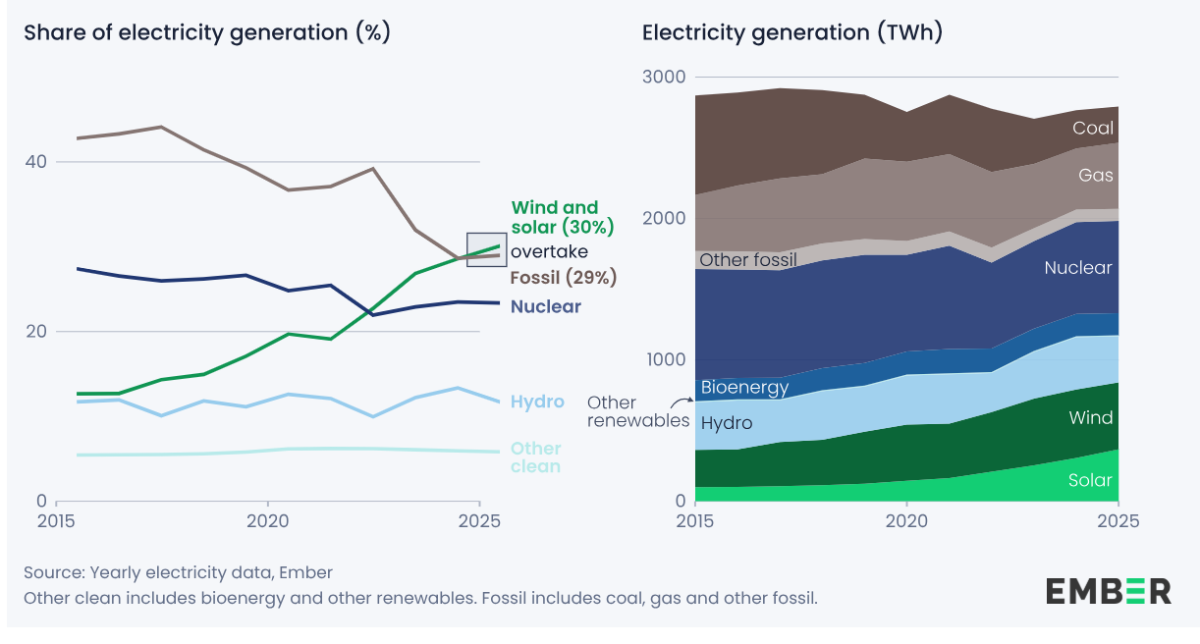 Credit: Ember
Destabilized Geopolitics
Ember analyst Beatrice Petrovich was the lead author of this year’s report. She told The Guardian it was a “major tipping point” that was of strategic importance to the EU, which has grown increasingly panicked about its reliance on other countries for energy. “The importance of this goes beyond the power sector,” she said. “The danger of relying on fossil fuels looms large in destabilized geopolitics.”
Gosh, who on Earth could she be talking about? Could it be the US, which is sending flotillas of minions to pressure officials in EU countries to buy its LNG or face punishing tariffs? Could be. Just this week, commerce secretary Howard Nitwit Lutnick was in Davos to add fuel to the political dumpster fire created by US demands to take over Greenland.
Lutnick criticized European leaders for adopting pro solar and wind policies, arguing that its lack of domestic battery factories risked making it “subservient” to China. “If you are going to be dependent on someone, it had better be your best allies,” he said in a justification of the “America first” approach that he encouraged other countries to emulate.
How anyone could see the US as their “best ally” when the alleged president insulted every world leader at Davos and threatened massive tariffs as punishment if they did not toe the line drawn by the US is hard to understand. Actions have consequences, and for Lutwick and his bloviating mentor, there will be consequences aplenty.
Solar Increase In 2025
A significant increase in the amount of solar power available in Europe was largely responsible for the upward trend in 2025, according to analysts who spoke with The Guardian. Solar generated 13% of all the electricity in the EU last year. In five countries — including the Netherlands, which is not known for being particularly sunny — it provided more than 20%.
Wind turbines generated slightly less than the previous year, the report found, but remained the second-largest source of electricity, responsible for 17% of EU power.
Methane-powered thermal generation increased by 8%, primarily because of a weather-related drop in hydropower output. Nevertheless, it remained well below its most recent peak that occurred in 2019. Coal-fired thermal generation fell to an historic low, accounting for less than 10% of EU power, most of it in Germany and Poland.
Solar and wind were “becoming the backbone” of Europe’s power system, Petras Katinas, an analyst at the Center for Research on Energy and Clean Air, told The Guardian. “Solar alone grew by more than 20 percent in a single year, proving that clean power can scale faster than any conventional technology. The challenge now is not generation, but how quickly Europe can deploy grids, batteries, and flexibility,” he said.
Battery Storage Is Key
The researchers at Ember found signs that evening peaks in electricity demand — which typically require using methane-fired peaker plants that add significant cost to consumers — are starting to be met by battery energy storage systems instead.
In fact, 20% of the BESS systems in the EU are located in Italy. It has a large number of planned projects, which means it could follow in the footsteps of California, where batteries routinely cover 20% of evening demand and are crowding out gas.
Petrovich said this could smooth price spikes. “If I were a policymaker or investor, I would seriously start questioning if plans for new gas plants are inflated and act to avoid a burden for taxpayers and risk of stranded assets.”
Together with hydropower, renewables accounted for nearly half of all the electricity generated in the EU last year. The data demonstrates how various energy sources are interdependent. Less rain meant lower hydro output, but sunnier skies boosted solar generation. When inclement weather limits sunshine, it tends to increase wind speeds, which results in more electricity being generated by wind turbines.
Amathia Rampant On A Field Of Lies
The MAGAnistas insist renewables are a dead end because you can’t just put up a solar farm and call it a day. You need short term and long term energy storage systems and a variety of energy inputs to make a coherent renewable energy system.
We could point out that thermal generation also requires a number of components — fuel supply, cooling towers, steam lines, boilers, and turbines — to function. The constant caterwauling from the fossil fuel apologists sounds a lot like the complaints of horse owners when automobiles were introduced.
In fast, we could say they are afflicted with amathia, a Greek word from the time of Socrates and Plato that means “intelligent stupidity” or “willful ignorance.” [Thanks to regular reader MJE for teaching us that word.] The know-nothings can harrumph and stamp their feet all they like, but renewables are gaining ground year by year. By the end of this decade, they will be the dominant source of electricity worldwide and those who have not made the transition will be racing to catch up.
Support CleanTechnica via Kickstarter
Sign up for CleanTechnica’s Weekly Substack for Zach and Scott’s in-depth analyses and high level summaries, sign up for our daily newsletter, and follow us on Google News!
Advertisement
Have a tip for CleanTechnica? Want to advertise? Want to suggest a guest for our CleanTech Talk podcast? Contact us here.
Sign up for our daily newsletter for 15 new cleantech stories a day. Or sign up for our weekly one on top stories of the week if daily is too frequent.
CleanTechnica uses affiliate links. See our policy here.