
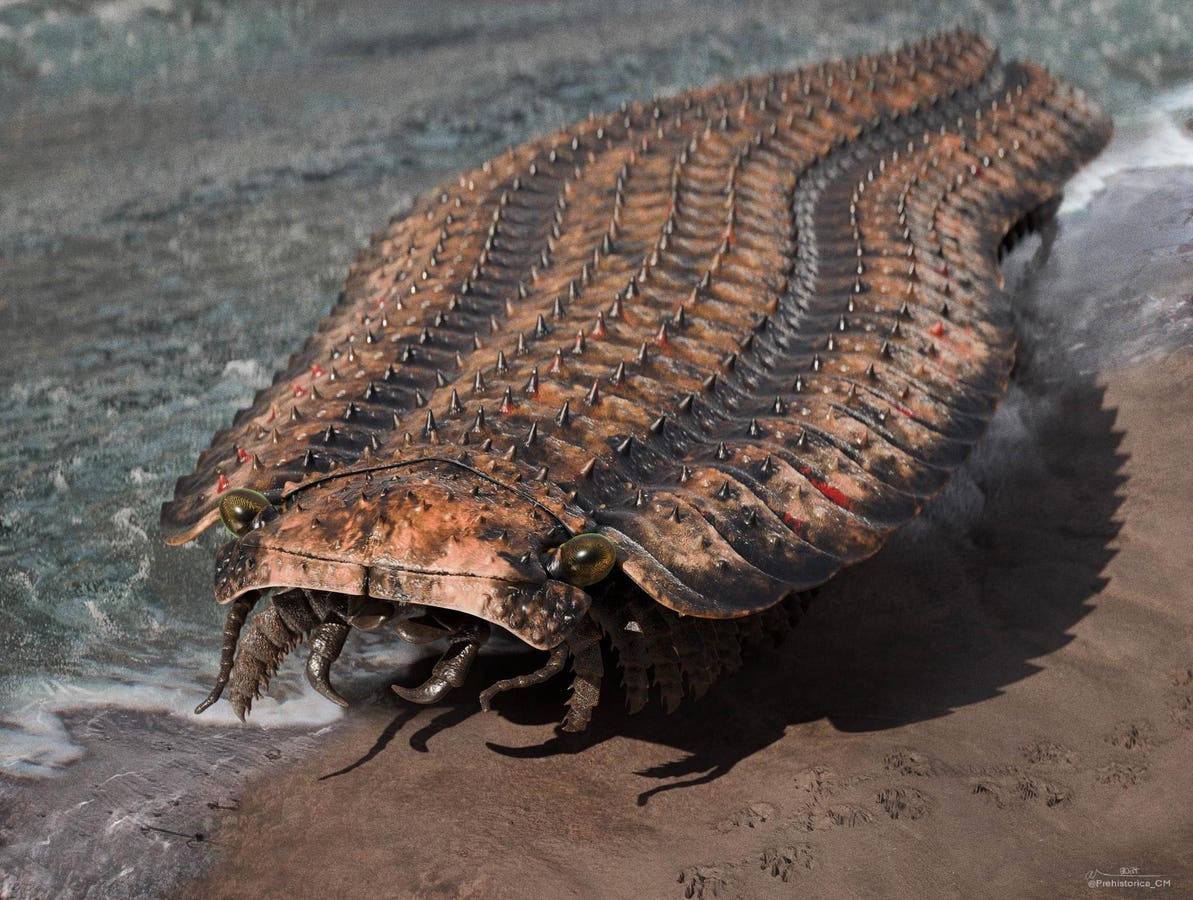
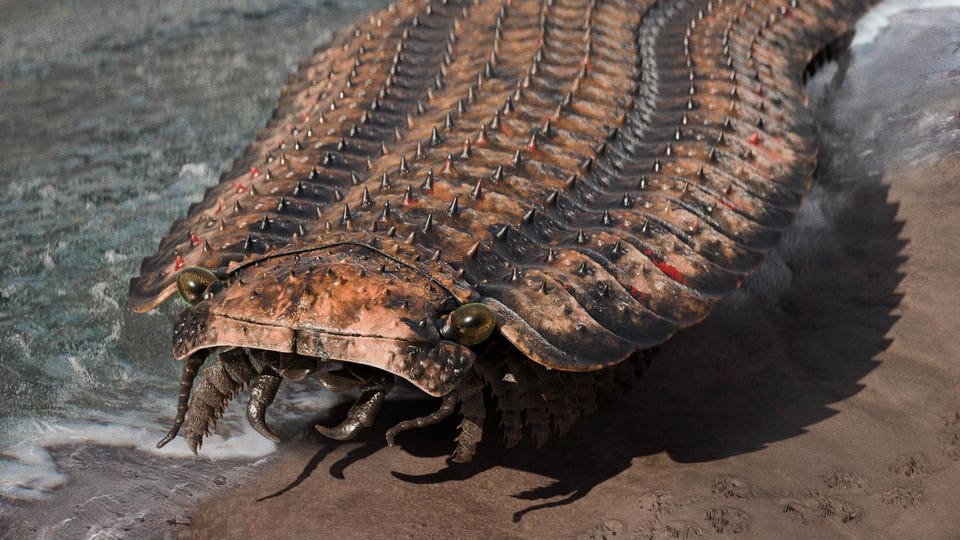
Long before dinosaurs, Earth’s forests were ruled by a many-legged giant. Here’s why this millipede’s size still challenges what we think arthropods can achieve.
By Prehistorica CM – Own work, CC BY 4.0, https://commons.wikimedia.org/w/index.php?curid=155755540
The idea of a human-sized arthropod sounds like either science fiction or a nightmare to most people. Some of the largest land-dwelling arthropods of today, such as coconut crabs or giant millipedes, are impressive, but they’re still modest in scale. None of them comes even remotely close to rivaling us humans in length or mass.
However, around 300 million years ago, during the late Carboniferous period, Earth was home to an arthropod that did exactly that. Its name was Arthropleura, and even today, it remains the largest land invertebrate ever known to science.
How Scientists Know This Millipede Was So Large
Arthropleura lived around 346 to 290 million years ago. During this time, Earth’s continents were clustered near the equator, and much of the land was covered in vast tropical forests. Fossils show that Arthropleura resembled an enormous insect: it had dozens of body segments and countless legs, arranged in pairs along its underside.
For decades, scientists debated where Arthropleura fit on the arthropod family tree. Was it a millipede, a centipede or something else entirely? Today, however, consensus places it within Myriapoda — a group that includes millipedes and centipedes — but as a member of an extinct lineage.
Its closest living relatives are thought to be millipedes, based on segment structure, leg arrangement and feeding adaptations. Its body was flattened and armored with overlapping plates, which is likely what gave it both flexibility and protection as it moved across the forest floor.
Recent reconstructions of Arthropleura, as described in a 2025 study from Open Paleontology, suggest that the largest species of Arthropleura reached lengths of a whopping 2.5 meters, or more than 8 feet. Some of the estimates even approached 3 meters. That makes it longer than most humans and comparable in size to a modern alligator.
What’s important to note is that Arthropleura is known primarily from fragmentary fossils; finding complete bodies intact is incredibly rare. For this reason, scientists have to rely on a combination of exoskeleton fragments and fossilized footprints left behind as the animal walked.
Notably, some of Arthropleura’s trackways measure more than 50 centimeters (19 inches) wide. By comparing the width and spacing of the tracks to those of modern arthropods, researchers can estimate its leg length, body width, and overall size.
The abovementioned 2025 study, which described new Arthropleura material from France, has provided us with the most complete body reconstructions to date. The fossils included well-preserved segments that allowed the study authors to scale up Arthropleura’s proportions with greater confidence than ever before.
The conclusion was unambiguous: it was a true giant. Yet, despite its formidable size, there is no evidence that Arthropleura was a predator. Analyses from a 2024 Science Advances study of its mouthparts and gut contents suggest that it lived off a diet composed primarily of decaying plant material.
In other words, this giant was likely a slow-moving herbivore or detritivore, and not the apex hunter that some might assume its size conferred. This distinction matters, as it’s integral for understanding how such a large arthropod could exist on land.
Why This Millipede Grew So Big
Arthropleura’s impressive size was far from an evolutionary accident. As seminal research from the Journal of Experimental Biology notes, it was made possible by a unique combination of environmental factors that no longer exist today.
Firstly, the oxygen levels of the atmosphere during the late Carboniferous were significantly higher than they are today. Estimates suggest oxygen concentrations of around 30 to 35%, which is much higher than today’s levels of around 21%.
Arthropods in particular breathe through a system of tubes called tracheae, which deliver oxygen directly to tissues. However, this system can become inefficient at large body sizes if oxygen levels aren’t high enough to support it.
This means that the higher atmospheric oxygen during the Carboniferous would have allowed oxygen to diffuse more effectively through larger bodies. This, in turn, would have removed one of Arthropleura’s major size constraints.
Secondly, the Carboniferous landscape was also dominated by dense forests of giant plants, such as lycopsids, horsetails and ferns. Given their size, these plants produced enormous amounts of leaf litter and woody debris, which offered detritivores like Arthropleura an abundant source of food.
Finally, and perhaps most importantly, terrestrial vertebrate predators during the Carboniferous were still relatively small and rare. Although some early reptiles and amphibians existed, none of them posed any serious threat to the many different arthropods that dominated the land, Arthropleura included.
So, with very little risk of predation pressure, paired with plentiful food, Arthropleura’s large body size was actually advantageous.
What This Millipede Teaches Us Today
During the transition from the Carboniferous into the early Permian, near the end of the Paleozoic, Earth’s climate underwent major changes. The two most notable changes, in Arthropleura’s case, were forests becoming drier and more fragmented, and atmospheric oxygen levels declining.
While these shifts did give rise to new species and adaptations, they also would have hit large arthropods particularly hard. The lower oxygen would have reduced the maximum possible body size. On top of this, the combination of habitat loss and the rise of more efficient vertebrate predators would have added crushing new evolutionary pressures.
These are the two primary reasons why paleobiologists believe Arthropleura vanished from the fossil record around 290 million years ago. It marked the end of an era when arthropods dominated terrestrial ecosystems at scales that now seem impossible.
This is one of many powerful reminders throughout evolutionary history that a size limit is never fixed. And these limits are shaped by the highly dynamic intersection between physiology, ecology and environment.
Notably, this also means that today’s arthropods aren’t small because they’re inherently incapable of being large, but rather because the atmospheric and ecological conditions impose constraints that didn’t exist in the past.
Studying Arthropleura has helped researchers gain a better understanding of how oxygen availability can directly influence an animal’s evolution. This is a topic with implications for everything, from climate change biology to the search for life on other planets.
Ever wondered which animal reflects your instincts, strengths, and survival style? Take this two-minute test to discover the creature that mirrors you best: Guardian Animal Test
Think a millipede is fascinating — or absolutely terrifying? Take this science-backed test to find out where your discomfort really begins: Fear of Arthropods Questionnaire