
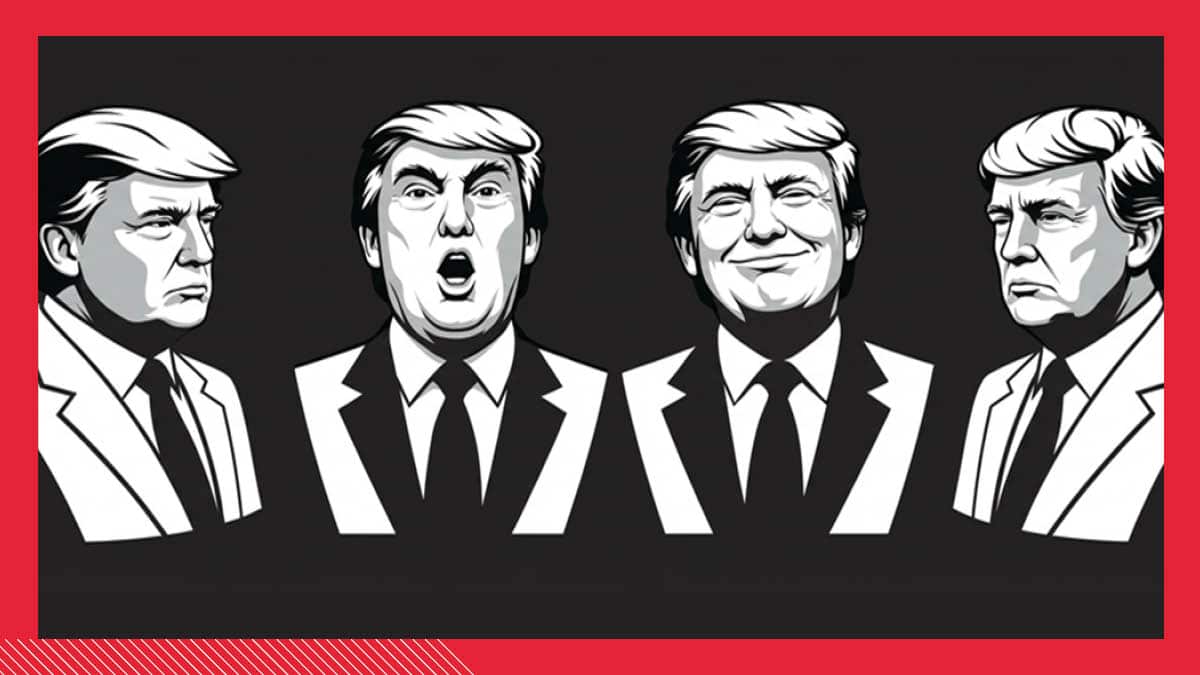
What is the least that can be said about US President Donald J. Trump? For there is no end to the most that can be said in this regard. Ranging from the “Donroe Doctrine” to “Tantrumps”, not only has Trumpism contributed scores of new words to English vocabulary, but his actions have lent new meanings to the global language of realpolitik and diplomacy.
The least that can be said about him is that he has baffled and flummoxed both his admirers and adversaries. This has given him an unfair agenda-setting advantage wherever he goes. Including Davos, where he deftly dialed back his sabre-rattling on Greenland and already announced a “deal” gaining control on the island before leaving.
STORY CONTINUES BELOW THIS AD
But here’s the rub. As a famous historian and conservative commentator puts it, most world leaders make the mistake of either not taking President Trump seriously or taking him too literally. Some make the mistake of being even more egregious, if not outrageous, in their bewilderment by calling the US President “mad.” I would argue that much of the world has misread President Trump much to his benefit.
The principal cause are his own statements, off-the-cuff, impromptu, unrehearsed, even outrageous though they may seem. For instance, a good deal of what he puts out on his platform, “Truth Social,” cannot be taken at face value. But the global press does precisely that, even amplifying how unconventional, undiplomatic, and unreasonable his pronouncements seem.
To my mind, President Trump is clearly gaming the international system to the advantage of the US. He does not seem to mind what and how much the people around the world name-call, even abuse him. He seems to revel in being the centre of the world’s attention. In the process, not only are world leaders false-footed, but a number of the tight-knit and exclusive club of experts everywhere, including those who supposedly have a 360-degree view, find themselves in deep waters, gasping for breath. Trump has rendered them ineffectual, even irrelevant. It therefore behooves other world states, especially “middle” powers such as India, to distinguish the grain from the chaff.
Given this reality, what should India do?
India’s approach to President Trump requires a fundamental recalibration of its age-old, even sage, diplomatic playbook. The conventional international relations toolkit, built on carefully parsed statements, doublespeak, incremental negotiations, not to speak of cunning and subterfuge, proves inadequate when dealing with a leader who operates through strategic unpredictability. Dismissing Trump as erratic or mentally unstable is not merely uncharitable but dangerously myopic. Such characterisations reveal more about the limitations of conventional diplomatic thinking than about Trump’s actual calculus or power.
STORY CONTINUES BELOW THIS AD
Let us never forget that there is the entire machinery of the US behemoth, including the State Department, the Departments of Defense, Treasury, Commerce, Treasury, even the Departments of Justice, Homeland Security, and Energy, which are involved in any international exchange or deal the US makes with other countries. But the Trump phenomenon seems to distort this with world attention overly focused on one individual. However powerful, controversial, or colourful he may be, Trump alone does not shape US domestic or foreign policy.
What we in India need is to recognise that Trump’s communication style is itself a negotiating tactic. His seemingly chaotic pronouncements serve multiple purposes. They not only signal American priorities but also test our mood or resolve. What is more, they create a negotiating room, while dominating media attention. When Trump floats an extreme position, he establishes a psychological anchor that makes subsequent pullbacks appear reasonable. These apparent compromises actually still favour American interests. India’s leadership must understand that what appears as volatility is often calculated pressure designed to extract concessions.
STORY CONTINUES BELOW THIS AD
India cannot afford to respond emotionally to every provocative statement while missing the underlying strategic game being played. The mistake of literalism is equally perilous. Taking every Trump statement as binding policy leads to analytical paralysis and reactive diplomacy. India must develop the sophistication to read between the lines, understanding that Trump’s transactional approach to foreign policy creates opportunities as much as challenges.
Similarly, India’s strategic community must recognise that Trump’s “America First” doctrine is not all that different from the ruling regime’s own proudly vaunted “India first” nationalist posture. If anything, ours was articulated much earlier by Prime Minister Narendra Modi than by US President Trump. In fact, while seemingly isolationist and protectionist, Trumpism reflects a recalibration of American engagement rather than withdrawal.
The United States under Trump remains deeply invested in shaping global outcomes but does so by leveraging economic and military power more aggressively and demanding explicit reciprocity. India’s trying to be “over smart” by over-leveraging its swing-state or balancing power advantage runs the risk of being snubbed or poked by both superpowers, the US and China. This we can ill-afford. The alternative is not to succumb to bullying but enter into consistent and convincing negotiations based on long-standing national self-interest. However, many in the Indian establishment are over-sensitive to neo-colonial bullying at the hands of the US while conveniently forgetting that China’s “salami slicing” is perhaps much more brutal, even if couched in lofty platitudes and sweet-sounding deception.
STORY CONTINUES BELOW THIS AD
India must also take the personal out of the equation. The pageantry of the “Howdy Modi” and “Namaste Trump” are clearly behind us as are the Modi-Xi Mahabalipuram or Gujarat extravaganzas. India must not mistake personal rapport for policy alignment. Grandstanding “jumlas” may create engaging optics, but substantive negotiations require hard-nosed bargaining and clear articulation of Indian interests.
What India must absolutely avoid is the trap of either overreaction or complacency. Overreacting to Trump’s rhetoric leads to unnecessary concessions made in haste. Complacency, assuming that strategic convergences on issues like China or terrorism guarantee American support, is equally dangerous. Trump’s transactionalism means that past cooperation earns limited goodwill; each interaction is effectively a new negotiation.
Ultimately, calling Trump “mad” is a failure of strategic imagination. It represents an unwillingness to grapple with the uncomfortable reality that international relations are becoming less predictable and more nakedly interest-based. India cannot afford such intellectual laziness. As an emerging power with global ambitions, India must develop the analytical sophistication and diplomatic flexibility to engage effectively with leaders and systems that don’t conform to established patterns.
STORY CONTINUES BELOW THIS AD
(Makarand R. Paranjape, author and public intellectual, is currently Sri Aurobindo Chair, Vedere University & Director of Education, AHCP LLC. Views expressed in the above piece are personal and solely those of the author. They do not necessarily reflect Firstpost’s views.)
HomeOpinionUS Sutra | Dealing with Trump: What India must and must not doEnd of Article