
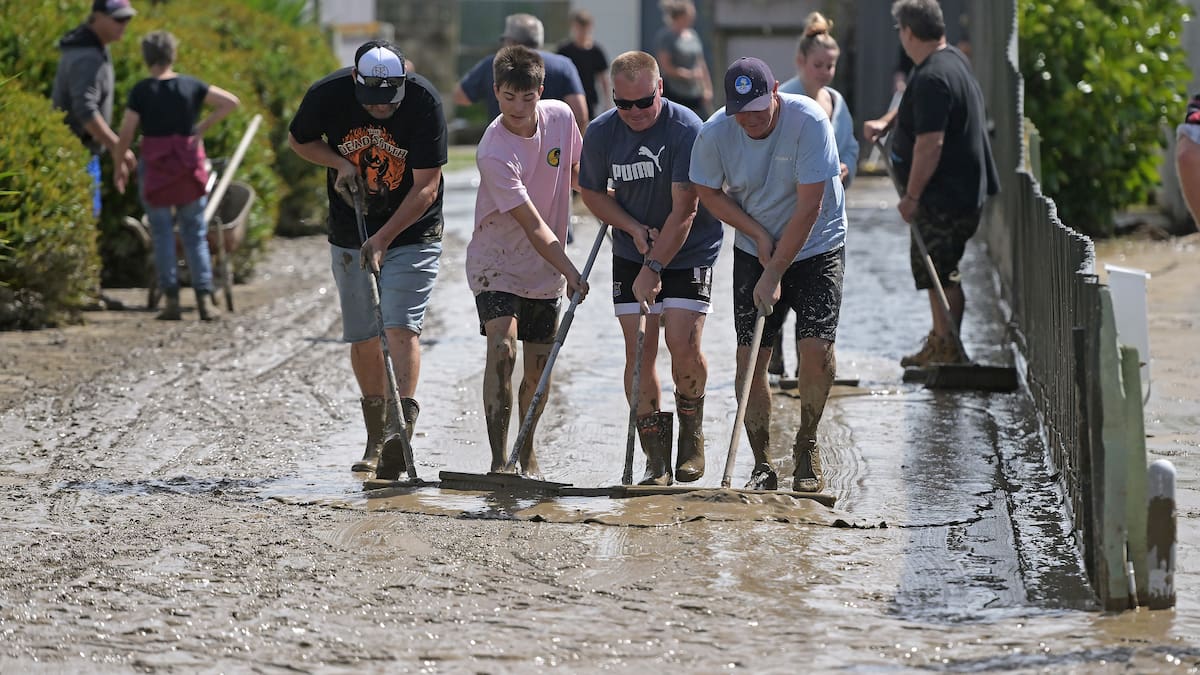
In the small hours of Valentine’s Day, 2023, Cyclone Gabrielle unleashed hell across the upper North Island. After two days of heavy rain, gale-force winds and power cuts, it doubled down, cutting off Northland, Tairāwhiti and Hawke’s Bay towns, wreaking havoc in both urban centres and remote communities and
killing 11. But how those communities survived the disaster, then regrouped and rebuilt, binds them in similar ways to the calamities that tore them apart.
Rahina Huata, an on-air host at iwi radio station Kahungunu in Hastings, recalls people being unsure of what to do as the day went on. Huata (Ngāti Kahungunu, Ngāti Ruapani) went to work early, leading to her reporting and broadcasting in 12-hour shifts throughout the emergency as Gabrielle intensified and widespread flooding and destruction gouged the region.
“We had four new staff members joining our two permanent radio announcers that very day,” says Huata. “We trained them through the chaos of that cyclone. They learnt to adapt very quickly.
“The radio’s job was to keep people informed, connected and calm. We were the only local radio station running in Hawke’s Bay. We had people calling up trying to find whānau, so we’d give a call-out, find them, and connect people.”
The radio station with around 20,000 listeners strived to get the latest Civil Defence alerts and other official information to the wider community – especially vital given the misinformation circulating about closed transport routes and available emergency centres.
“Although we broadcast those updates, it was more than that – we shared hope,” says Huata. “We were the voice reassuring people.”
For cut-off rural communities, the radio was a lifeline. People ended up at marae throughout the region, and as Huata and her colleagues kept reporting, people came together, providing kai, clothes, equipment, furniture, muscle and aroha.
Three years on, the region is still recovering. Huata talks of children with “rain anxiety” having to be reintroduced to water in a controlled manner, and although the community spirit isn’t broken, the mental strain is evident. Some families are still not housed, some are still navigating insurance claims.
While Huata and her colleagues took to the air, their operations manager with a camera crew travelled to remote rural communities to record people’s experiences.
Bringing people together: Ngāti Kere’s David Tipene-Leach and Radio Kahungunu’s Rahina Huata. Photos / Supplied
David Tipene-Leach, chair of the Ngāti Kere Hapū Authority and a research professor at the Eastern Institute of Technology, was one of those interviewed in Pōrangahau, a coastal village east of Dannevirke. He praised the efforts of those who came to help the mainly Māori community combat the impact of flooding and the generosity of people throughout the country who donated money and supplies.
The village, built in a valley next to a river, had flooded multiple times, devastatingly so in 1941, 1953 and 2004. Tipene-Leach (Ngāti Kere, Ngāti Manuhiri) said he was concerned that after the flooding, everyone would resume their daily lives and the small community, which has high numbers of pensioners and children, would be forgotten. He feared inequitable outcomes for Māori communities would result from the disaster. In the years since, much has been achieved. But as he predicted, the bulk of work in Pōrangahau was left to locals relying on their initiative and existing links with council, rural and government agencies.
Although the overwhelming generosity of the wider community – especially those offering their holiday homes to homeless residents – was deeply appreciated, villagers had to work out how to rehouse those whose uninsured homes had been yellow-stickered due to floodwater contamination.
The hapū authority pieced together a budget from several sources and, using mainly unskilled Māori workers, restored the damaged houses over a 15-month period. Temporary housing was brought in, kaumātua housed, shared meals organised and mental health support delivered as the hapū got on with rebuilding.
The authority is now working with Rongomaraeroa Marae trustees to make sure the marae, which remained open throughout the disaster, is back in full working order. Tipene-Leach notes ironically that the marae and kaumātua flats are the last in line for restoration.
In October last year, 21/2 years on from Gabrielle, a massive fire that took days to extinguish in high winds destroyed 250ha of pine forest just outside Pōrangahau. Farmers and villagers met MPs to voice concerns about the wildfire risk and invasive pests. Volunteer fire chief Peter Hobson told the meeting a similar event during a hot dry summer would be “unstoppable”. “You could evacuate people and that’s about all you could have done,” he said.
For Tipene-Leach, the sapling-size forests on the edge of the village are another significant risk his small community must manage. “This little township is all we have. Past government actions have contributed to our people having to leave, to go elsewhere for work – Flaxmere, Australia, anywhere but here. There are 200 people left. We have to hold on to what we have.”
A huge forest fire outside Pōrangahau in October brought a renewed sense of vulnerability to a village still rebuilding after Gabrielle. Photo / Supplied
The self-sufficient street
Communities across the country are starting to understand that locals represent the first response to a disaster. The extent of their readiness varies. A small cul-de-sac in South Auckland is possibly the most prepared in the country for an emergency.
Malcolm and Sue Wood bought the first house in a Clendon Park subdivision, with views across Manukau Harbour to Auckland Airport, in 1998. Malcolm, originally from Leicester, emigrated to New Zealand in 1974 when Fletchers advertised for experienced boilermakers. Brought up in a family where the back door was always open and with a pragmatic, “can do” attitude, he was soon the go-to person in the street. When his lawn mower was stolen, he set up a neighbourhood support group before he knew a formal organisation existed.
“The community is important to me. People move into Eloise Place and they don’t want to leave; the last to leave was 98 years old,” he says.
He knows and understands the local environmental risks. Standing on his sheltered deck, Wood gestures to the south from where the wind is blasting across the harbour. There’s a flood risk at the top of the street; to the north is the Wiri oil terminal.
Wood has seen his aluminium flag pole whisked away by 130km/h winds. He ruefully recalls the Perspex dome covering his spa pool being airborne, never to be seen again.
“Ten years ago, the council held these disaster group meetings. I went along, then talked to my immediate neighbours about having a plan. Their plan was to come here! We persisted and now we have a plan for the entire street to be self-sufficient for at least three days. We know who has the necessary medical skills, a chainsaw, a generator, who needs their meds kept at a certain temperature, and who is vulnerable.”
The highly diverse community bonds over activities and shared meals. At such times, information is updated on a very comprehensive spreadsheet. And Wood has done what every textbook tells a good leader to do – ensured someone can fill his shoes if needed.
Malcolm Wood has mobilised residents in his South Auckland street to be ready for the next big one. Photo / Supplied
Melissa Graham, who lives up the road, is no stranger to risk as a member of the Corrections Department’s prisons inspectorate and understands the importance of a sound workable plan. She was brought up on Norfolk Island, where she was part of the ambulance service and abseiled down cliffs and the sides of ships in land and sea rescues.
She recognises the power of a connected community, and of giving back.
Graham and partner Glenn Rigby had been in their new home for only a few weeks in 2015 when Wood came knocking. Within a few months, she was lending her experience to Wood’s neighbourhood support committee, breathing life into an emergency plan that is now a “living document”. Every resident now has a copy of information they need to keep safe; Wood and Graham hold residents’ private information.
Graham’s “go bag” is right by her front door – for her, it’s not “if”, it’s “when”.
“This ‘she’ll be right’ attitude is not doing us any favours,” she says. “People must understand they can’t rely on emergency services to rock up and help them. People have to get to know their neighbours and understand that when these high-risk events happen – and they will – it’s your neighbour who will help you out. Yes, it’s a matter of trust, but we need to pool our resources to survive.”
Mobilising locals
The “when” hit Auckland on Anniversary Weekend in January 2023, less than a fortnight before Gabrielle, causing devastating flooding, landslips and four deaths. A slow response from Mayor Wayne Brown and his senior leadership team was roundly condemned at the time and in a subsequent review.
Since then, much has changed for Auckland Council’s emergency management team. The council has more dedicated staff, local board emergency plans in place and senior advisers across board areas. There is better communication and community involvement, and engagement with groups likelier to be heavily affected by emergencies. But it’s more than a structural and budgetary change, it’s about people power – community-led solutions to local risks.
The council’s principal emergency management advisor, Greg Morgan, works with business groups, the disability sector, youth, elderly and immigrant organisations, emphasising that communities have agency – a bottom-up rather than top-down approach. Although a plethora of online information is available, Morgan stresses “neighbours … are your go-to people in the first instance”.
“We have great examples of communities being on top of potential emergencies. Last year, our team delivered programmes to 3000 school students so that they and their whānau will feel that disasters are a part of life and they can be in control. Through connecting natural disasters to ngā atua Māori [the spiritual realm] in te ao Māori, young people learn that disasters are to be respected and they can be ready with a plan. When something happens, they don’t have to go to a place of fear.”
Auckland Council emergency management advisor Greg Morgan. Photo / Supplied
In Mt Roskill, former Puketāpapa Local Board chair Richard Barter is the Acts of Roskill Kindness Trust co-ordinator. With a background in disaster relief here and overseas, Barter provides programmes supporting community resilience via council contracts.
When the 2023 floods hit, Barter and colleagues scrambled to support affected communities as best they could. The commitment stretched to supporting more than 2000 people for two years without local or central government funding.
Realising a similar emergency could easily happen again, Barter, along with youth workers Peter and Tili Leilua, Wesley Primary School principal Andy Crowe and then-local board deputy chair Fiona Lai, worked with community contacts, especially within Pasifika churches, to improve preparedness.
Barter managed to get some Red Cross funding to buy a 20m container and pack it with the necessities to support the community in a future emergency – portable toilets, generators, a huge tent, water and solar power.
His message is similar to that of others who try to mobilise communities. “We need to change our mindset from being victims of past and future events to being prepared. We need local information we can use and act on. Weather updates can feel sensationalised, so we set up our own weather station. We have cameras at our local awa/creek, we know exactly the trigger points indicating a potential problem and when to sound the alarm. The information is transparent and verifiable.”
In a suburb of 60% renters, many residents have little control over properties. Drawing the community together through Kāinga Ora, churches, the local board, community leaders and youth groups has paid off. The community has mobilised. With that energy has come new ideas – floodwater diversion tubes to protect homes, sandbags available locally, six community hubs being prepared and 25 young people who are working through a workshop programme on climate resilience and change.
The message is the same across the motu: empowering the community to get through street by street, suburb by suburb, town by town. It’s a slow process often brought home to people only by a disaster on their doorstep.
The flooded Moutere River, south of Motueka, in July. Photo / Getty Images
Flood lessons
The Nelson-Tasman region covering 10,200 sq km has seen its fair share of emergencies – fires and, more recently, a succession of floods. Kathy King, emergency management advisor for the region, works with government and community agencies and volunteers to prepare and support communities during emergencies. Like Morgan, King knows communities have the knowledge to plan for emergencies. “In the past, we did the planning, printed it off, and it remained on shelves in offices across the region,” she says. “Now, we support local champions to develop and run with local plans that best suit their community.”
During extreme episodes, the regional team of six is boosted by up to 80 trained council staff who work in shifts around the clock.
King is full of praise for the community response to emergencies. When evacuated residents from the small village of Tapawera needed accommodation during floods last July, owners of both the Tapawera Forestry Park and a nearby hop farm opened their doors.
King urges people to have a plan, to not be complacent, and to get out early, especially if they are vulnerable. Although people are learning from each emergency, it is a slow process.
One of the toughest aspects is the recovery phase following the initial response. It can take weeks, months or even years to recover.
Tasman district councillor Kerryn Ferneyhough, who moved to Motueka from Auckland after a frightening experience in the 2023 Anniversary Weekend floods. Photo / Supplied
Kerryn Ferneyhough’s successful election campaign for a Tasman District Council seat representing the Motueka region was very direct – community resilience. She noted how locals had worked together against the elements during major floods in June and July, and that council systems had battled at times to connect with residents.
Ferneyhough, a primary school teacher, and partner Ben Walch relocated to Motueka after the Auckland floods three years ago and know first-hand how powerless residents can become in a short time. She says she will never forget the sound as the river near her home became swollen and flooded. “It was dark, we had evacuation alerts but the roads were under water. We didn’t know what was going to happen and I was full of this sickening fear of ‘What next?’” says Ferneyhough, who has since completed a Civil Defence course.
“We have this idea that there is this system that will come and save us, but actually, we are responsible for our own safety. I was lucky, I was on my school holidays during the recent floods so I could help, but we shouldn’t rely on luck to get through.”
John Prestidge, principal of Motueka High School, downplays the role his school played in the floods. “We weren’t a driving figure in the floods. We used our location and communication links in the best way we could. We had outreach through social media to a wide audience of residents, our school community and our 15 contributing schools, including informative video clips that had massive shares,” says Prestidge.
The school became a food and essential-supplies hub, preparing meals and distributing donated kai and other essentials through community volunteers. The hard part was winding the operation down when people felt there was still a need for it to stay open.
Although the students are back, and being supported by counselling if needed, Prestidge knows the community has a long way to go, needing better communication between council and residents, consistent, clear messaging from government agencies and tighter co-ordination across the district.
The government allocates about $890,000 a year via a contestable fund to help communities improve resilience and capability in a natural disaster. But the responsibility ultimately comes down to this question: how well prepared are you for when the next emergency occurs?”
SaveShare this article
Reminder, this is a Premium article and requires a subscription to read.
Copy LinkEmailFacebookTwitter/XLinkedInReddit
Tags:
- (natural
- 2023
- across
- after
- and
- apart
- are
- binds
- both
- calamities
- centres
- communities
- critical
- cuts
- cutting
- cyclone
- day
- days
- disaster
- disasters
- doubled
- down
- gabrielle
- galeforce
- good
- havoc
- hawkes
- heavy
- hell
- hours
- in
- island
- killing
- Local
- neighbours
- Networks
- New Zealand
- News
- NewZealand
- north
- northland
- NZ
- power
- rain
- rebuilt
- regrouped
- remote
- similar
- small
- survived
- tairwhiti
- that
- them
- then
- those
- tore
- towns)
- unleashed
- upper
- Urban
- valentines
- ways
- why
- winds
- wreaking