
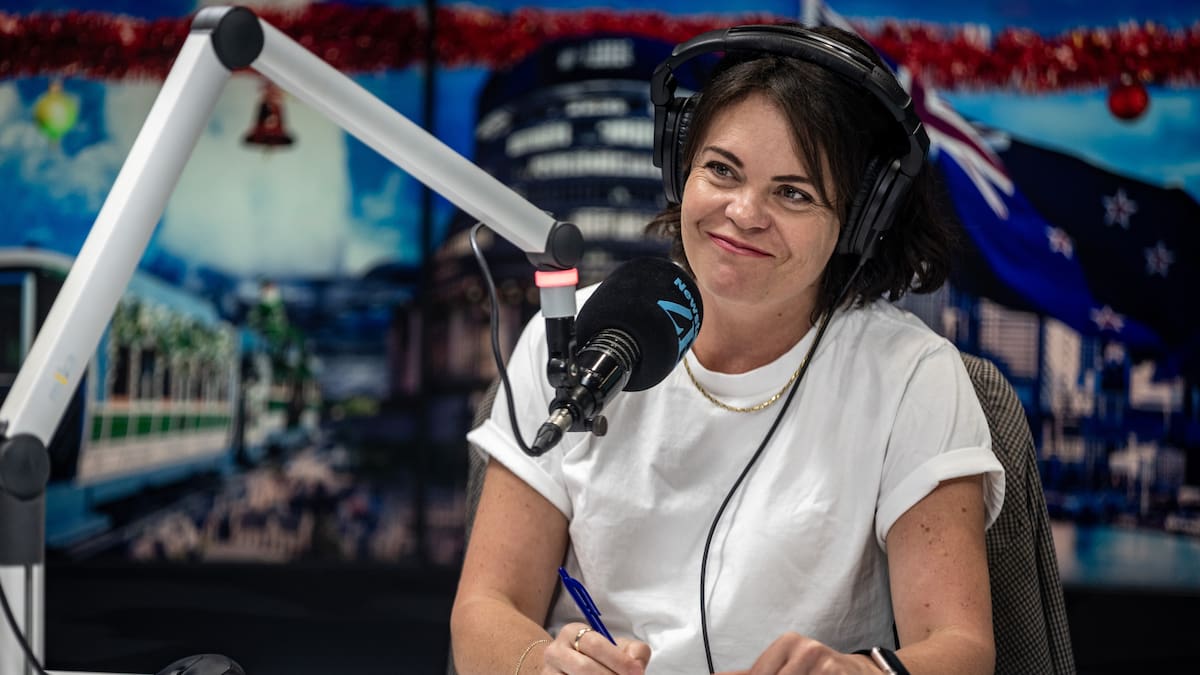
According to the most recent GFK audience survey, radio attracts around 3.327 million listeners per week, a number that has remained broadly stable over the past 12 months.
Coast FM breakfast hosts Jason Reeves, Toni Street and Sam Wallace.
“AM and FM radio is an important source of news and information for many New Zealanders,” Media and Communications Minister Paul Goldsmith said.
“It also plays a crucial role in emergency broadcasting.
“By extending the spectrum licences that underpin our radio networks until 2051, we are ensuring that the operators – whether they are large commercial networks, independent stations, or regional, community or iwi networks – can continue to broadcast.”
The decision to extend the licences – there are currently 1053 across New Zealand, almost 900 of them FM – follows a period of public and industry consultation in 2025.
Media and Communications Minister Paul Goldsmith. Photo / RNZ, Mark Papalii
In a statement on Tuesday evening, the Ministry of Business, Innovation and Employment (MBIE) said commercial, community, and iwi broadcasters would continue to have access to radio spectrum.
“Commercial broadcasters can expect renewal offers in coming months, while non-commercial operators will be engaged well ahead of the expiry of their current licences.”
The Breeze’s Auckland breakfast hosts Robert Rakete and Jeanette Thomas.
It said commercial licence holders – such as NZME and MediaWorks – could expect renewal offers in mid-2026, and would have six months to consider them.
Renewal offers would be based on a national value of $29 million for the current commercial licence-set.
“This means the per-capita price paid will be lower than was consulted on in 2025, reflecting industry feedback and information provided through the consultation,” the MBIE statement said.
“We are aware that licence holders will be keen to understand the precise costs associated with their specific licence set.
“MBIE is currently working to confirm the final per-capita price and to revise population coverage for each licence based on the latest census data.
“Once this has been completed, MBIE will generate offer documents for all licence holders. MBIE will not be responding to ad hoc requests for information on specific licences until the complete data set is ready and all offers are generated.”
Goldsmith said: “While the landscape for the sound broadcasting industry is changing, with many New Zealanders now accessing news and community updates in other ways, it’s clear radio broadcasting still plays an important role.
“There are currently more than 1000 licences in place, reflecting the widespread use of both AM and FM frequencies across our country.”
He said the freeing up of more channels, from the previously planned youth network, would be the first availability of new channels in major centres for many years.
“This is an important commitment to our media industry, providing clarity and certainty about the future of our AM and FM networks.”
The new licences would start on April 3, 2031.
“As part of these offers, licence holders will have the flexibility to pay and renew licence-holdings at five-yearly intervals rather than being required to pay the full amount up front,” the Ministry of Business, Innovation and Employment said.
“If a licence holder does not wish to renew its licences at these intervals, it will be able to instead relinquish them to the Crown. RSM [the MBIE’s Radio Spectrum Management] will then make these licences available again to the market.”
The Ministry of Business, Innovation and Employment says it is imposing a temporary moratorium on new licences – to come into effect on February 20 – to give it the “administrative stability” needed to generate offers efficiently. That will be seen as a controversial move in some areas.
The ministry also said that local commercial FM licence types would be retired in 2031.
“Current licence-holders will be able to transition to either a community or commercial licence, with offers to be made in the second-half of 2026.
“If licensees do not wish to transition, they will be able to continue operating under their current conditions until the expiry of their licences in 2031.”
Spectrum licences would continue to be available for community broadcasters from 2031. The Ministry for Culture and Heritage would have more details on the renewal process later in the year.
And spectrum licences would continue to be available for iwi broadcasters from 2031.
“Te Puni Kōkiri will lead work on the renewal of spectrum for iwi radio broadcasting ahead of 2031, which will consider sector views on the best use of spectrum for iwi radio broadcasting and spectrum which has previously been put aside for a national Māori radio service.”
Editor-at-Large Shayne Currie is one of New Zealand’s most experienced senior journalists and media leaders. He has held executive and senior editorial roles at NZME including Managing Editor, NZ Herald Editor and Herald on Sunday Editor and has a small shareholding in NZME.