
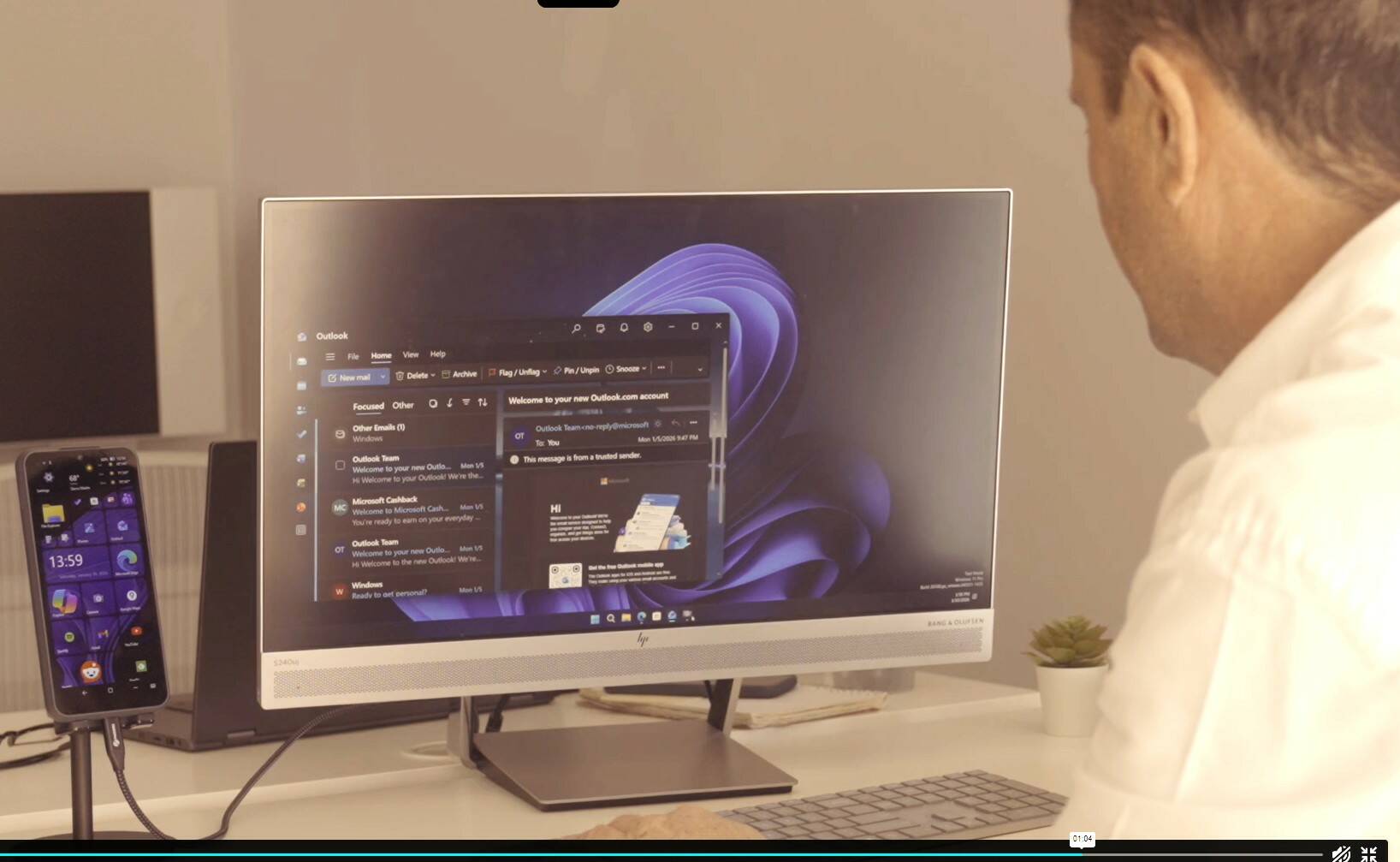
For most mobile devices, the OS is either Android or iOS, but a pair of new systems promises a host of additional OS options you can dual boot into. The Android phone can run Linux and boot into Windows 11 where it functions as a PC while the tablet runs a smorgasbord of Google-free OSes.
Nex
Nex comes first, if only by age. It’s launching the NexPhone. This is a decently specced Android phone, but with one unusual feature and one that we’ve not heard about before. The first is that, along with a clean copy of Android 16 with its own desktop mode, it will also include a bundled Debian Linux VM for running hardware-accelerated desktop Linux apps.
In addition, for a denser desktop experience, the device dual-boots with a copy of Windows 11 for Arm64, meaning that you can reboot into Windows; attach a screen, keyboard, and mouse with the bundled USB-C hub; and have a pocketable desktop computer.
The company behind the device, Nex, has been around for a decade: The Register covered the launch of the NexDock 2 in 2019 and a year later got its talons on one. A later version, the NexDock 360, is sold alongside Puri.sm’s Librem 5 Linux phone. Founder and CEO Emre Kosmaz has a blog post explaining the history and inspiration behind the device.
Nex plans to start shipping the NexPhone in the third quarter of 2026. For now, Nex is asking for a $199 downpayment to reserve a phone, with another $350 to pay when the devices start shipping.
Brax
Brax Technologies is a newer company, started by prolific – and sometimes controversial – Youtuber Robert Braxman. Following the Brax2 phone in 2022, last year Brax successfully crowdfunded a $300 Google-free Android phone, the Brax3, on Indiegogo. It runs French de-Googled Android variant iodéOS, raised over $1M in backing, and started shipping in May 2025.
This year, Brax is following this up with an unusually expandable tablet called open_slate. Like the Nex phone, the open_slate will offer the ability to dual-boot: in this case, between a choice of de-Googled Android variants and several Linux distributions. On its forums, Brax has an open_slate “megathread” with more detailed specifications. For operating systems, it says:
Planned support includes:
Android-based systems (BraxOS, iodeOS, LineageOS, AOSP and others)
Native Linux distributions (e.g. Ubuntu Touch, Ubuntu, Debian, Yocto Linux and others)
So far, we must admit that these do actually look pretty decent and provide a number of the things that the Reg FOSS desk has long wanted in a tablet computer.
There will be two versions: one with 8 GB of RAM and 128 GB of flash, and one with 16 GB of memory and 256 GB of storage. It will also have a user-replaceable battery and a microSD slot for up to 1 TB of additional storage. All good stuff, if maybe not quite industry-redefining – but there is more promised.
As well as the microSD slot, the tablet will also have an M.2 slot for an NVMe SSD. That’s different, and should be both much faster and more capacious than SDXC – and especially handy with a more mainstream Linux distro.
It is also promised to have two USB-C ports and a USB 2 type-A port as well. That would be very handy: this vulture has a Planet Computers Gemini, and its double USB-ports were one of reasons we backed its Kickstarter.
The specifications start to go overboard for us, though, when it comes to the hardware privacy switches: the device is planned to have no fewer than six which will fully disconnect, at the hardware level, multiple functions: camera, microphone, Bluetooth, GPS, mobile network, and Wi-Fi. That frankly seems like overkill, but we’re sure that it will make some extremely privacy-conscious buyers salivate.
Although it’s not been around as long as Nex, this is Brax Tech’s third product launch, and we will be watching with interest to see how close the shipping hardware matches the company’s goals.
Bootnote
Thanks to Reg reader RobX for telling us about the NexPhone.