
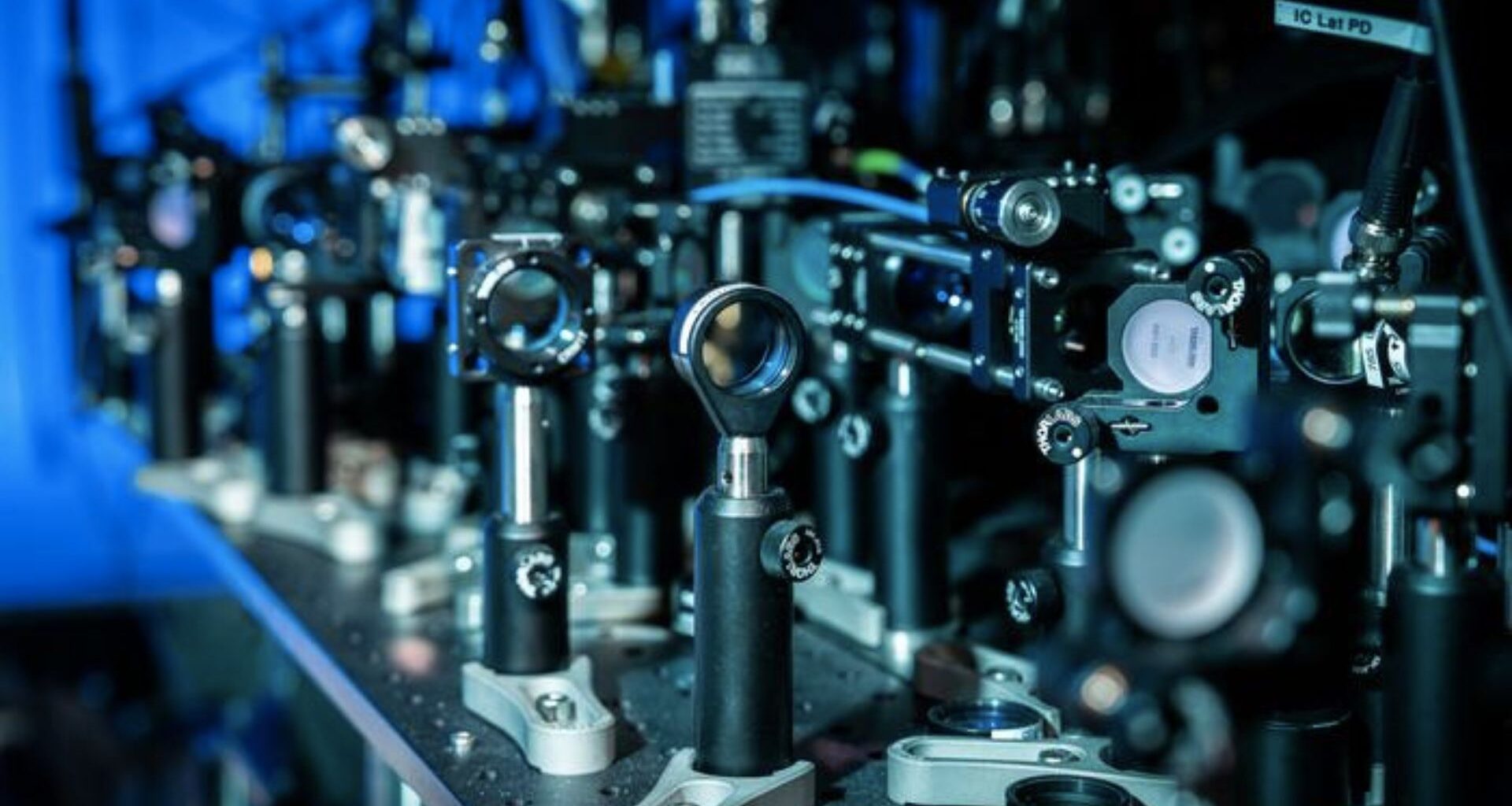
Scientists in the United States have developed a new type of “optical cavity” that can efficiently collect single photons, the fundamental particle of light, from single atoms. These atoms act as the building blocks of a quantum computer by storing “qubits”, the quantum version of a normal computer’s bits of zeros and ones. This work enables that process for all qubits simultaneously, for the first time.
Researchers from Stanford University describe an array of 40 cavities containing 40 individual atom qubits as well as a prototype with more than 500 cavities. The findings indicate a way to ultimately create a million-qubit quantum computer network.
Scientists highlighted that an optical cavity is created when two or more reflective surfaces cause light to bounce back and forth, as happens when a person steps between a set of fun house mirrors and sees thousands of their image repeated into the distance.
Optical cavities are much smaller, use the many bounces of a laser beam
Unlike the fun house, these optical cavities are much smaller and use the many bounces of a laser beam to get extra visual information from atoms. Researchers have been experimenting with optical cavities for decades, trying to get enough light to bounce back and forth enough times to interact with the tiny, nearly translucent atoms.
“If we want to make a quantum computer, we need to be able to read information out of the quantum bits very quickly,” said Jon Simon, the study’s senior author and associate professor of physics and of applied physics in Stanford’s School of Humanities and Sciences.
“Until now, there hasn’t been a practical way to do that at scale because atoms just don’t emit light fast enough, and on top of that, they spew it out in all directions. An optical cavity can efficiently guide emitted light toward a particular direction, and now we’ve found a way to equip each atom in a quantum computer within its own individual cavity.”
New type of cavity architecture
The research team led by Simon’s lab took a different approach and used microlenses inside each cavity to focus the light more tightly on a single atom. This creates fewer bounces of light but is still more effective at getting quantum information from the atom, according to a press release.
“We have developed a new type of cavity architecture; it’s not just two mirrors anymore,” said Adam Shaw, a Stanford Science Fellow and first author on the study. “We hope this will enable us to build dramatically faster, distributed quantum computers that can talk to each other with much faster data rates.”
Published in Nature, the study introduces the cavity-array microscope, an experimental platform where each individual atom is strongly coupled to its own individual cavity across a two-dimensional array of over 40 modes.
The approach requires no nanophotonic elements and instead uses a free-space cavity geometry with intra-cavity lenses to realize above-unity peak cooperativity with micrometre-scale mode waists and spacings, compatible with typical atom-array length scales while keeping atoms far from dielectric surfaces, according to the study.
“We achieve homogeneous atom–cavity coupling and show fast, non-destructive, parallel readout on millisecond timescales, including through a fibre array as a proof of principle for networking applications. As an outlook, we realize a next-generation iteration of the platform with over 500 cavities and a nearly 10-fold improvement in finesse,” said researchers in the study.