
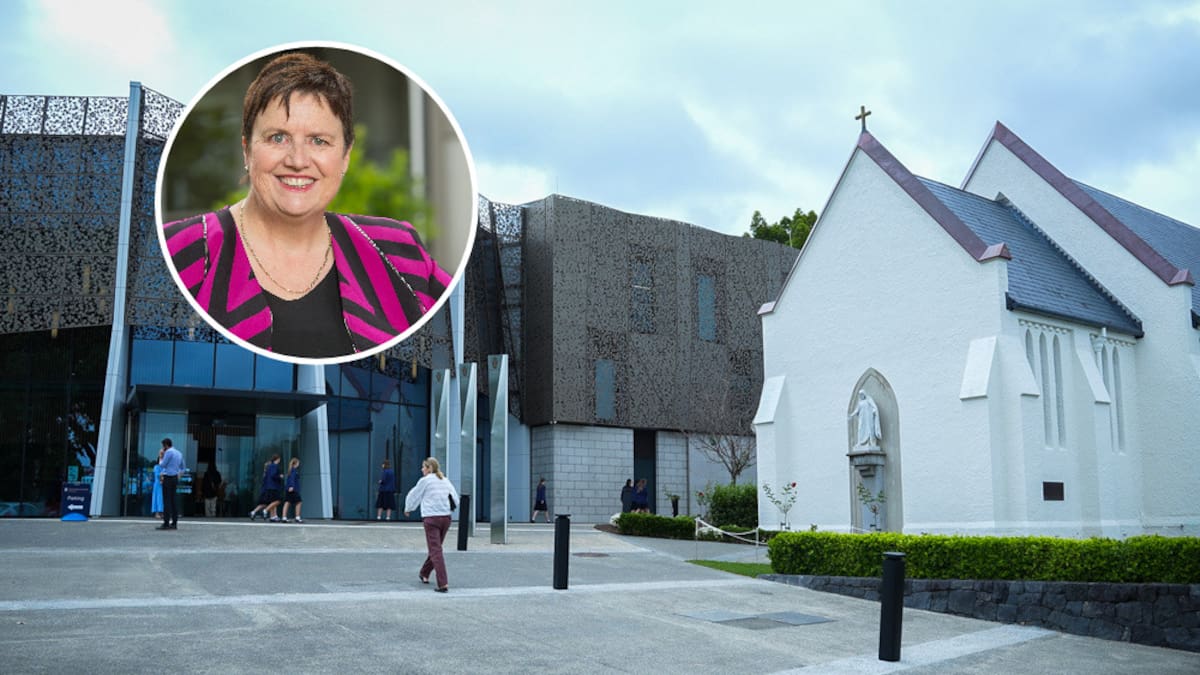
Their medical conditions and parents’ marital statuses were also recorded, with one parent telling an Australian media outlet the document was like a “dirt file” on students.
Hastie and Somerville House have apologised for the “distress and hurt” caused.
The Diocesan School board said it was aware of the incident when hiring Hastie.
The teachers’ notes were written in 2021, “well before” Hastie became principal of the Brisbane school in 2024, the board said.
It believed Hastie handled the Australian controversy “with transparency, empathy and decisive leadership”.
She moved “quickly to support affected students and families while reviewing policies and procedures and putting stronger safeguards in place”, the Diocesan board said.
The Herald also approached Hastie and Somerville House – one of Brisbane’s most expensive girls’ schools – for comment.
Australia’s ABC reported last November that students found the teachers’ notes when looking for a file a teacher uploaded to Microsoft Teams.
The document reportedly included wide-ranging notes.
Some students were labelled “quirky” and “disorganised”, while one pupil was thought by her peers to “have head lice”, the teachers noted.
The teachers also commented on parents’ personalities and whether they were married – with some described as “complainers”, “intense” or “in your face”.
One parent, speaking to the ABC, described the document as a “dirt file” containing “salacious, malicious commentary about children”.
Another told Brisbane’s Courier-Mail newspaper it was a “complete betrayal of trust”, saying teachers had done “the exact opposite of what they’re constantly telling children about: Not to bully, not to gossip, not to talk behind people’s backs”.
In news reports on November 20, immediately after the data leak became public, parents complained about a lack of an initial apology from the school, with others claiming in the following days the school had shown a “lack of action”.
Dr Sandra Hastie has a long and accomplished teaching record in NZ and Australia, Diocesan says, including as head of Rangi Ruru Girls’ School.
Hastie, as principal of Somerville House, told the Courier-Mail on November 22 that an investigation had been launched and cyber experts called in.
“We sincerely apologise for the distress and hurt many within the school community are experiencing,” she said.
“We are very disappointed by what has happened, as the nature of some of these comments falls short of our standards and values. We are taking this situation very seriously.”
Then last week, Somerville House revealed Hastie had resigned, telling Australian media outlets it was due to family reasons and unrelated to the data leak.
Diocesan last week announced on its website that it had hired Hastie to replace its long-serving principal, Heather McRae.
The announcement said Hastie had vast experience, having previously served as principal of Rangi Ruru Girls’ School in Christchurch and Saint Kentigern Girls’ School in Auckland.
Hastie was an “outstanding educator” who brought vision, a proven track record, and an “exceptional reputation”.
The school’s board told the Herald it started an independent recruitment process to replace McRae in the middle of last year.
Board chair Jenny Spillane said Hastie was the strongest candidate from a “highly competitive field”.
She was unanimously chosen “based on her stellar credentials, track record in multiple schools across New Zealand and Australia, and her clear vision for girls’ education”.
The board said Hastie applied because she has family in New Zealand requiring support.
As one of Auckland’s most prestigious private girls’ schools, the Diocesan board said it also held itself to “high standards when it comes to the collection, use and protection of student information”.
“We have clear policies and guidelines in place to ensure information is collected only where it is appropriate, necessary and in the best interests of students.”
It said it regularly reviews privacy and student well-being, invests in cybersecurity, and typically looks at policies on a two-to-four-year cycle to “ensure we keep up with new technologies”.
Diocesan School for Girls charges fees of about $30,000 per year.