
The charges included failing to ensure his 184 sheep received treatment that alleviated unnecessary pain or distress.
Judge Stephen O’Driscoll said Evans lived on a 23-ha farm lot in Rangiora where he maintained the flock.
The offending concerned the ill treatment and poor care of those sheep and spanned more than a year, the judge said.
During that time, the Ministry of Primary Industries (MPI) and its inspectors frequently engaged with Evans and attempted to intervene.
In March 2024, MPI received the first of multiple complaints regarding the health of the sheep.
Inspectors visited the property 14 times over the following year.
Many of the sheep were in poor condition. Photo / Ministry for Primary Industries
They found sheep suffering from advanced foot-rot, necrotic tissue and maggot infestation.
Some were suffering from arthritis, evidenced by misshapen and overgrown hooves, joint misalignment and impaired mobility.
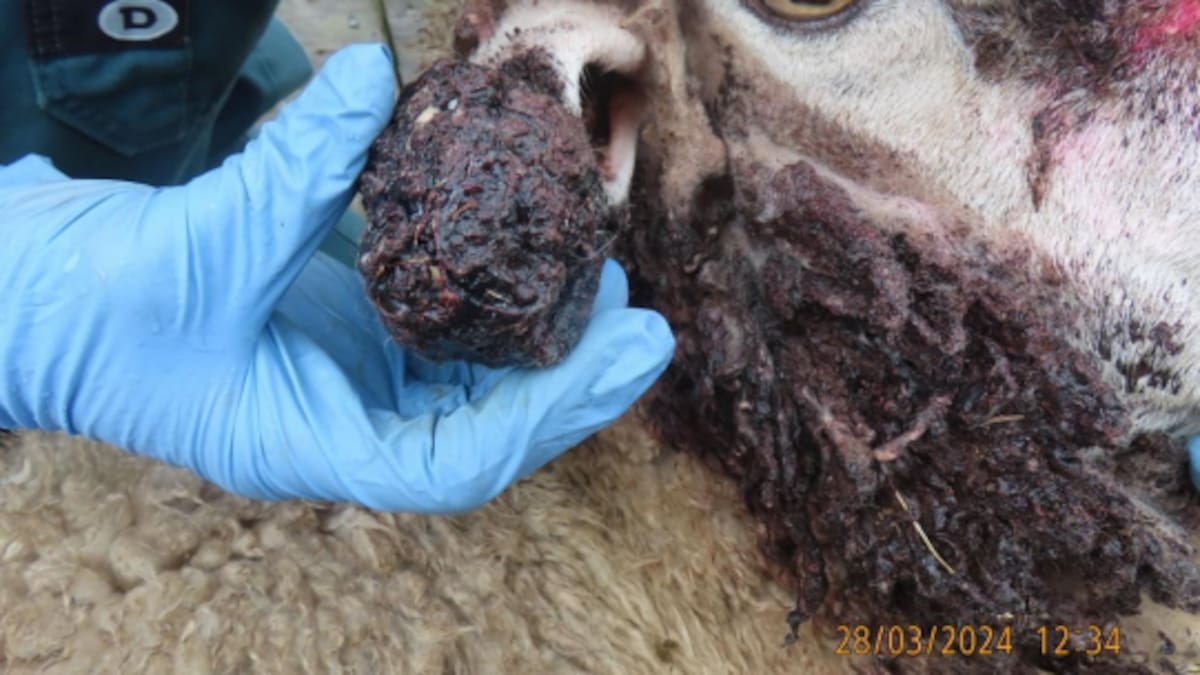
One was found to have a large mass on its ear, which was ulcerated and weeping.
Some sheep were suffering from flystrike.
A lamb suffering from advanced flystrike was observed with open sores, live maggots, lameness and significant irritation.
None of the animals had received veterinary treatment and many required euthanasia to end their suffering.
Evans then engaged a veterinarian who assessed 27 sheep in poor condition.
However, the court heard Evans failed to take immediate remedial action by not arranging for the animals’ humane destruction.
Over the following months, inspectors found dozens more sheep suffering from lameness and flystrike.
Evans ignored multiple notices to euthanise the animals.
At the hearing, MPI lawyer Ayla MacTavish submitted a starting point of 18 to 24 months’ imprisonment was appropriate.
However, she acknowledged that an alternative sentence to imprisonment could be appropriate, accepting that Evans had long suffered from mental health issues and that he had admitted the charges early on.
Defence lawyer Stuart Gloyn submitted that MPI had overstated the gravity of the offending.
Gloyn said it lacked the aggravating features present in more serious cases and that imprisonment was not justified.
He submitted that a $50,000 fine for the reckless ill-treatment charge was the appropriate starting point, with a $10,000 uplift for the remaining offending.
Gloyn accepted that Evans’s offending involved delays in, and failure to treat suffering sheep, and failure to comply with directions to treat the animals.
However, he submitted that a 55% discount was appropriate, for Evans’ guilty pleas, previous good character, mental health issues and remorse, resulting in a $27,000 fine.
Judge O’Driscoll said Evans’ offending was aggravated by the causing of significant pain or distress to the animals, and his sole responsibility for the flock.
The judge noted the offending occurred in circumstances where Evans had previously been on notice for animal welfare concerns on his property.
He said MPI had made repeated requests for immediate action.
“In my assessment, this adds an element of ignorance in that the defendant knew his sheep were suffering but did not turn his mind to their care and treatment.
“However, I do caveat his lack of remedial action in response to the MPI interventions with the defendant’s poor mental health, which affected his ability to take action.”
The pre-sentence report showed Evans experienced increasing stress and difficulty coping with the demands of managing a farm in the context of repeated engagement with MPI.
The judge said Evans’ mental health difficulties did not excuse the offending nor diminish the seriousness of the harm caused.
On charges of failing to ensure the health of the animals was met, failing to ensure they received treatment, reckless ill-treatment and failing to comply, Evans was fined $30,000 plus $9840 in costs.
He was disqualified from owning or exercising authority over livestock for life.
Al Williams is an Open Justice reporter for the New Zealand Herald, based in Christchurch. He has worked in daily and community titles in New Zealand and overseas for the last 16 years. Most recently he was editor of the Hauraki-Coromandel Post, based in Whangamatā. He was previously deputy editor of the Cook Islands News.