
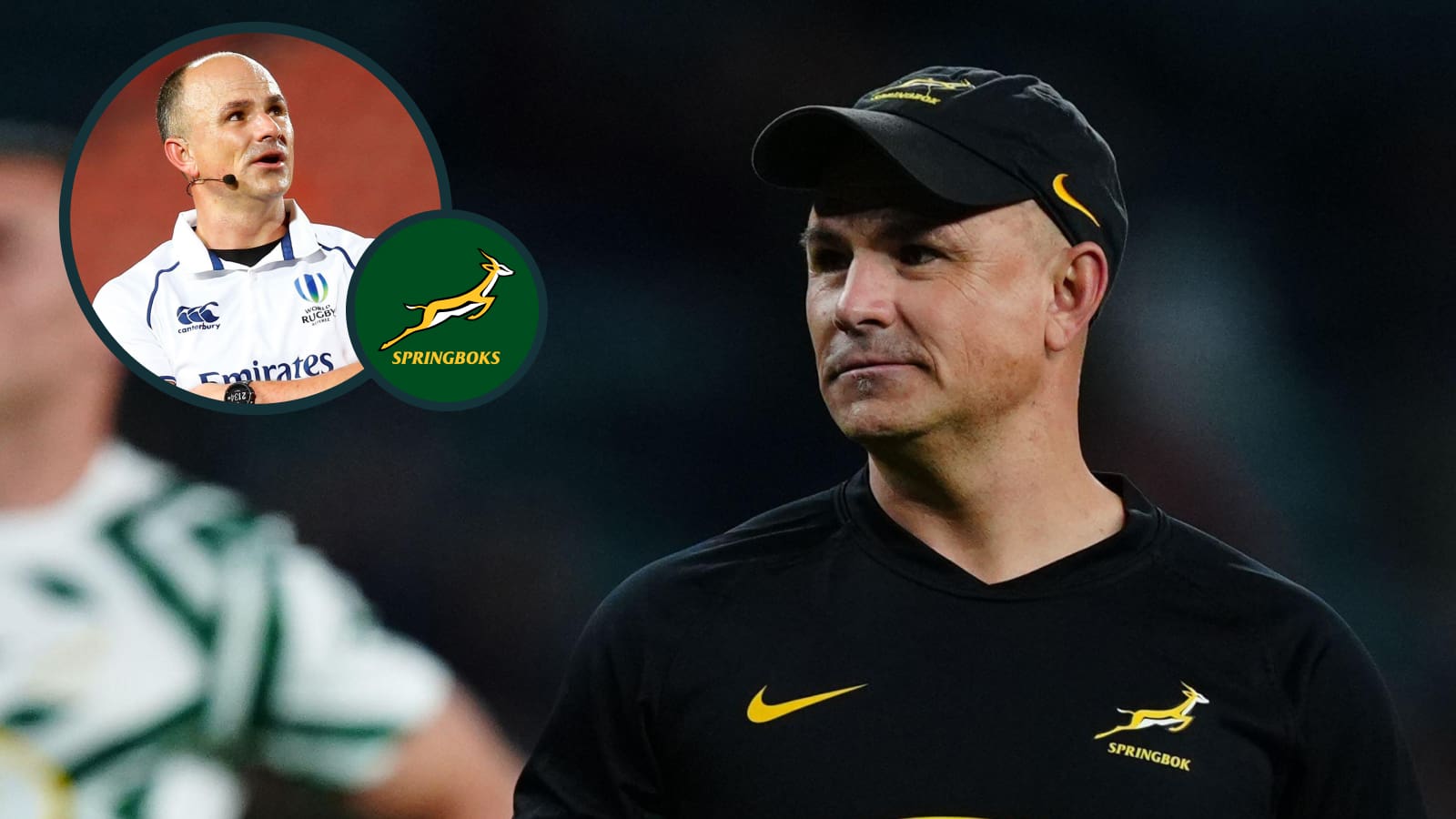
Former international referee Jaco Peyper says that he felt pressured by stakeholders to achieve certain metrics in matches.
The South African officiated at the highest level, overseeing Super Rugby matches as well as Test fixtures in the Six Nations, Rugby Championship and Rugby World Cup before hanging up his whistle in 2023 due to injury.
Peyper states that during his career, he had to learn not to be pressured by tournament organisers and stakeholders to produce certain types of rugby matches.
“I got it wrong so many times.”
He said as much on an episode of the Rassie+ podcast during the discussion around the ball-in-play metric.
“I got it wrong so many times. When we started competitions, say Super Rugby or whatever tournament, there’s this pressure from the outside to have an entertaining tournament or to deliver a certain product,” he explained.
“I remember we called it ‘high octane’, this is early 2010, 2012, whatever it was in Super Rugby. So then a referee feels the pressure to make the tournament like that instead of just applying the laws.
“Instead of just keeping it safe, keep it fair, and apply the law the same to both teams. Yes, little things like we were really strict on the tackler that really assisted the game, get tacklers out of there that cleaned up the contest, but it’s not the referee’s job to make the game flow. It’s the player’s job.”
He continued: “It’s the referee’s job to make sure it’s safe first, and then even-handed and then if it’s all going so well, then the referee can look at contributing. Often, I felt the pressure of trying to either open up or break the game open if it’s a stalemate.”
Springboks assistant coach Felix Jones agreed that it’s not the match officials’ job to create a certain kind of product. “It should be a contest first,” he said.
“The flow must be an outcome of the contest that’s going on.”
I felt the pressure
Peyper clarified that was what he experienced, and other officials may not feel the same as he did.
“I can’t speak for others, but I’ve had these conversations with many, many experienced referees – flow is often not a good game because it’s so easy to keep the ball in hand for 30 phases, but it’s one-off rugby, one-off rugby, one-off rugby, where when it’s more dynamic and broken field, when you create these contests, and it’s a little bit more dynamic, then there’s no set defence then and it’s also different to referee,” he said.
“But I certainly felt the pressure often, and then you have to reset yourself after four weeks in the competition when you are inconsistent, or you had a few high-impact moments, then you have to reset and understand that you have to get back to the basics. Get the contest right, get it safe, get it fair, and then the players and the coaches can take it away.”
Hitting KPIs
Now SA Rugby’s national law advisor, Peyper, said that the officials were also marked on metrics like ball-in-play that were produced in matches that they oversaw.
This meant that the referees would make decisions in order to look after the key performance indicators (KPIs) that they were evaluated on.
“I was one of the first who had to learn from this; they told us fewer scrums, fewer resets, fewer kicks, more ball in play,” he explained.
“So those were some of the game measure metrics, basically. You can’t judge a referee on that.
“If one of the KPIs of a referee is to bring the kicks down, bring the ball in play up. So if you go into a game in 40 minutes, you go ping, ping, ping, then the referees are going to start doing things to manipulate his outcome.”
Erasmus added: “And to please the guy who looks after his KPIs.”