
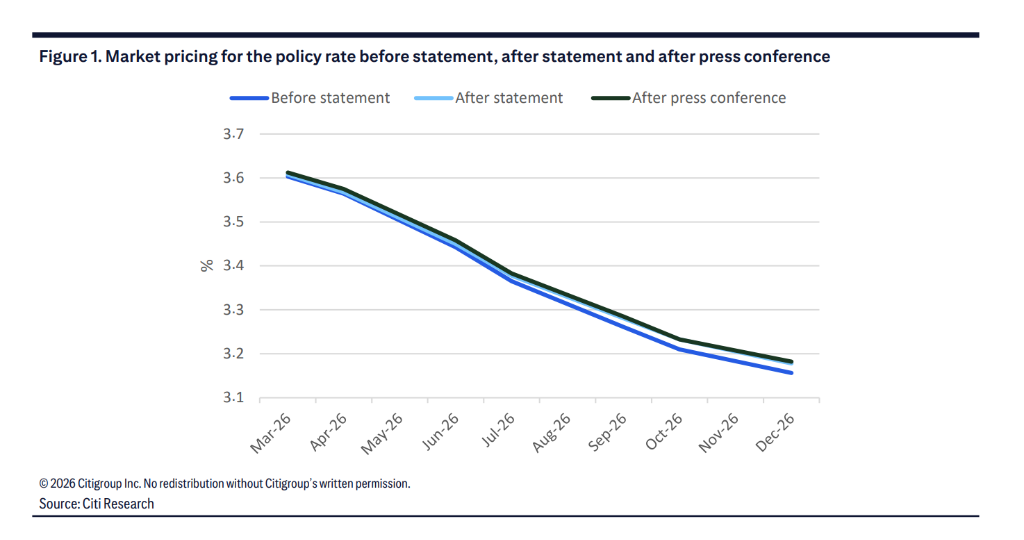
Powell indicated that the monetary policy stance “is likely to be broadly neutral, or slightly tight,” a statement interpreted by Citi as suggesting that while policy may remain on hold in the short term, there is still an inclination towards easing.
Citi believes the threshold for rate cuts is actually quite low; whether it is a rise in unemployment or sustainable slowing of inflation, either could trigger a rate cut. Citi predicts that the Federal Reserve will cut interest rates by 25 basis points in March, July, and September this year.
At the January FOMC meeting, Powell made every effort to maintain a stance of ‘providing no new guidance,’ attempting to convince the market that the Federal Reserve is currently in a wait-and-see mode with no immediate action planned.
 However, for astute investors, the signals from this meeting are far more dovish than they appear on the surface. Although the Fed kept interest rates unchanged, Powell acknowledged that the current policy rate is in a ‘slightly restrictive’ range and expressed caution about the so-called ‘stabilization’ signs in the labor market. This, in fact, reveals concerns within the Fed about an economic slowdown.
According to the ZF Trading Platform, on January 28, Citi Bank directly pointed out the core issue in its latest research report: although the Fed is currently holding steady, the threshold for rate cuts is actually very low. Whether it is rising unemployment or signs of sustained slowing inflation, either could quickly trigger a rate cut.
Based on this, Citi maintains its aggressive forecast, predicting that the Federal Reserve will cumulatively cut rates by 75 basis points by 2026. For investors, this means the liquidity turning point is not far off, and the current ‘pause’ is merely a prelude to the next round of easing. The key trading windows may be in March, July, and September—Citi’s projected rate-cutting periods. Do not be deceived by Powell’s outward calm; the real game lies in his characterization of the ‘restrictive’ interest rate, which leaves ample room for subsequent policy shifts.
 The Ambiguity of ‘Neutral’ vs. the Clarity of ‘Restrictive’
The most intriguing detail from this meeting lies in Powell’s description of the current level of interest rates. He continued to describe the policy rate as being at the upper end of the neutral range, stating that the policy rate ‘is likely to be broadly neutral, or somewhat restrictive.’
This subtle semantic distinction is crucial. If it is ‘loosely neutral,’ it implies that the Fed can maintain the status quo for an extended period. However, if it is ‘somewhat restrictive,’ it suggests that if inflation continues to fall, real interest rates would effectively rise, potentially over-constraining the economy.
Powell reiterated that most officials expect further rate cuts this year, and no official has included a rate hike option in their baseline assumptions. This statement effectively eliminates the risk of a rate hike, establishing a unidirectional downward trend in interest rates, with the only remaining uncertainty being the timing.
Labor Market: Superficial Stability and Underlying Weakness
The Federal Reserve made minor adjustments to its description of the labor market in the policy statement, changing the previous phrase of the unemployment rate ‘gradually rising’ to ‘showing some signs of stabilization,’ and removing the wording that ‘downside risks to employment have increased in recent months.’ On the surface, this appears to support a hawkish stance.
However, Citi pointed out that investors must not overinterpret this change.
Powell explicitly downplayed this modification in the statement during the press conference, warning that he ‘would not read too much into it.’ While he acknowledged that this might be an early sign of stabilization, he also provided evidence that the labor market remains weak. He specifically cited data from the Conference Board’s consumer survey, noting that the number of people who consider jobs ‘plentiful’ is declining, while those who find jobs ‘hard to get’ is increasing. This indicates that the Fed Chair himself does not believe the labor market has escaped danger, and his ‘picky’ attitude toward the data suggests his inclination to look for reasons to cut interest rates.
Inflation Path: Tariff Disturbances Do Not Alter Downward Trend
Regarding inflation, Powell maintained a constructive stance, believing that inflation will continue to return to the 2% target. The current core inflation is slightly above the target mainly due to tariff-related increases in commodity prices.
Powell clearly stated that this tariff-driven strength in commodity prices is expected to fade by mid-year. Meanwhile, service sector prices are slowing down. This means that the Fed views the current inflation rebound as a temporary supply-side shock rather than overheated demand. As long as service sector inflation continues to decline, the Fed is confident in achieving its inflation target later this year. This characterization of the causes of inflation further clears obstacles for rate cuts.
Internal Divisions Emerge: Waller Casts Dissenting Vote
This meeting was not unanimous, as the voting results revealed divisions within the Federal Reserve. Although the majority supported keeping interest rates unchanged, Miran and Waller cast dissenting votes, favoring a 25-basis-point rate cut at this meeting.
Particularly, Waller’s dissent, while anticipated by the market, merely confirms his known dovish stance. In contrast, Goolsbee and Schmid prefer maintaining the status quo. These internal divisions indicate that even during periods of inaction, forces supporting easing remain strong and are not entirely convinced by the so-called ‘solid economic’ data.
 Looking to pick stocks or analyze them? Want to know the opportunities and risks in your portfolio? For all investment-related questions,just ask Futubull AI!

Editor/Melody