
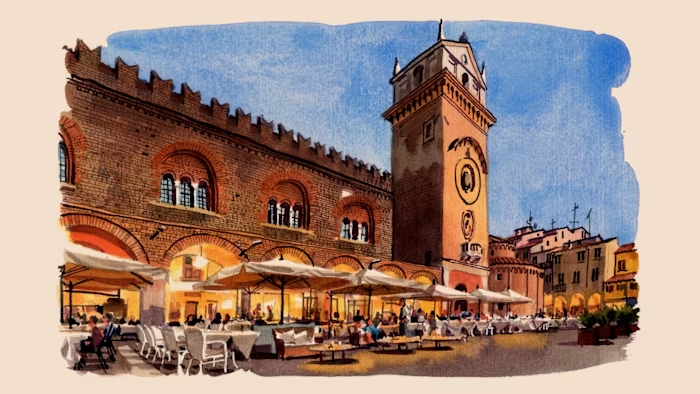
“It’s like a scene from Fellini, right?” says Mario Codognato as we enter Piazza Erbe, the preposterously picturesque heart of Mantua in Lombardy. The art historian guides me along the edge of the market square, which is partially covered by a loggia, where winter-clad crowds spill out of cafés and over the cobbles, drinking Aperol and lapping up early-evening gossip. It’s la dolce vita with puffer jackets.
I’m in Mantua to visit a new contemporary art museum in a very old building. Sonnabend Collection Mantova, a trove of art acquired by the late New York gallerist Ileana Sonnabend and her husband Michael, opened at the start of last month on the south-east side of the piazza. It is housed in the piano nobile of the Palazzo della Ragione, a crenellated brick-built palazzo dating from the mid-13th century that was formerly both town hall and courthouse.

Mattia Palazzi, the mayor of Mantua, calls the venture “a cornerstone for the city’s future”, hoping it might draw some of the visitors who overlook his city as they rush to Verona, Venice and Florence. But can conceptual art really reinvent a place better known for Mantegna, whose former home you can visit, and Monteverdi, who premiered his opera L’Orfeo here in 1607?
Walking in off the piazza, visitors climb a long, gentle sweep of stone steps that rise under the palazzo’s clock tower. Inside the main hall are masterpieces of American pop art by Andy Warhol, Roy Lichtenstein, Jasper Johns and Jeff Koons, as well as Italian Arte Povera works by Mario Merz and Michelangelo Pistoletto. It’s a 20th-century transatlantic showcase.
 Jeff Koons’ ‘Wild Boy and Puppy’ (1988), part of the Sonnabend Collection © Jeff Koons
 ‘Kite’ (1963) by Robert Rauschenberg . . .
  . . . and ‘Berries’ (1985) by Gilbert & George — both now on display in Mantua © Sonnabend Collection
Sonnabend was born in Bucharest and emigrated to New York in 1941 with her first husband, the suave Italian gallerist Leo Castelli. Italy threaded through her long career — she kept an apartment in Venice and was a conduit between the Italian and American avant-garde. Following her death in 2007, the collection was left to her adopted son Antonio Homem who was keen for it to be on public view. When Codognato, a family friend, heard about the empty palazzo, Homem presented the collection to Mantua on a 12-year loan.
The works have been sensitively situated by Marsilio Arte, an Italian art publisher and museum management company. Federico Fedel, the architect responsible for creating a white cube gallery within a landmark historical building, explains how he came up with the idea of “a castrum [a grid-like fortress] with five metre-high walls set at the centre of the palazzo: a sequence of masonry partitions, like the ribs of a ship’s hull”. But Fedel’s intervention also highlights the remaining fragments of original frescoes — an archipelago of details featuring knights on horseback visible alongside Koons’ puppies and Warhol’s flowers.
 ‘Ileana Sonnabend’ (1973) by Andy Warhol © The Andy Warhol Foundation for the Visual Arts
The following morning, I breakfast on sbrisolona, a crumbly peasant cake of cornmeal and almonds that is a local speciality, and have a standing espresso at a local bar, before Codognato and Fedel take me to see the Ducal Palace, the former seat of the House of Gonzaga that is currently the city’s main attraction. The princely Gonzaga dynasty turned Mantua into a political and religious dynamo between the 14th and 18th centuries and the scale of their palace is staggering — there are some 1,000 rooms — as is the fact that it is virtually empty of other visitors. I don’t find augmented reality iPad guides, but I do discover some eccentric remnants of the Gonzagas’ time: falconry hoods, disintegrating slippers, a stuffed alligator.
The highlight is the frescoed wedding chamber by Andrea Mantegna. The court painter was a maestro at detailing dogs, and here his grey hunting hounds lurk on the walls like mafia heavies, upstaging their noble masters. The grand interiors and Mantegna’s revolutionary perspectives provide interesting counterpoints to the “palazzo of pop art” in the piazza: two vastly different creative visions, separated by half a millennium and a short walk through a side street.
 Treasures in the Ducal Palace include the Renaissance Polyptych of St Anne of Koper altarpiece . . . © Alamy
 . . . and Andrea Mantegna’s ‘Suite of Cardinal Francesco’ (detail shown above) © Alamy
 Piazza Sordello, seen from the arcade of the Ducal Palace © Alamy
The arrival of the Sonnabend Collection is “a decisive leap forward in how the city presents itself to the world, from a Renaissance capital of culture to a city able to engage in dialogue with the contemporary”, says mayor Palazzi, who meets me for lunch in Cento Rampini, a trattoria on the ground floor of Palazzo della Ragione. The restaurant, I’m told, is a favourite with locals (and my chicken with artichokes, a regional favourite, is rustic perfection).
Mantua has a lot of competition, says Palazzi. It is not on the tourist tick-list, like Rome, Venice and the Amalfi coast. Nor does it get the crowds that nearby Verona draws (largely on the promise of peering up at Juliet’s fictional balcony). The hope is that contemporary art, along with literary and music festivals, will entice a younger crowd than those interested in the Middle Ages and Renaissance.
After lunch, I walk the city. Its medieval heart is veiled in the nebbia, the soft mist that consumes much of northern Italy in the winter. At this time of year, one views Mantua as if through tracing paper. Curious architectural details appear, ghostlike, out of the fog, reminders of times past: a section of mosaicked Roman pavement, a 15th-century portico, an iron neo-gothic newspaper kiosk from the 1920s.
 The clock tower at the Palazzo della Ragione
The next day, bolstered by panettone and more coffee, I peruse the berrettos and Borsalino fedoras at Antica Cappelleria Tragni, Mantua’s oldest hat shop, established in 1904. After cakes and frescoes, hats are Lombardy’s other great forte. “Ours is a family shop for many generations and many like this in the town have now closed,” says Ilaria Tallarico, the daughter of the current proprietors, who helps out during the colder months when hats are popular. The opening of the Sonnabend Collection is a hopeful sign, she notes.
Before driving back to Verona airport, I return to Palazzo della Ragione and climb its 15th-century clock tower. The mechanism for its complex astronomical clock looks as unremarkable as a piece of old farm machinery. However, the view from the top is spectacular. I look down over the locals dotting their way around the market, from cheese stalls to cashmere stands. It really is like watching one of Fellini’s sweeping aerial shots.
Details
Christian House was a guest of Marsilio Arte (marsilioarte.it) and stayed at Grand Hotel San Lorenzo (schiavonhotels.it; doubles from about €120). Sonnabend Collection Mantova (sonnabendmantova.it) is open daily except Tuesdays; tickets cost from €10
Find out about our latest stories first — follow FT Weekend on Instagram, Bluesky and X, and sign up to receive the FT Weekend newsletter every Saturday morning