
According to a document from the International Energy Agency in June last year, China is the leading refiner for 19 out of 20 important strategic minerals, with a reported market share of 70%.
In October, Australia and the United States agreed to their own “critical minerals framework”, also said to be non-binding, described by Australian Prime Minister Anthony Albanese’s government as delivering a “secured supply chain for critical minerals and rare earths, required for defence and other advanced technologies”.
“The historic framework signed today will assist both countries in achieving resilience and security of critical minerals and rare earths supply chains, including mining, separation, and processing, through use of economic policy tools and coordinated investment,” an Australian government press release said.
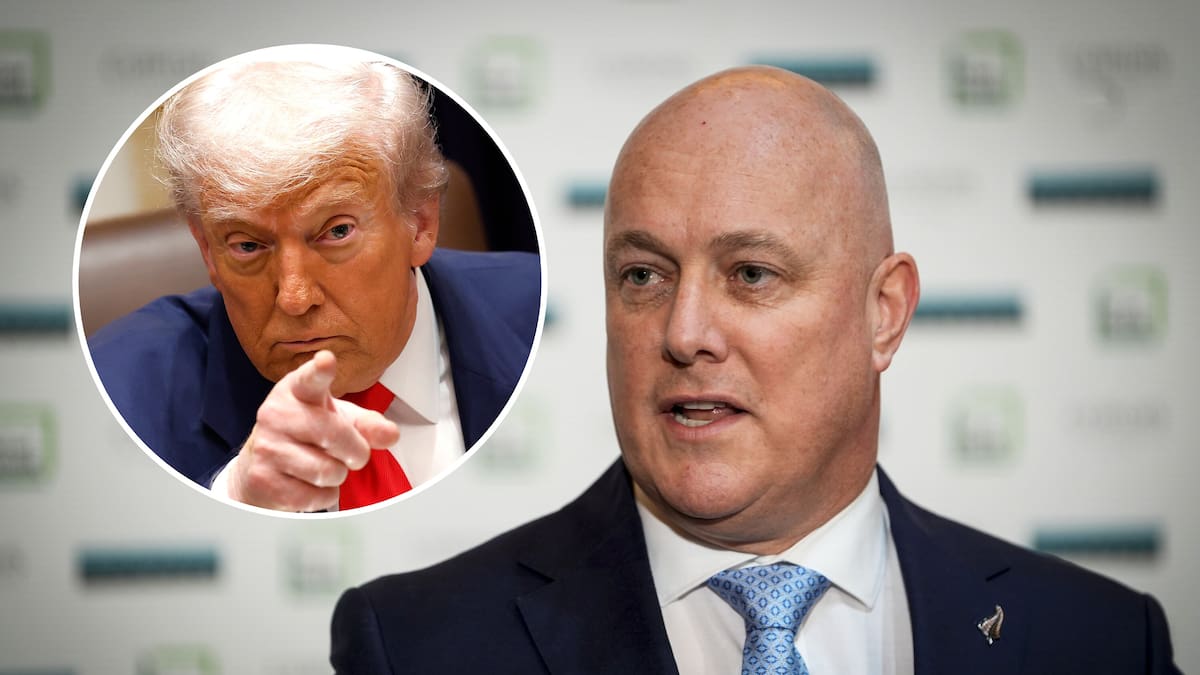
Prime Minister Christopher Luxon met with US President Donald Trump on the sidelines of Apec last year. Photo / Pool
Jane Kelsey, an Emeritus Professor of Law at the University of Auckland, earlier this month wrote that the Australian framework would likely be the template for further US negotiations on critical minerals.
The Australian framework includes identifying “projects of interest to address gaps in priority supply chains”, working “together to develop new or bespoke mechanisms to strengthen critical minerals and rare earths supply chains” and “taking measures to accelerate, streamline or deregulate permitting timelines and processes”.
Trump this month issued a proclamation stating his Commerce Secretary Howard Lutnick had found processed critical minerals and their derivative products (PCMDPs) to be “essential to the national security of the United States”.
“PCMDPs are indispensable to almost every industry, including national defence programmes and critical infrastructure. PCMDPs are embedded across defence and commercial supply chains and play an essential role in the production of advanced weapons systems, energy infrastructure and everyday consumer goods.”
It was also found that the “United States is too reliant on foreign sources of PCMDPs, lacks access to a sufficiently secure and reliable supply chain to PCMDPs, is experiencing unsustainable price volatility with respect to critical mineral markets, and is suffering from weakened domestic manufacturing and production capacity of PCMDPs”.
This was described as a “significant national security vulnerability”, with the US lacking “access to a sufficiently secure and reliable supply chain for PCMDPs”.
That led Trump to direct his team “to enter into negotiations with trading partners to adjust the imports of PCMDPs so that such imports will not threaten to impair the national security of the United States”.
Lutnick also said that “it may be appropriate to impose import restrictions, such as tariffs, if satisfactory agreements are not reached in a timely manner”.
Professor Jane Kelsey has written about the potential consequences of Donald Trump’s proclamation. Photo / Mark Mitchell
In her piece, Kelsey said New Zealanders had “heard nothing from the government about any demands from the Trump administration, and it is following a softly-softly foreign policy approach to the US”.
“But if New Zealand is a target of the latest Trump directive, there needs to be a full discussion about the implications – before, not after the fact.”
A memorandum filed to the Waitangi Tribunal on Tuesday said any such negotiations between New Zealand and the US would be relevant to the tribunal’s Climate Change Priority inquiry.
The claimants raised concerns an agreement could “be finalised and signed without Māori, or anyone else in Aotearoa, being aware” and may ”breach the principles of rangatiratanga and kāwanatanga”.
They sought the tribunal “to seek information urgently from the Crown to establish whether the United States government has sought such an agreement and if so, the process for its development, the likely content, the role of Māori in that process, and the protections for Māori responsibilities, duties and interests and the Crown’s obligations under Te Tiriti o Waitangi”.
New Zealand has a Minerals Strategy, which aims to double our exports to $3 billion by 2035. That is accompanied by a Critical Minerals List, which includes 37 minerals said to be “vital to the economy and susceptible to supply chain risks”.
Foreign Affairs Minister Winston Peters last year said New Zealand had joined the international Minerals Security Partnership “to attract investment in our critical mineral sector”.
It’s a multilateral group which includes countries like Australia, Canada, France, Japan, the UK, the US and the European Union.
The US Department of State says it aims to “accelerate the development of diverse and sustainable critical energy minerals supply chains through working with host governments and industry to facilitate targeted financial and diplomatic support for strategic projects along the value chain”.
Winston Peters and Shane Jones have spoken about the mineral strategy. Photo / Mark Mitchell
Access to critical minerals, which can include the likes of lithium, nickel, cobalt and copper, has become increasingly geopolitically important. Not only are they necessary for many energy technologies, but they are also used in defence and security equipment.
Last year, Beijing moved to impose export controls on some rare earth minerals, angering the US President, who threatened additional tariffs on China. The impasse was eventually broken during a face-to-face between Trump and Chinese President Xi Jinping on the sidelines of Apec in South Korea in October.
Jamie Ensor is the NZ Herald’s chief political reporter, based in the press gallery at Parliament. He was previously a TV reporter and digital producer in the Newshub press gallery office. He was a finalist in 2025 for Political Journalist of the Year at the Voyager Media Awards.