
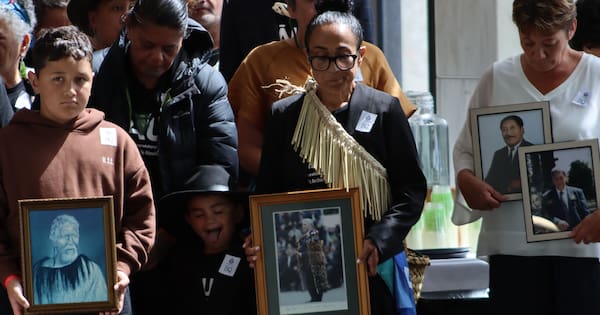
Emotion ran high at Parliament on Thursday as central North Island iwi Ngāti Hāua watched their Treaty settlement pass its final reading, closing a nine-year chapter in their fight for recognition and redress.
By Moana Ellis of Local Democracy Reporting
For Ngāti Hāua, it was a day decades in the making. Nearly 200 iwi members were in the House as their Treaty settlement, Te Pua o te Riri Kore, was formally enacted into law.
The legislation marked the culmination of negotiations over redress for historical breaches of Te Tiriti o Waitangi.
Outside Parliament, Ngāti Hāua Iwi Trust chair Graham “Tinka” Bell said he was emotional and happy.
“The biggest thing for me, understanding law, is that we will have legal muscle. Mā te ture te ture e patu. Only the law can defeat the law.
“So, I’m exhilarated. I’m really happy for our families. I’m thrilled to bits and I’m thinking of our tūpuna and all those who fought to get us here.”
Deputy chair and WAI claimant Lois Tutemahurangi said she was “absolutely ecstatic we’ve finally got here”.
“And I’m feeling happy that so many of our iwi have turned out to tautoko our kaupapa.”
Treaty of Waitangi Negotiations Minister Paul Goldsmith said it was a significant day for both the Crown and Ngāti Hāua.
“Through this settlement the Crown acknowledges its historical breaches of the Treaty, returns 64 culturally significant sites, and provides $19 million of financial redress.
“The legislation also provides statutory pardons for Te Rangiātea and Mātene Ruta Te Whareaitu, who were tried under martial law in 1846, meaning they were deprived of protections that would have been their right at a civilian trial.
“These pardons remove their convictions, recognise their mana and honour their legacy within Ngāti Hāua for future generations.”
Goldsmith said recognising this history was vital to restoring the relationship with Ngāti Hāua.
“The redress provided by the Crown will contribute to the economic, social and cultural wellbeing of Ngāti Hāua for future generations,” he said.
“It was a privilege to welcome Ngāti Hāua back into the House … and to share this moment as we look toward a future shaped by a strengthened relationship.”
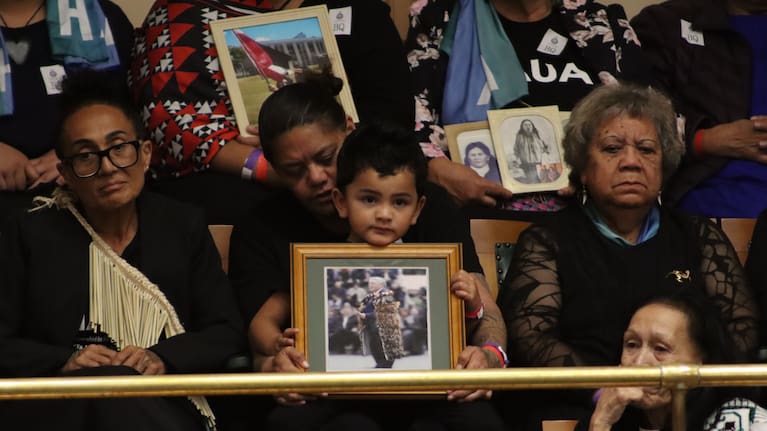
Ngāti Hāua, centred in Taumarunui, has about 2500 members.
On the steps of Parliament, pou tiriti/treaty negotiations manager Aaron Rice-Edwards said his feelings were mixed.
“Most people get to this stage and feel mixed emotions. It’s been a hard road for our people and we’ve lost a lot of our good leaders on the way. But yes, [it’s] a celebration to get this important milestone.
“There’s a lot in there. We packed in there as much as we could for our people. But the work’s not done yet. This is really just the start of the next part of the journey – and looking forward to that.
“We’re turning the kei (stern) of our waka to our future and start imagining what that looks like now we’ve got some resources and some access to our whenua again.”
Te Pou Tupua of Te Awa Tupua and iwi historian Turama Hawira also reflected on mixed emotions.
“Today is a day to celebrate but I’m thinking about the old people. Most of all it’s a day to remember those who paved the pathway and paid the ultimate, and honour them.
“But kua kōrero te kōrero. Ahakoa te aha, me pai te kore ki te korekore rawa. [The story has been told. No matter what, it’s better to have nothing than nothing at all.]”
Trustee Joey Allen said the settlement marked a major moment for the iwi.
“All the mahi that’s been done over the years since I was little, this is what it’s all about: getting our settlement, getting over the line. E tū ngā hapū ngā iwi o Ngāti Hāua.”
Trustee Louise Wahapa said she felt both sadness and excitement.
“I’m looking forward to going back to our marae and strengthening our hapū.”
Iwi members said they were pleased to be in Wellington to witness the moment.
“I’m feeling awesome today,” Willie Huch said. “It’s a powerful day to be Ngāti Hāua.”
His sister Moira said: “I’m very happy to be here and glad that it’s done. Mauri ora, whānau.”
Mitch Roderick-Hall said she was proud.
“I’m really proud for our mokopuna and our people who waited a long time for this to happen. I miss our Nan, miss our old people but kei konei mātou hei whawhai tonu ake [we are here to fight on].”
A copy of Te Pua o Te Riri Kore, the Ngāti Hāua Deed of Settlement, is available online by searching for: Te Tari Whakatau – Ngāti Hāua.
– LDR is local body journalism co-funded by RNZ and NZ On Air