
It was a week for parliament to say hello, and others to say goodbye.
It was a summer which hardly felt like a break from the bullshit. Early election day excitement was drowned out by severe weather events; Labour tried to Mamdani-fy itself and lost one of its own; two polls arrived, and a mighty totara decided it was her time to fall. And it’s only just the first week of parliament.
That mad rush was felt on Tuesday as politicians filed to caucus meetings before ministers headed to cabinet, then the Beehive theatrette (of 1pm Covid conference fame) where Luxon announced a $1.2m fund for flood resilience. Then, it was time to take business to the House, with the first order being a cross-party acknowledgement of the loss of life from the landslide in Mount Maunganui.
Afterwards, Christopher Luxon gave his start of year address. In an election year, the prime minister’s statement can provide a window into the big issues which will rule the general election campaign trail. And for the government, these were the National Party classic hits: economic recovery, education, getting tough on crime and housing and infrastructure.

After the prime minister’s statement is delivered, the House spends 13 hours debating said statement. It’s how parliament has operated for ages, so hypothetically, the opposition could’ve spent their whole summer break writing their rebuttals. Labour leader Chris Hipkins obviously didn’t, because the best line he could come up with was that House must have turned into a laundromat “such was the level of spin and dirty laundry in the corner”.
Onto Green Party leader Chlöe Swarbrick, whose Shakespearean-style ode to those who get jumpscares from Luxon and live in slug-infested homes only earned her grief from the government side. Swarbrick’s speech had Act Party leader David Seymour, for once, trying to imagine how someone else feels. “You can imagine the disappointment of Chris Hipkins back in his office thinking, ‘Oh man, I’m trying to climb Mt Everest, and [Swarbrick] is my Tenzing,’” Seymour told the House.
When it came to Winston Peters’, he was less sharp speaking on his own than he was spraying digs at Swarbrick from across the aisle. In a progressively more grumbly, mumbly old man voice, Peters lamented the “amateur-hour people” in the Labour Party, the “tradies-on-push-bikes” in the Greens and the “show ponies in the Māori Party”.
“Hear, hear!” cried Shane Jones, caught in a daze of smitten ecstasy. “Hear, hear, hear, hear!”
By Wednesday, only one word was on the parliament hivemind: Crusher. Defence minister Judith Collins – who had evaded journalists on Tuesday – made a midday announcement that she was resigning. The out-going minister for everything leaves about 100 empty portfolios in her wake – a nice chance for someone like, say, National MP Chris Penk, to be promoted from minister outside to minister inside cabinet.
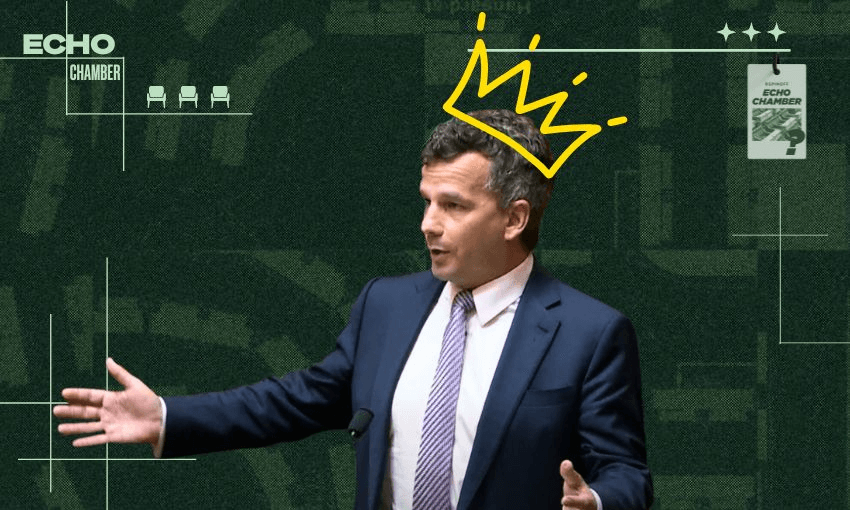
During Wednesday’s question time, Seymour proved no matter the quality of education you receive, anyone can make mistakes. Responding to a patsy by Act MP Laura McClure on the success of his charter schools, Seymour read aloud a letter from a parent whose son, thanks to his Auckland-based charter school, was bursting with newfound knowledge – namely, about Mozart and King Charles V.
“Point of order, Mr Speaker,” Hipkins cried, lifting himself from his throne. “The member may have misspoken, but given that he’s speaking to our head of state, I think maybe he may wish to correct himself.” The court jester forgot that his big boss’s name is King Charles III, not V!
It was an easy gotcha, but the speaker was feeling generous. “[Seymour] also mentioned Mozart, of course, so perhaps there was a European King Charles – which there has been – which the member himself is not aware of,” Brownlee said. Unfortunately, the speaker is right – Charles V was a Holy Roman Emperor.
Before the dinner break, the House farewelled one of the fold. Labour MP Adrian Rurawhe, former electorate MP for Te Tai Hauāuru, delivered his valedictory ahead of leaving parliament after Waitangi Day. Rurawhe recalled his journey as assistant speaker of the House, wrangling points of order from Jami-Lee Ross and Ian Lees-Galloway, and the shift in vying for the title of minister to taking on the role of speaker in 2022.
“I pinch myself almost every day and, you know, wonder how this guy from Rātana Pā gets to be the speaker of this House,” Rurawhe said.
When question time came around on Thursday, there was one star of the show: Seymour. Standing in as acting prime minister, associate finance minister and associated education minister, it was his interjections during Greens MP Tamatha Paul’s question to social housing minister Tama Potaka which created the most tension in the House.
In quoting the MP for Epsom’s concerns that housing intensification can’t come at the expense of “looking into everyone’s backyards and their swing sets and their pools”, Seymour challenged Paul to set the facts straight. What he really said was that Aucklanders would be keen on a bit of intensification, but they have their hang ups, “such as not having people looking in their swing sets or backyards”. It was the world’s hardest round of spot the difference.
So, there were some struggles as Paul was asked to rephrase her question. She leaned on the question of “what’s more embarrassing: having cabinet overrule his recommendations … or the prime minister making him weaken Auckland’s housing targets altogether?” This only gave the government more ammunition. “I am not a judicial officer on embarrassment,” Potaka told her.
“Would the minister consider it more embarrassing to mindlessly read questions off a script or not be able to mindlessly read the questions off a script?” Seymour asked, having just read a script sent to him by education minister Erica Stanford a few questions earlier.
“Not as embarrassing as King Charles the fifth,” Paul retorted.
Afterwards, a final reading of Ngāti Hauā Claims Settlement Bill took place, with iwi members lining the seats of the public gallery, alongside framed photos of their tūpuna. The settlement – nearly a decade in the making – will see $20.4m in financial redress, $6m for cultural revitalisation, the pardoning of two tūpuna and the return of 64 culturally significant sites.
A speech by Greens MP Steve Abel traversed the “wicked acts of colonisation” (this made Goldsmith laugh), which led to the settlement. He focussed on “the character of colonisation that Hauā were subjected to” – Edward Gibbon Wakefield of the New Zealand Company, a “self-interested capitalist exploiter”. “Frankly, he’s a scumbag,” Abel told the House.
Te Pāti Māori co-leader Debbie Ngarewa-Packer, MP for Te Tai Hauāuru (where Ngāti Hauā is based), challenged Treaty settlement minister Paul Goldsmith’s description of the “misdeeds” made by the Crown against Ngāti Hauā. “Cheating in a test is a misdeed and stealing is a misdeed,” Ngarewa-Packer said. “But having a deliberate campaign that targeted the tangata whenua here in Aotearoa is anything but a misdeed.”
The waiata which echoed through the House was dampened with a few tears. It’s always a treat when parliament ends the week by passing a Treaty settlement – a reminder that despite all the bullshit, some progress happens in this place, every now and then.