
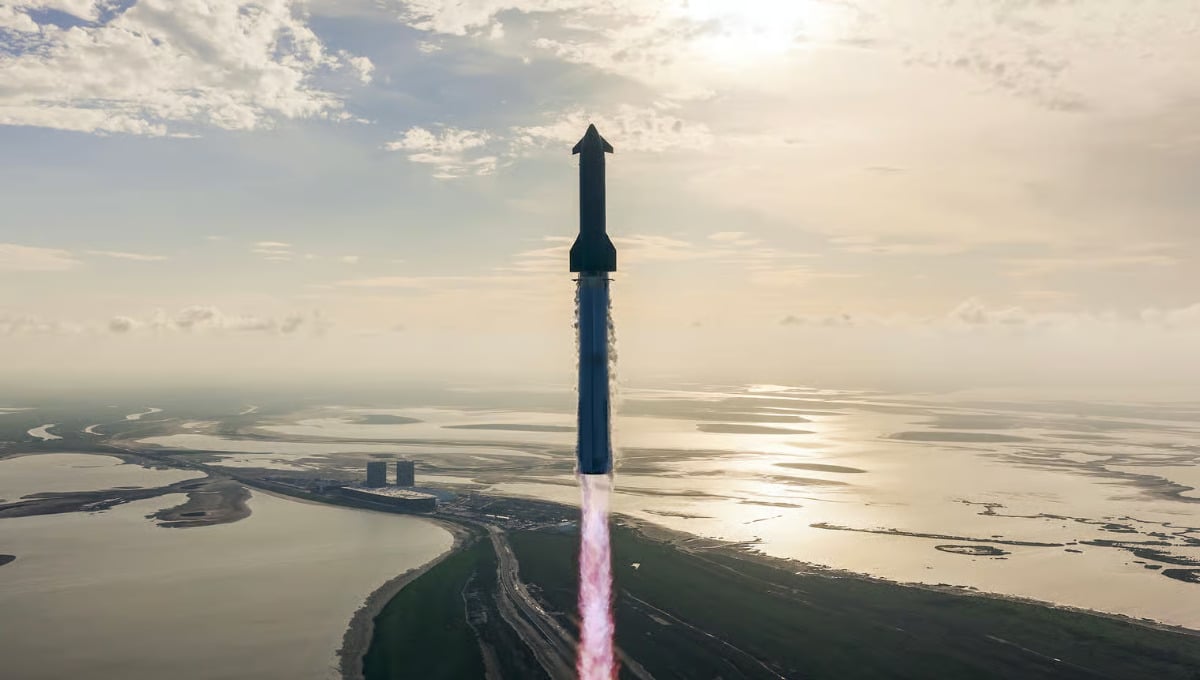
In a breathtaking display, SpaceX hit multiple high-stakes goals during the latest test flight of its Starship rocket. From pinpoint trajectory control to a bold Raptor engine relight, every stage delivered. The mission also saw the successful deployment of eight next-gen Starlink satellite simulators—and pushed the rocket to its limits to trial its structure and thermal protection systems.
After a string of concerning failures, this tenth flight marked a major turning point, perfectly embodying SpaceX’s belief that “failing fast means learning fast.” The success reflects real progress in developing the company’s mega-launcher, even as some daunting technical challenges remain.
The launch took place in the early hours of Wednesday and hit a long checklist of objectives.
Splashdown confirmed! Congratulations to the entire SpaceX team on an exciting tenth flight test of Starship! pic.twitter.com/5sbSPBRJBP
— SpaceX (@SpaceX) August 27, 2025
All 33 Raptor engines roared to life—only one failed and shut down. After separation, the Super Heavy booster made a controlled descent and splashdown in the Gulf of Mexico.
During its return, engineers tested several burns, including a crucial “boostback” maneuver. This allows the booster to reverse course after separation, cutting down fuel needed for the return trip. That saved fuel can then be redirected to ascent—meaning more payload and more efficiency.
Major progress takes shape
As for the upper stage—the one destined to carry people and cargo—it flew cleanly this time. No explosions. No catastrophic failures. That’s a big deal, given earlier flights ended in total loss. SpaceX had never been able to gather data from controlled reentries—until now. This mission delivered critical insight for the teams working to move Starship forward.
Open the pod bay door, HAL
Starship deploying @Starlink simulator sats pic.twitter.com/3CSOyulzcJ
— SpaceX (@SpaceX) August 26, 2025
Mission goals were checked off one by one: Starship maintained stable flight and attitude, a Raptor engine fired back up for two seconds mid-flight, and all eight Starlink satellite simulators were deployed. One of the simulators was accidentally knocked during its release, but thankfully it caused no issues.
Reentry also went well—despite losing a few heat shield tiles and taking some damage to one of the flaps. It’s worth noting the mission was designed to deliberately test the rear flaps under extreme conditions. That kind of stress test is key for improving the rocket’s design before it carries actual missions.
Live views brought to you by @Starlink pic.twitter.com/3yVzQrMZBz
— SpaceX (@SpaceX) August 27, 2025
Thermal protection under pressure
This flight gave Starship’s heat shield its toughest challenge yet. Engineers had purposely removed tiles from certain areas to see how vulnerable they were during reentry. Several new protection systems were trialled, including metallic tiles—some with active cooling—to better handle atmospheric heat.
They also revisited “hot spots” spotted during the sixth test flight, running diagnostics to correct those issues. Developing a reusable and effective heat shield remains one of the toughest engineering problems SpaceX faces.
Elon Musk has pointed out that back in the shuttle era, heat shields took months to refurbish between flights. But SpaceX is aiming for something entirely different: a quick check and minor reset, all within a few hours—ready to fly again.
One critical step still ahead? In-orbit refueling. It hasn’t been tested yet, but it’s a make-or-break requirement for future long-distance space missions.
Liftoff of Starship! pic.twitter.com/d6d2hHgMa0
— SpaceX (@SpaceX) August 26, 2025
This flight was the second-to-last for the Block 2 version. Just two or three more are expected before the year wraps up.
A promising test flight, with big lessons ahead
Flight number ten delivered the goods—key data, proven capabilities, and a clear reminder: innovation never comes easy.
Yes, it was a leap forward. But there’s still a steep climb ahead, especially when it comes to reliability.
SpaceX is clearly playing the long game, with each test flight expected to teach vital lessons for future launches.
Their bold goal? Get two Americans back on the Moon before 2027. And that means every flight—win or fail—must bring them closer.

Rémy Decourt
Journalist
Born shortly after Neil Armstrong’s first steps on the Moon in 1969, my journey into space exploration has been entirely self-taught. A military stay in Mururoa sparked my formal education in space sciences, and early sky-watching experiences in an astronomy club ignited my passion. I founded flashespace.com, transitioning from sky observation to a deep interest in space missions, satellites, and human and robotic exploration. Since 2010, I’ve been part of Futura’s editorial team, covering space news and working as a freelance writer with extensive international field experience in space-related sites.
