
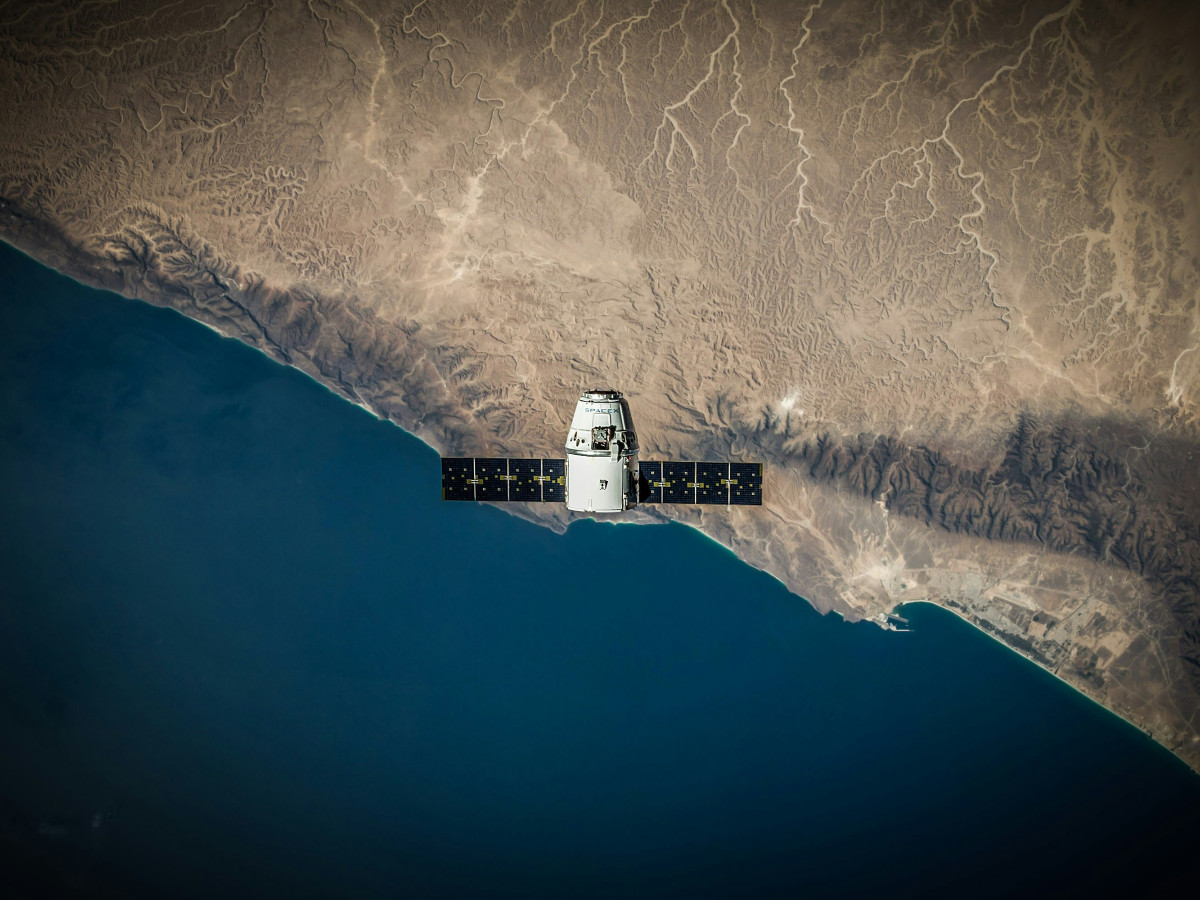
SpaceX has carried out its latest launch of Starlink satellites, adding to a network that already numbers in the thousands and provides internet coverage across much of the world. Supporters say it’s transforming connectivity, particularly in remote areas. But critics warn of congestion in Earth’s orbit, and the impact on astronomical research. Robert Massey at the Royal Astronomical Society has been telling Chris Smith why it matters to all of us…
Robert – Starlink is a so-called constellation of satellites working together, in this case eventually tens of thousands that are designed primarily to deliver internet access to the surface of the earth and you know the premise of the company is to do that to remote areas that wouldn’t be able to get it through ground-based links, although actually also in places that have those links.
Chris – And that aspiration to take the internet to remote areas, is that being delivered? As in, is the mesh in this constellation comprehensive around the earth or does it dwell in certain hotspots only?
Robert – The distribution of satellites, from what I can tell, is pretty global, because obviously if you put satellites into orbit you can cover the surface of the earth fairly quickly, the more of them you have as well. It can’t be long before they reach the 10,000 number that have been deployed. The challenge I think to the kind of model that SpaceX have is that it was sort of being rolled out as a way of reaching places in sub-Saharan Africa and so on, and of course whilst that’s technically possible, you actually need the money to buy the equipment and when you look at the kind of income levels in middle-income countries it’s going to be an expensive ask. So I’m not really convinced it’s got that impact, it’s much more about affluent consumers in the west who happen to live in remote areas.
Chris – If they’ve got 10,000 satellites already and this is just one entity and you think we didn’t even have that many satellites in total a few years ago, why do they need more?
Robert – You’re quite right to point to that step change. There’s been a huge paradigm shift. If you look back to 2019, just before the first Starlink satellites launched, there were a couple of thousand operational satellites in orbit around the Earth. We’ve now gone to a five-fold increase in a few years and that shows no signs of slowing down, because it isn’t just SpaceX that are doing this, there are other companies as well. Amazon Leo system, Guowang in China and so on are all examples of companies that are looking to get in on this and different countries have interest, the European Union has an interest too. It is nothing less than a change in the way we use low-Earth orbit and that brings additional challenges. This is going to lead to congestion, the risk of collisions is much higher unless there is some really very good avoidance mechanisms in place to stop that, and then there’s the impact on astronomy too.
Chris – But why so many? Is this just about maximising the quality of a service? Is it resilience? I mean what’s their stated aim and how many satellites are they going to go to in total?
Robert – The licences and the plans for Starlink appear to indicate they’re heading towards the number of around 40,000 if they want to. There is a bit of land grabbing in this in the sense that if you file for a licence with the Federal Communications Commission which is the body that Starlink uses and many companies use because they’re launching from US soil they need to do that, then they will be aiming to kind of grab an orbital shell almost like staking a claim like a pioneer staking the claim in the American analogy in the West and thereby you deny your competitors access. Whether or not you go on to deploy that money is another question but certainly the plans seem to go up to that level and the more of them you have I guess the higher your bandwidth the more customers you can connect to.
Chris – I must admit that when I’ve been gazing at the night sky in the last couple of years where seeing a satellite was a rarity – in my youth I remember doing the same thing – you’d occasionally see something, and you’d go hey look I’ve seen a satellite. Now, it’s to a penny every few seconds you can spot one. What is going to be the impact on our view of the night sky?
Robert – This is a critical concern for the Royal Astronomical Society, the organisation I’m Deputy Director of, and also astronomers around the world. What’s happening, as you rightly point out, you see satellites all the time now, so if you pick up a pair of binoculars and you look at something in the sky it’s very, very likely a satellite or two will cross through the field. If you’re an astrophotographer and you take an image of the sky or an object in the sky, it’s very, very likely you’ll get satellites crossing the field and that’s simply because there are so many more now and they are bright enough, they’re in low-Earth orbit, that they’re visible. It’s particularly bad in dark sky places. I don’t think you notice it as much in cities because you’ve got light polluted skies, it’s harder to see fainter things, but if you’re in dark sky places and you look up at on a moonless night with a milky way stretching across the sky – let’s imagine all these wonderful late summer evenings when that’s possible – you do sort of get this crisscross effect. You look and you think there’s a satellite, there’s a satellite, there’s a satellite, and I suppose people would look at that and say oh well it’s a trade-off between that and the internet and I understand that point, but then I would say look the sky is not just the domain of private corporations, that actually humanity as a whole is a stakeholder in this as well as astronomers. My argument would be that the night sky is an environment that we should protect in its visual appearance as much as we would protect landscapes on Earth, but also this is just the start of it. If you look at the plans around the world, and the number of licence applications, the number of companies that are springing up, we could be heading for say half a million satellites. Imagine moving to a world where you have half a million satellites only 50 times as many as you see now. Did we sign up for that? Did we say that we wanted the view of our night sky changed forever in this way? I don’t think we did and I think it’s entirely reasonable that groups like ours, and others around the world, are arguing in places like the United Nations and arguing with the EU, which has actually been quite receptive, and other bodies to say hang on a minute you know this is something we need to protect when you think about this. It’s damaging the science of astronomy because if you’re trying to take images particularly of what are called transient phenomena, whereby things vary over time, if a satellite happens to go through the field and go in front of that object at the time it’s varying in a critical point, you don’t get it back. You can’t go back to it and say to a cascademic variable or to a nova or something, “please be at exactly that point in your cycle again so we can do the image again.” That data is then lost. It may have an impact on things like the detection of near-Earth objects that we obviously want to be aware of in case they’re coming towards the Earth. All those kind of things are critical applications and we argue that they shouldn’t be compromised, that actually, the satellite operators even if we accept they need that many, and I’m not entirely sure I do accept it, but even if we accept, they need that many that they should adhere to standards that make them as faint as possible so they do as little damage as possible to our view of the sky and to astronomy.
Chris – So long term then, are we just basically looking at a future which is all going to be space-based observation then?
Robert – The problem with the argument that you move your observatories into space is, A, that’s obviously much more expensive. They’re much harder to maintain, and even if you do that, some of the lower ones, the ones in lower Earth orbit, for example the Hubble Space Telescope is already quite badly affected by satellites that are a bit higher up, and because they’re only a bit higher up, they’re closer to the telescope than to observers on the ground they actually appear much brighter in the field of view of Hubble, so it isn’t really a great solution actually. Unless, you imagine, I don’t know trillions and trillions being spent on putting something on the moon, but realistically we ought to be protecting the skies from the ground, and I think there’s a stronger argument or a good argument at least alongside that which is that it’s not just for professional astronomers, but for humanity as a whole. If you said to people in a century’s time you’ll have a night sky that’s full of criss-crossing streets that are incredibly bright, which I’m not necessarily saying that comes to pass, but would people sign up to that? I’m not sure that they would.