
Hiringa co-founder and chair Catherine Clennett said using a hydrogen-fuelled truck to transport the solar panels from Auckland to Ruakākā was a good example of how the project was cutting emissions even before opening and that process alone would avoid an estimated 10 tonnes of carbon.
Australian‑born and educated Clennett, whose engineering and commercial background spans the energy, resources, infrastructure and telecommunications sectors, founded Hiringa with her husband Andrew Clennett, chief technical officer Dan Kahn and head of trading and markets Matthew Carnachan.
The company positions itself as a leader in generating renewable electricity and “making, moving, storing and selling” green hydrogen for industry and transport.
Clennett said construction methods across the company’s projects were chosen to reduce embodied carbon, including cutting back on concrete and steel.
The Ruakākā project is being delivered with investment partner MyFarm, which invests across New Zealand’s rural economy. MyFarm raised $17.7 million from about 70 wholesale investors – around 90% New Zealand based – to support Hiringa’s solar-to-hydrogen farm rollout.
The two companies have entered a 10‑year agreement under which Hiringa will buy 100% of the power generated from up to five solar farms developed over the next two to three years.
MyFarm CEO Andrew Watters said the 5MW scale was chosen because it was “commercially meaningful but quick to establish”. Despite not being a fast-tracked project, Ruakākā moved from concept to construction in just over 12 months – far shorter than the four to six‑year timeframe typical for large solar projects.
Watters said solar still contributed only about 1% of New Zealand’s electricity but was likely to grow to 10%, calling the industry “still quite new”. He estimated about 30,000 panels would be installed at Ruakākā, taking advantage of a 10‑fold drop in panel costs over the past decade.
Clennett said Ruakākā’s location was strategically ideal for the network. “There are a lot of heavy‑vehicle movements up into Northland and back to Auckland”.
Avoiding carbon from the outset… Panels for Hiringa’s new solar to hydrogen farm at Ruakaka arrive on a hydrogen-powered truck, the only emissions from which are water. Photo / Peter Payne
The use of hydrogen fuel added only about 1% to the overall project cost, while delivering disproportionately large emissions benefits, she said.
Low-emission freight is becoming a commercial incentive for exporters, particularly those supplying Europe, where companies must now report and reduce carbon across supply chains. Green transport corridors, she said, are moving from concept to a real, purchasable reality.
Clennett said hydrogen trucks drive almost identically to diesel models, with similar torque and handling and operational feel – the difference being that the exhaust releases only water vapour.
Heavy road transport was only the start for Hiringa, which also wants to supply fuel to the rail, aviation, and marine sectors – areas where electrification remains limited and where high‑energy‑density fuels are essential.
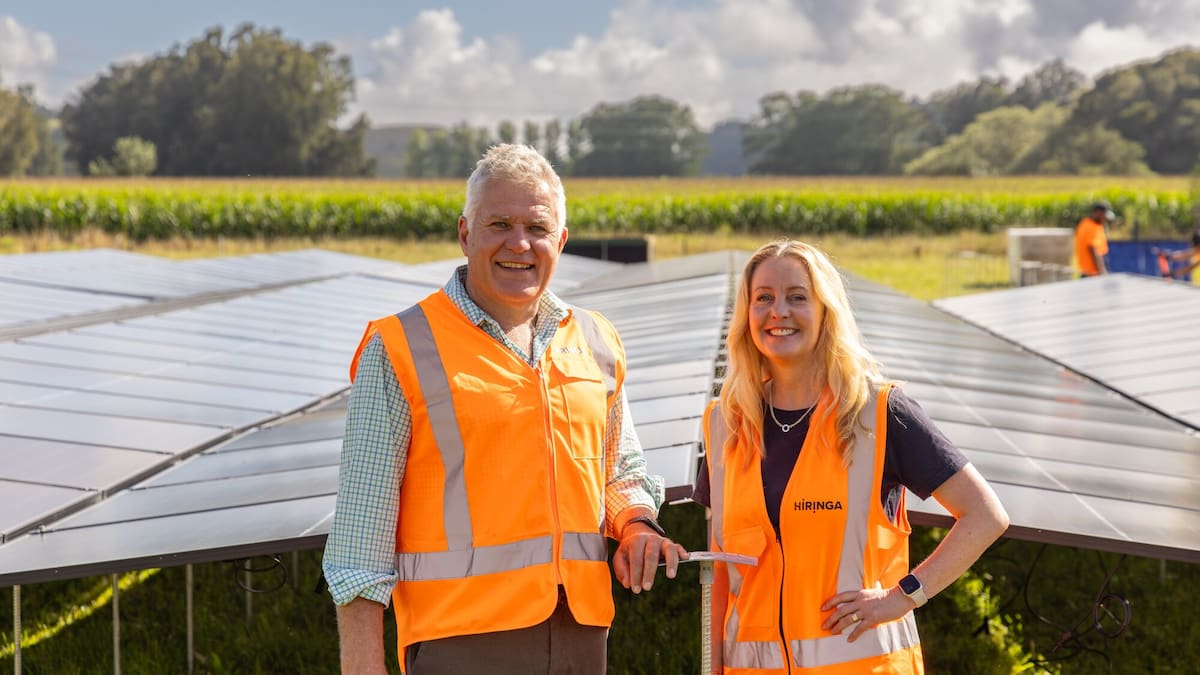
The construction of the farm is expected to employ about 50 locals. Photo / Peter Payne
Hiringa’s goals align with the Government decarbonisation policy, with ministers repeatedly highlighting hydrogen’s role in decarbonising hard‑to‑electrify sectors.
Hiringa’s $50 million investment in the refuelling stations was initially supported by a $16 million Government loan from the Covid-19 Recovery fund.
With wharf infrastructure being redeveloped at Marsden Point, Clennett said the site would be well-placed to support emerging green shipping lanes.
Clennett said construction of the Ruakākā project would generate employment for about 50 people and had created work for Patu Harakeke, Northdrill and McKay, with some ongoing roles expected once the site becomes operational.
This project met with no public opposition. Hiringa previously faced a Court of Appeal challenge by Greenpeace Aotearoa and Ngāruahine hapū to its Kāpuni wind‑to‑hydrogen project.
Sarah Curtis is a news reporter for the Northern Advocate, covering a wide range of issues. She has 20 years’ experience in journalism, mostly as a court reporter in Gisborne and on the East Coast