
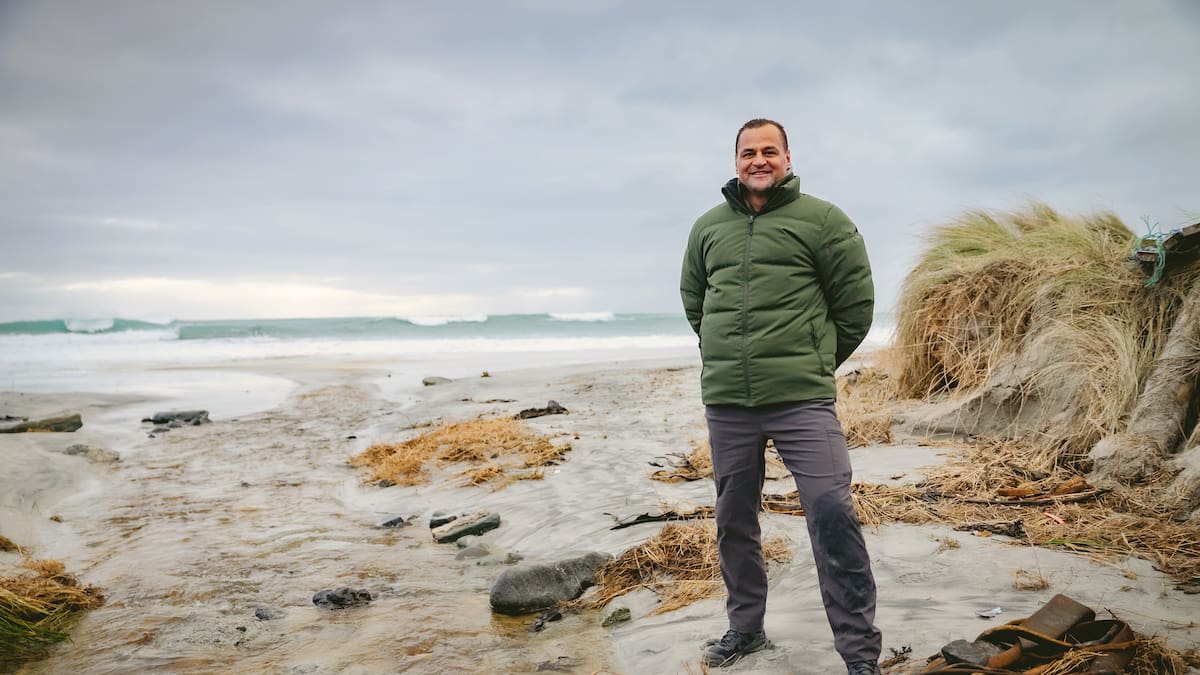
In his element: Scotty Morrison joins the dots between knowledge and environment. Photo / Supplied
When he embarked, Scotty Morrison never expected Origins, his voyage into Polynesian prehistory, to last more than one season. But his visits to Taiwan, where the Pacific migration began, and to the cradle of humanity itself in Ethiopia’s Omo Valley, revealed “so much more to do and so much more
to explore”.
A second season took the story from the far east of the Pacific to its western shores, following the kūmara’s journey from the Americas in the holds of early explorers. And now a third literally brings it all home.
Early in the first of two parts, Morrison returns to “my Hawaiki”, Raʻiātea, the island in French Polynesia where his own ancestral waka, Te Arawa, set sail for a new land to the southwest 800 years ago. But the story isn’t so much about the feats of navigation of the first people to sail to these islands – it’s what they did when they got here.
Aotearoa New Zealand’s first people found new geologies and new flora and fauna. The arrival, Morrison says, would have been like “going from the dairy to the supermarket. Holy heck, look at this, it’s flush with food sources. They must just have looked at it and thought, ‘Man, we can build things out of all of this, it’s just limitless what we can do in this land.’”
But the nature of the land, and what was food, medicine or poison had to be learnt through experiment and, as Te Arawa’s Tame Malcolm explains in the programme, systematically shared within the new population.
Morrison asks, “In the first hundred years of arrival in Aotearoa, what did they do? Where did they go? How did they find food sources? How did they work out where to stay and what were the best places for them to actually start to locate themselves?”
That knowledge was gained through a sustained burst of scientific inquiry, what we now know as mātauranga Māori.
“I hope people watching get a taste of how the knowledge system that our ancestors created connected them with their environment. How they were able to sync themselves into this new environment and then, over a couple of centuries of observation, started to place the gems of knowledge within our storytelling.”
The first occupants, as Morrison puts it in the programme, “used metaphor to cloak their knowledge in story”.
Thus, Ngāi Tahu’s legend of the chief who chased to the West Coast the taniwha that had kidnapped his wife is, functionally, a mineral map.
“Once you start to peel back the layers of those stories, you see what extraordinary minds they had, that high level of intelligence not just to understand the science of everything, but to frame it in a Māori context, in their context of the time.
“It was holistic whakapapa, not just the whakapapa that we understand today as being the recitation of names of ancestors in a direct line. As they named things, they created a spirituality around them and they created, for want of a better word, a religion around them and placed their faith and their belief into what they had created.”
In the second episode, Morrison travels to the Chatham Islands, where the remains of a waka that appears to be recorded in traditional stories as one of two that brought Moriori ancestors from the mainland, were discovered in 2024. If parts of the story of Origins would have been impossible to tell even 20 years ago, this is history as breaking news.
“We had to quickly rush back into the sound booth,” last year, he says, “and add a couple of parts in, because now they’ve been able to prove that it is the Moriori waka Rangihoua.”
This is not, Morrison hopes, the conclusion of Origins. He believes there is one more part of the story to tell.
“Right at the end of the second episode, we’ve left the door open. That first 100 years is very much about creating a new home and adapting to the new home and finding the resources and creating a knowledge system that allows them to be able to sustain themselves and live here successfully. There are continual journeys going back and forth from Aotearoa to Eastern Polynesia; they’re getting more people, they’re saying, ‘This is what we’ve found, come back with us.’
“That carries on for hundreds and hundreds of years until a point in our history where that all stops – 1500, 1600. A lot of historians have said that’s because of a big change in weather patterns and wind systems, which for 200 years means it becomes impossible for them to return home. It’s that point where they start to consolidate their areas and create tribal boundaries, and it’s there that conflict starts to arise. After living in a reasonably peaceful way for hundreds of years, they start to develop their weaponry and their expertise around warfare, to be able to defend their tribal areas that they’ve marked out.”
Although the second season of Origins is now available only on Whakaata Māori and the first currently can’t be watched anywhere, Morrison would like to see all episodes eventually collected as a historical resource for New Zealanders.
The ancestors he has followed across the Pacific and back were, says Morrison, “really extraordinary people”, and “despite the negative impacts of colonisation, it’s in our DNA to be extraordinary. I believe every Māori person can be extraordinary like our ancestors were.”
Origins screens at 7.30pm on Tuesdays on TVNZ 1 and will stream on TVNZ+.
SaveShare this article
Reminder, this is a Premium article and requires a subscription to read.
Copy LinkEmailFacebookTwitter/XLinkedInReddit