
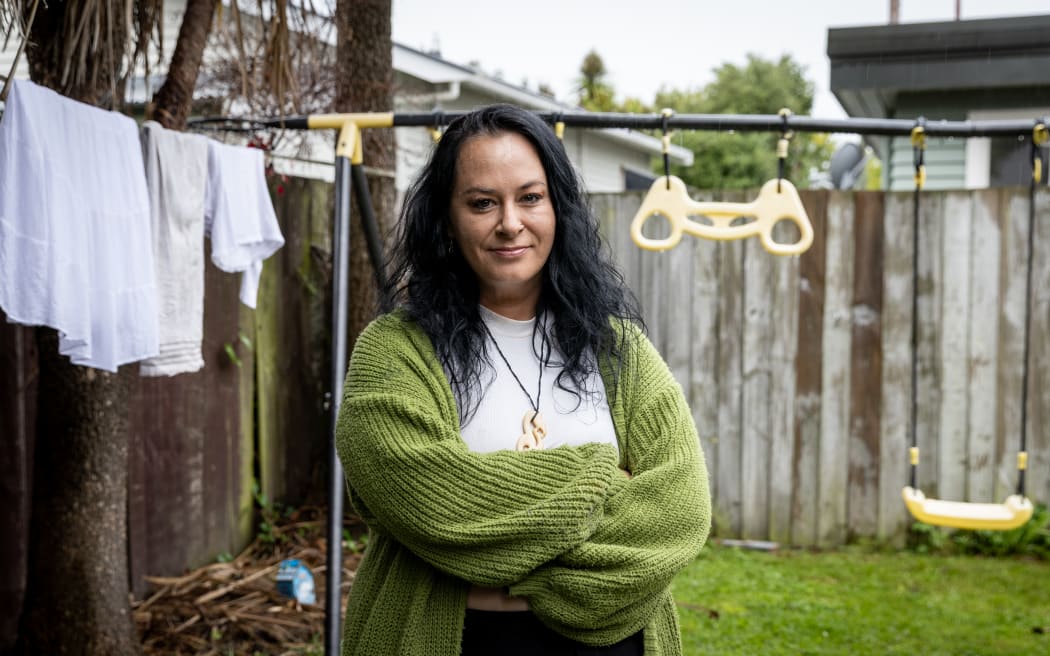
Local musician and community advocate, Rebecca Robin, said the meeting with council staff in Bromley on Tuesday night got heated.
Photo: RNZ / Nate McKinnon
A Christchurch woman says she walked out in anger more than once from a community meeting about a putrid-smelling sewage plant.
Offensive odours have plagued the city’s eastern suburbs after a fire destroyed key infrastructure at the Bromley Wastewater Plant in 2021.
But the latest stench has locals complaining of nausea and headaches – and residents have been driven indoors.
Christchurch City Council said the recent heavy rain had affected the health of the oxidation pond, and it was using all available tools to improve water quality.
The council has been approached for comment.
Local musician and community advocate, Rebecca Robin, said the meeting with council staff in Bromley on Tuesday night got heated.
She said residents felt their suffering had been dismissed, and she wanted to see the stench treated as a public health issue and for there to be on-the-ground support.
“People are angry, they’re worried about the health effects, they’re not getting any immediate relief,” Robin said.
“I’m hoping this meeting has made them want to do more of a health response for people, rather than telling them to call their GPs or nurse practitioners. They need to be out here knocking on doors and checking on people.”
Robin said while some people could escape the smell, others couldn’t, and there was a financial cost to the odour for those who could no longer hang out washing.
“People [are] going, ‘Hey, we need to go to the laundromat,’ and … I think the point they’re missing is that the laundromat costs money.
“All of those things, they add up.”
Linwood Ward councillor, Yani Johanson, who represents the Bromley suburb, was pushing for a register to record residents’ stench-related health issues, and also for free medical visits.
“Fundamentally, cost is a barrier. Why should this community, who are suffering, have to pay to go and see a doctor, when through no fault of their own, they’re getting sick?”
He said the stink was not new, but the social and well-being response had been missing for years.
Johanson believed the commitment to establish a team focussed on supporting people was a step in the right direction.
Bromley resident Ciarán Farmer, who lives about 200 metres from the wastewater treatment plant, said he had had beetles and midges all over his house as the smell had intensified.
His family had also been dealing with health problems.
“Over the past couple of months we’ve had random sinus problems, headaches, I have a constant headache. I wake up in the morning feeling sick, it’s just a never-ending queasiness. My daughter goes to bed with a bucket,” he said.
Christchurch mayor Phil Mauger said the council had heard loud and clear that it needed to support people who had been suffering from the stench from the sewage plant.
“The people that have been immediately affected have been living with this for years and they’re the ones that are paramount to look after. I fully take on the fact it causes mental anxiety, coughing and things like that,” he said.
Mauger said the council was working on setting up a team to go door knocking in the worst affected area and ask people what they needed.
“One thing that we need to be doing is maybe keeping more of an eye on it’s building, it’s a little bit bad, and go out and flag it, because otherwise we’re playing catch up ‘oh it’s smelly’,” he said.
“It’s no use doing it after the fact we’ve got to be proactive.”
The city council said replacing the fire-damaged trickling filters at the plant with an activated sludge reactor would fix the odour problems.
Work had started on a new sludge plant, with construction expected to take about three years.
Canterbury Regional Council chair Dr Deon Swiggs said the Christchurch City Council needed to take action to comply with the conditions of its resource consent.
One of the key conditions of that consent was that odour should not leave the boundary of the wastewater treatment plant, he said.
“In recent weeks, odour has very clearly been leaving the site. That triggers more directive compliance action. We now have a better understanding of what has gone wrong and are working with the City Council to get them back to compliance so residents right across Christchurch are no longer affected,” Swiggs said.
The regional council had been inundated with reports from the public. Since January 26 it had received nearly 4000 complaints, with 2500 of these from the eastern suburbs.
“That’s a significant number, and it reflects just how widespread and severe the issue is,” Swiggs said.
Swiggs said the regional council could not force the city council to shut down a major sewage plant as that would be unrealistic and have huge consequences.
“What we can do is require them to tell us how they plan to return to compliance. They must explain what they are doing, how they plan to manage the smell, and what the timelines look like,” he said.
A council information sheet given to meeting attendees included comment from National Public Health Service medical officer of health Dr Annabel Begg.
She said exposure to hydrogen sulphide odour from the plant could cause nausea, headaches, eye and throat irritation, skin irritation, sleep disturbance, and worsening asthma symptoms at relatively low concentrations.
“If people exposed to the odour don’t experience physical health effects, continued exposure to unpleasant or nasty, noxious odours can still have an adverse effect on people’s mental wellbeing,” she said.
Begg said long-term health effects were highly unlikely, but said those experiencing health issues should seek advice from their healthcare provider.
The information sheet included the details for free services – Health Improvement Practitioners, Pae Ora ki Waitaha Support, and Healthline.
The council said the recent stench was likely the result of a combination of high-levels of rain and changing wastewater loads arriving to the ponds.
It said the temporary plant had a narrow margin for error and while the ponds were showing signs of improvement, the recovery depended on algae growth.
The council said it was reviewing the data to see if factors other than weather and “high load” were factors in the stench, and was using every tool available to improve the health of the oxidation ponds, including using jetboats to increase dissolved oxygen.
It said replacing the fire-damaged trickling filters with an activated sludge reactor would fix the odour issues. The programme was expected to take three years, with commissioning targeted for 2028.
Sign up for Ngā Pitopito Kōrero, a daily newsletter curated by our editors and delivered straight to your inbox every weekday.