
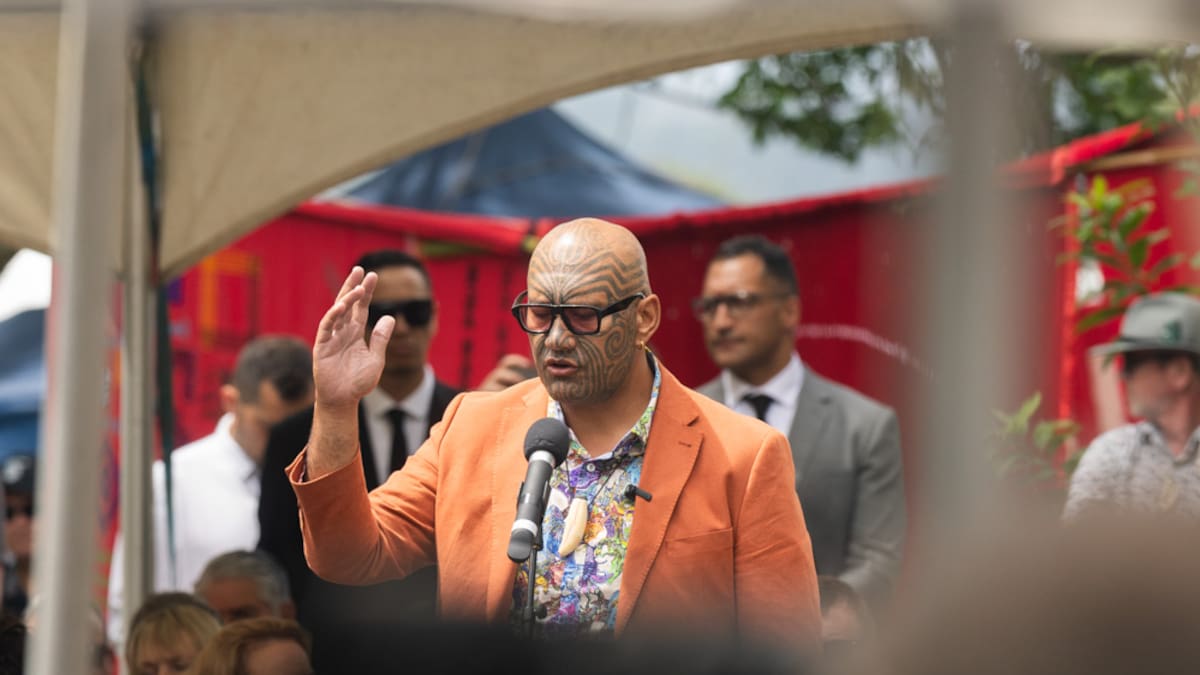
Kapa-Kingi, one of the home speakers, is as tied to the breakdown of the party as any. It was his accusations of a dictatorial leadership that thrust the party’s internal rifts into public eye.
He is also the son of Mariameno Kapa-Kingi, who won Te Tai Tokerau for Te Pāti Māori in 2023 but is now battling her party in court, awaiting the judge’s verdict on the validity of her 2025 expulsion from the party.
Eru, a lead figure in the influential Toitū Te Tiriti protest movement, used his time on the paepae to demand both Te Pāti Māori and Labour “sort yourself out”.
Eru Kapa-Kingi had sharp criticism for Te Pāti Māori and Labour. Photo / NZME
It’s likely Labour was referenced after MP Peeni Henare’s resignation, which many are speculating was caused by internal troubles, a claim the party continues to hose down.
Te Pāti Māori, namely its co-leaders and members of its executive, has maintained Eru’s broadside should have been managed internally or at least on the marae where fierce kōrero is common.
So when the 29-year-old son of a “rogue” MP who’s called Waititi a dictator told the co-leader to get his s*** together, many would’ve expected Waititi to immediately respond in kind.
Instead, Waititi thanked his party’s former vice-president. Speaking without his co-leader Debbie Ngarewa-Packer, who was with her ill husband, Waititi expressed his appreciation that Eru had raised his concerns in the appropriate setting.
“I can hear the anger and feel the pain and the courage to stand before the people to lay out what you had to say,” Waititi said, acknowledging Eru was simply “speaking on behalf of your mother”.
As he shifted on to the corrupting nature of the House, it offered the perfect opportunity to rise above the raruraru [conflict] and call for peace and a renewed commitment to replacing the coalition Government.
Rawiri Waititi was without his party co-leader, Debbie Ngarewa-Packer, at Waitangi. Photo / Jason Dorday
But no such call came. He chastised those who amplified Te Pāti Māori’s troubles publicly and declared his party will inevitably decide whether a left-leaning coalition is possible.
Perhaps realistically, he confessed, “This kotahitanga, unity, it is difficult. If it was easy, our ancestors would have accomplished it themselves.”
To conclude, Waititi and party members performed a famous Tairāwhiti haka. Kiri Tamihere-Waititi, Waititi’s wife and the daughter of party president John Tamihere, advanced toward those on the hau kāinga (the home people).
As she drew within inches of the front row where Eru was seated, Mariameno – watching from the marae’s verandah – jumped up from her chair and snapped, “hoki atu” or “go back”.
It was a moment of real tension and one which anyone without an understanding of marae tikanga might have viewed as a line crossed.
New Zealand First deputy leader Shane Jones later told the Herald Waititi-Tamihere’s actions were “totally in keeping with Māori culture”.
Shane Jones felt the conduct was well within marae tikanga. Photo / Jason Dorday
However, he noted it proved an “irreversible rupture” within the party.
Mariameno later took an opportunity to say her piece. Standing by her son, she demanded: “I am not going anywhere.”
Both the Kapa-Kingis and the party leadership are awaiting Judge Paul Radich’s decision after Monday’s court hearing in Wellington, which considered Mariameno’s challenge to her expulsion from the party alongside Te Tai Tonga MP Tākuta Ferris.
Today’s proceedings only further deepen the rift between the MP and her party. It again raises the increasingly imminent question of what happens should Radich return Mariameno to Te Pāti Māori permanently.
The party’s attempt to hold another vote on the MP’s expulsion suggests there is an appetite to try again to push her out. Its leadership will be all too aware of its obligations under the party’s constitution, which has regularly failed to pass muster under a legal microscope.
Regardless, it sets up what could be an ugly fight for Te Tai Tokerau this election if one combines Mariameno’s refusal to budge, Te Pāti Māori’s intense motivation to beat her and Labour’s commitment to win back the Māori seats. That’s even without mentioning a strong Greens contender in Huhana Lyndon.
Today’s pōwhiri gives New Zealand’s voting public as good a preview of the election campaign as they could expect.
From left: Tama Potaka, Christopher Luxon, Winston Peters and David Seymour all spoke during the pōwhiri today. Photo / Jason Dorday
Speeches from Christopher Luxon and David Seymour were tepid but relentlessly on message. Being poles apart on what comes after Act’s failed Treaty Principles Bill shapes as a key tension point that doesn’t seem likely to abate.
Winston Peters was typically provocative, declaring Waitangi celebrations should rise above performative politics before warning any doubters they’ll soon be proven wrong.
Meanwhile, Labour, the Greens and Te Pāti Māori – the two former starting the week trying to resemble unity and political consensus by excluding the latter – present as being as chaotic as the coalition they paint with the same title.
Welcome to election year 2026.
Adam Pearse is the deputy political editor and part of the NZ Herald’s press gallery team based at Parliament in Wellington. He has worked for NZME since 2018, reporting for the Northern Advocate in Whangārei and the Herald in Auckland.