

From a millennial councillor with more than 30,000 followers on their personal social media account to those who prefer to avoid it. Local Democracy Reporting asked Gisborne district councillors how they engaged with residents and whether social media was a useful tool.
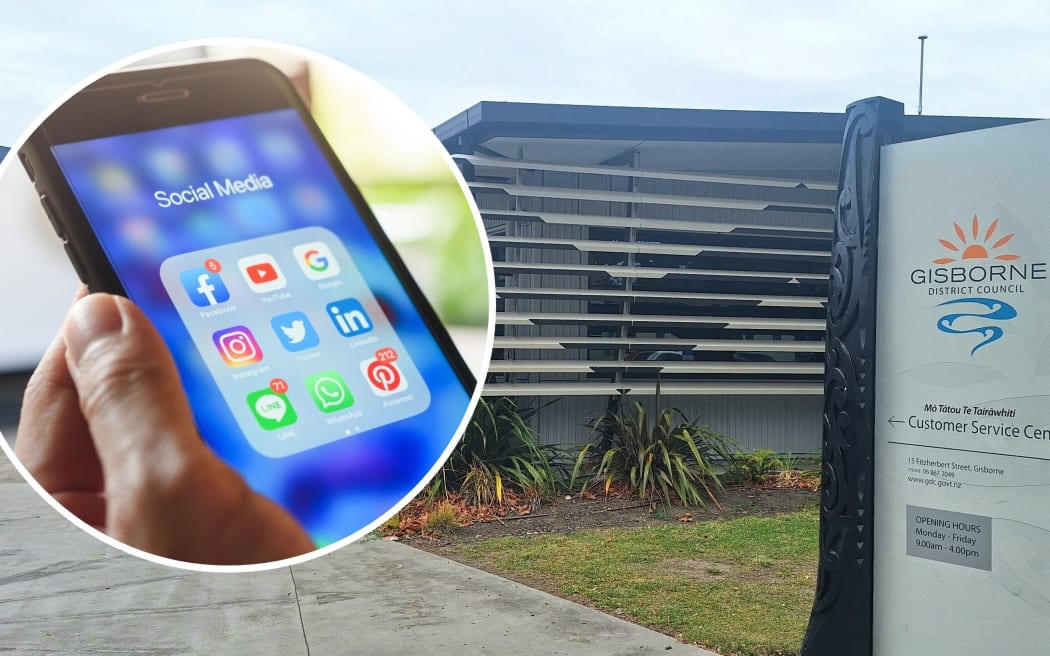
Photo: LDR / Supplied
While some elected members find social media a source of misinformation and time-consuming, others say it’s a useful way to reach residents.
A Local Government New Zealand (LGNZ) learning module on social media had been “a popular module with younger members”, an LGNZ spokesperson said.
All the councillors who responded to Local Democracy Reporting said they still interacted with the community, either in person, by email, phone or text, but social media use was far more varied.

Mayor Rehette Stoltz, 49, said there had been more interaction since the rise of social media, but she found that most meaningful engagements happened via email, phone or in person.
Social media pages, especially those without formal administration or terms of engagement, were “often sources of misinformation and any attempt to correct it is shot down”, she said.
“I am in constant contact with constituents. That is a huge part of my day, every day.

Gisborne Mayor Rehette Stoltz.
Photo: RNZ / Angus Dreaver
“I have learned over time that traditional ways of interaction – phone, email, in-person – often are the best way to share the correct information and answer questions thoroughly.”
Councillor Debbie Gregory, 59, said, in her first six years on council, when she was tagged in any social media posts, she encouraged people to email her.
“I look at agendas and choose who to contact, if required,” she said. “I have a personal policy not to comment online, after some negative experiences.
“It can be time-consuming and pointless in some cases.”
Gregory used social media as a tool to stay informed on council complaints by being a member of popular community Facebook groups.
“In many cases, it is difficult to refrain from commenting, but if I do, it can ruin a whole day.”
In recent months, Gregory had answered a few queries on Facebook, where she had all the information and was able to “put things right”, which was well received.
“I might reconsider my social media policy in the future.”
First-term councillor Samuel Gibson, 36, has more than 30,000 followers on social media, where he shares his passion for the outdoors.
It is a platform he grew before becoming a councillor. During his campaigning in the last election, he started another page to promote his council ambitions.
“It’s my most prominent tool of communication so far,” he said.
Gibson found social media “really useful” in gaining public feedback and informing residents on what was coming up in council and what he was doing.
“I do an update each week, when we are having hui.”
Most constituents were active on social media, rather than reading the council report or the council website, he said.
“I use reels as the algorithm works better this way. I sum up what’s happening in layman’s terms and it gets quite a lot of feedback.”
Quite a lot of comments thanked him “for keeping folks informed”, he said.
Depending on how councillors phrased things, it could be an issue with the Local Government Official Information Act and rules, such as being perceived to have your mind already made up before a meeting, Gibson said.
Stoltz said, before meetings, she did not use Facebook, but might be in contact with a resident, if they were interested in an upcoming issue or decision.
As the council Facebook page covered most operational issues, she did not feel the need to repost or duplicate the operational content on her ‘Mayor Rehette Stoltz’ page.
She used the page to share some engagements with constituents and tried to post once a week – “sometimes more, sometimes less”.
“I cannot share every event or interaction, as it will take me an hour or two every day to make that happen in a meaningful way.”
Her page made it clear that, if a constituent would like to discuss council issues, they could reach her on her Gisborne District Council email address or by cellphone.
“I also extend an open invitation to join me for a cuppa in my office.”
Long-term councillor Larry Foster, 72, and in his fifth term – the first from 1989 and the last four consecutively – said he did not use social media, apart from occasionally using the council Facebook page.
However, he did use WhatsApp, as councillors used it to circulate information.
LGNZ learning experience manager Tania Hawkins said social media was one of the tools councillors could use to “engage constructively and authentically” with their communities.
Councillors received guidance from an LGNZ-run learning and development programme called Ākona.
“Ākona has several sections focused on community engagement, including an ‘Ako hour’ on the safe and effective use of social media,” Hawkins said.
“This has been a popular module with younger members, especially.”
– LDR is local body journalism co-funded by RNZ and NZ On Air.