
“When I’m playing bowls, I’m not thinking about cancer,” she said.
“I’m thinking about the next shot and whether the bowl is actually going to do what I asked it to.”
A senior and representative player, Wood says bowls gives her a much-needed mental break.
“It gets me out of my own head,” she said.
“You can’t really feel sorry for yourself when you’re lining up a bowl.”
That focus on living fully underpins how she approaches her illness – and comes as new research shows outcomes for people diagnosed with advanced breast cancer in Aotearoa are improving.
Mehdi Shahbazpour – Breast Cancer Foundation NZ head of research and strategic programmes.
A national picture
Mehdi Shahbazpour, Breast Cancer Foundation NZ head of research and strategic programmes, said advanced breast cancer was when the disease spread beyond the breast and nearby lymph nodes to other parts of the body,
Shahbazpour said more than 350 people are diagnosed with advanced breast cancer in New Zealand every year, and many live with the disease long term.
New research released by the foundation shows median survival for people with advanced breast cancer has increased, and Māori outcomes are now on par with non-Māori.
“When we look at how Kiwis are doing when they’re diagnosed with advanced breast cancer, we are starting to see some improvements, which is great,” Shahbazpour said.
However, he said there were still clear opportunities to do better — particularly through prevention, early diagnosis and improved follow-up care.
“One of the main things is making sure as many people as possible have their cancer diagnosed early through screening,” he said.
“That gives people a much better chance of reducing the risk of recurrence.”
Shahbazpour said people who go on to develop advanced breast cancer must also have timely access to the best available treatments and stronger monitoring once initial treatment ends.
“We need to do better at diagnosing advanced breast cancer earlier than we currently are,” he said.
“That means surveillance and follow-up for early breast cancer patients needs to be standardised and modernised.”
Wood said her experience reflected both the progress being made – and the gaps that remained.
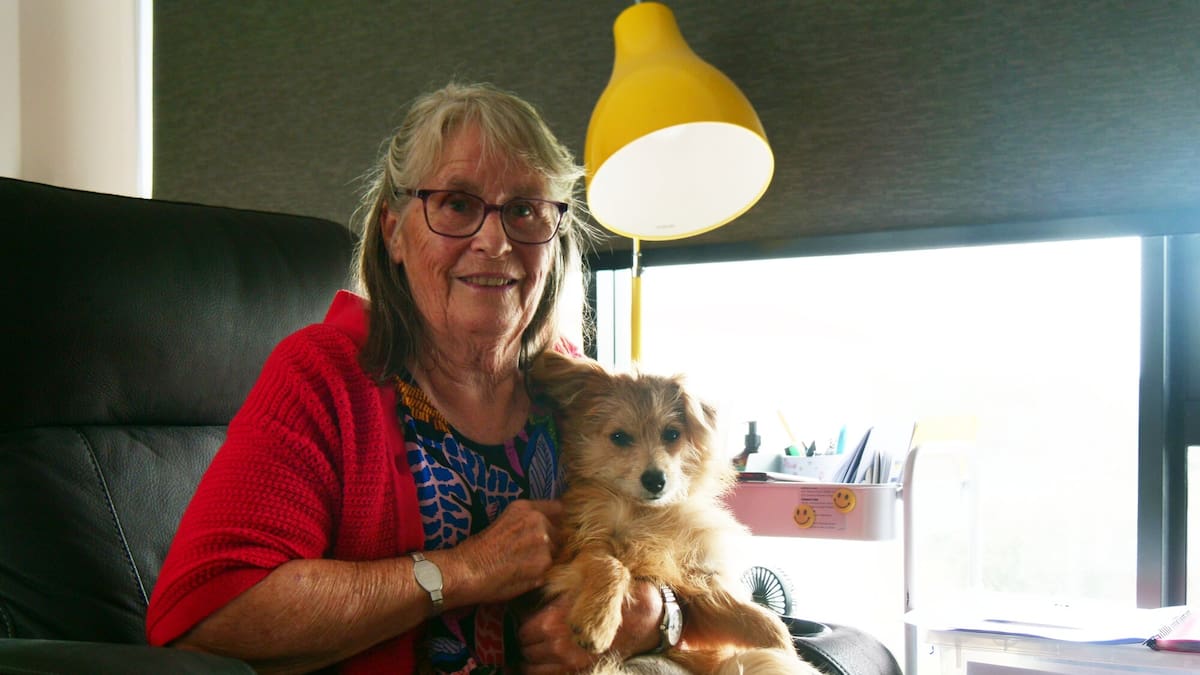
Diana Wood with her dogs Willow and Summer. Photo/ Tom Eley
First diagnosis
Wood was first diagnosed with breast cancer in 2013 after a routine mammogram picked up a pea-sized lump deep in her breast.
“If it hadn’t been for that mammogram, I never would have found it myself,” she said.
She was shocked when doctors told her she would need a mastectomy.
“It was such a tiny lump,” she said.“But I did what I was told and got on with it.”
Wood underwent surgery, chemotherapy and five years of hormone therapy. When treatment ended, she believed the worst was behind her.
“I felt confident I’d make it past the 10-year cancer-free milestone,” she said.
“I really thought that chapter of my life was over.”
When cancer came back
Nine years later, on April Fools’ Day in 2022, that confidence was shattered.
During a routine self-check, Wood discovered a lump under her arm and was referred back to the breast clinic.
Scans and a biopsy revealed the cancer had returned — and progressed to stage four — spreading to her lymph nodes, ribs, spine and tailbone.
“My family was with me when my GP told me,” she said.
“I let him keep talking to them and I walked out to the car. I just couldn’t deal with it.”
The signs she didn’t recognise
Looking back, Wood now realises the warning signs had been there long before her diagnosis.
“For about a year, I’d had aches and pains in my back,” she said.
“It got so bad I had to stop playing bowls for a while, which was huge for me.”
At the time, she assumed it was just part of getting older.
“I had no idea the pain was likely caused by cancer spreading,” she said.
“I wish I’d known what to look out for. If someone had told me these things could be symptoms, I would’ve gone back sooner.”
Grieving, then choosing to live
After learning her cancer was now advanced, Wood went through a period of grief — not just for her health, but for the future she thought she had secured.
“You grieve for the life you expected,” she said.
“You have that moment where you think, ‘This isn’t fair’.”
But she made a conscious decision not to let that grief define her.
“I decided I wasn’t going to be miserable to be around all the time,” she said.
“I just have to get on with it – with life.”
The hardest part – waiting
One of the hardest aspects of living with advanced cancer, Wood said, was the waiting.
“It’s that space between being assessed and waiting to hear what happens next,” she said.
“I’m tired of waiting, and I’m tired of feeling tired.”
She’s even tried to strike certain words from her vocabulary.
“Waiting and tired – those are two words I’m trying really hard not to use, because that’s all we use,” she said.
Diana Wood says she appreciates every single day now. Photo/ Tom Eley
Treatment — and hope
After her stage four diagnosis, Wood began taking Ibrance, a targeted therapy that worked well for nearly three years.
“It gave me my life back,” she said.
“I could keep playing bowls, keep gardening, keep knitting for the hospital and spend time with my grandchildren.
“I wasn’t sick — I was living.”
But a few months ago, Wood found another lump on her chest wall. A biopsy confirmed the cancer had progressed again, and she was told she could no longer take the drug.
“I asked my oncologist, ‘Is this it then?’” she said.
“She laughed and said, ‘No, no — we’re still good.’ That meant everything to me.”
Wood is now preparing for her next step, with surgery scheduled for February 5 — the day after she spoke with the Waikato Herald.
The uncertainty is difficult, she admits, but fear doesn’t get to run the show.
“When I was first told I had stage four cancer, they gave me three to five years,” she said.
“My attitude has always been that I’ll outlive that.”
She still wants to see things.
“My grandchildren growing up, getting married.”
Living with advanced breast cancer has changed her priorities.
“I appreciate every single day now,” she said.
“I put my energy into what makes me happy and being around good, positive people. That’s how I cope.”
Tom Eley is a multimedia journalist at the Waikato Herald. He previously worked for the Weekend Sun and Sunlive.