
And while MPs, diplomats and lobbyists were able to temporarily emancipate themselves from the turgid waft of stewing faecal matter as it curdles along the capital’s south coast, there was no escaping the whiff of controversy that pervaded commemorations of our national day.
Perhaps unexpectedly, it was the Opposition that struck first, with the announcement that Labour’s Peeni Henare, whose Ngāpuhi whakapapa often gives him a starring role in proceedings, would be stepping away from politics.
Labour and Henare played happy families on the day, but it was widely known that Henare was unhappy with the party after the Tāmaki Makaurau byelection last year – a fact hinted at by other politicians at Waitangi.
All sides are telling a strand of the truth: Henare is keen to move on and Labour hasn’t forced him to the door, but it’s also true that not everyone is perfectly happy behind the scenes.
It appears Henare wanted another tilt at winning back Tāmaki Makaurau at the election this year, while the others in the party were less keen. It also appears there’s been a bit of tension, perhaps even a falling out, between Henare and Willie Jackson, co-chair of the Māori caucus.
The waka ceremony during Waitangi Day commemorations. Photo / Jason Dorday
Jackson is leader Chris Hipkins’ consigliere on all things te ao Māori. It’s a vital role, given the fraught political landscape: Hipkins needs to maintain some kind of relationship with Te Pāti Māori while distancing himself from them; he also has to unite the left by campaigning against the coalition on Māori issues, without reigniting the co-governance controversies that helped eject the party from power in 2023. It’s a line Hipkins trod well at Waitangi, in no small part because he’s well advised.
Jackson has been a key supporter of Hipkins during his time as Opposition leader, which mattered a great deal in the months after the 2023 election, when Hipkins’ position was uncertain. His left-wing bona fides have helped shore up Hipkins’ position when it’s come under attack from the left for his strategically milquetoast centrism, particularly on matters of tax (Jackson backed Hipkins’ CGT call and isn’t shy about critiques of wealth tax backers like David Parker and Phil Twyford).
The disagreement, if any, isn’t grumpiness with Hipkins’ pivot to the centre – Henare is on the NZ First-inclined right of the party, and some National MPs joke he’d be a better fit in their caucus (like his cousin Tau or grandfather James). Rather, it’s his role within the party.
When he left Parliament early during the first sitting block of the year, rumours of an imminent resignation circulated (the official explanation is that his departure that week was unrelated to politics), but that didn’t stop the rumour circulating further. NZ First’s Shane Jones made the decision to go public with the spat on Wednesday, wink-wink-nudge-nudge-ing that there was more to the resignation than Labour was letting on.
Labour MP Peeni Henare. Photo / Andrew Warner
Jones isn’t an idle speculator. He’s related to Henare (their grandparents were close), and Henare occasionally gilds his Hansard with kind references to the fellow northerner and “uncle”, Jones. Jones’ leader, Winston Peters is also one of Henare’s uncles. The two are close. When Henare was hauled before the Privileges Committee over his role in 2024’s unsanctioned parliamentary haka, it was Peters who privately messaged Henare words of support.
As lines of communication between Labour and NZ First withered, Henare was relied upon to keep them open – occasionally to the point of controversy. Last year, Henare found himself the protagonist of a small scandal over his foreign affairs chats with Peters, of which Hipkins was unaware.
Henare also seemed to get lost, by accident or design, in the reshuffling of Labour’s northern candidates. Willow-Jean Prime switched from the general seat of Northland to the Māori seat of Te Tai Tokerau, once contested by Henare’s grandfather running for National. Retiring Far North Mayor Moko Tepania, who has said he doesn’t want to become an MP “in the short term”, is rumoured to be in the running to replace Prime as the party’s candidate in the general seat.
As for the controversy on the Government’s side, its genesis is far away from Waitangi – in New Delhi.
The Government’s India Free Trade Agreement has all the ingredients of a major political storm – one that is expected to make landfall in the next few months.
News of the deal was announced on one of the last days of the year. The Prime Minister joked that the media could go back and enjoy their holidays after his unexpected press conference on the topic, although his published diary suggests he did exactly the same thing, with his December 22 press conference announcing the deal at his last recorded engagement of the year.
That’s meant precious little scrutiny from the public, or even from Parliament, has been applied to the deal.
This isn’t helped by the fact the actual text of the agreement is so hard to come by – hardly anyone knows what it actually says. The public, and most of Parliament, has no way of bridging the distance between the wildly different claims of the agreement being made by the New Zealand and Indian sides.
The genesis of the agreement was entirely political, coming as a campaign commitment made by Luxon at the last election. Parliament’s analysis of the deal, which is only now getting under way, is shot through with politics too.
The John Key Government opened talks in 2011 but allowed negotiations to wither after the Indian side’s concessions on exports “misse[d] out probably the most important ones from New Zealand’s point of view”, namely dairy. Some years later, in 2023, the public servant who would go on to negotiate Luxon’s deal warned that it would be “impossible” for New Zealand to do “because it is such a significant part of our export profile”.
That proved to be prescient, given the deal announced last year includes next to nothing on dairy, which remains New Zealand’s key export.
While the Government is trumpeting the fact that it includes improved access for 95% of New Zealand’s exports to the country, this neglects the fact that New Zealand hardly exports much with India to begin with and the point of an FTA isn’t just to improve access to existing exporters, but to open the market to new ones.
We exported just twice as much to India last year as we export to Fiji, despite Fiji’s population being one and a half thousand times smaller than India’s.
Politics are also at the heart of how the deal will be analysed. Labour’s in a bind, knowing the deal is so-so, but fearing to break from the bipartisan consensus on trade policy. The party’s flirted with reactionary anti-trade Trumpism once, over the Trans-Pacific Partnership (Jacinda Ardern marched down Queen Street to tell the Key Government to back out of the deal, but agreed to its renamed successor 16 days after being sworn in), but was avowedly pro-trade during its last stint in power. It can’t pull the same stunt twice.
Prime Minister Christopher Luxon and India PM Narendra Modi during Luxon’s visit last year. Photo / Interest.co.nz
There’s a further challenge too, which is fearing to get offside with New Zealand’s not inconsiderable Indian diaspora, most of whom are likely to support a deal.
The Indian Government is not shy about signalling to the diaspora its pleasure or displeasure with a political party. Labour, keen to win back Auckland, the epicentre of that diaspora, will not want to do anything to get offside; this is made even more challenging by the fact it’s the migration aspects of the deal that are likely to be the most controversial.
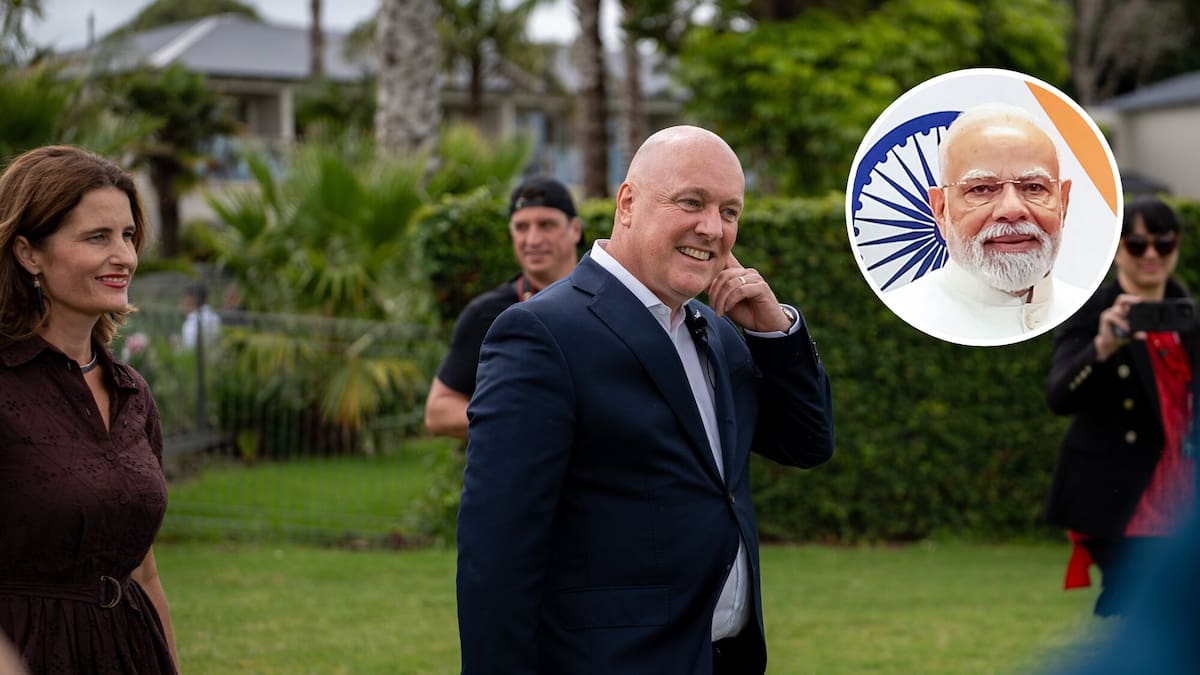
Added to the mix of complications is the plan, currently being laid, for Indian Prime Minister Narendra Modi to visit in the middle of this year – all going well. The visit, if it comes off (and there’s plenty that could derail it), would be a coup for Luxon, as it would be the most significant official visit by a foreign politician since Chinese President Xi Jinping popped in on Key in 2014.
Modi doesn’t do ordinary visits, popping in on a leader for a dry bilateral at some grand government building. When Modi travels, he tends to schedule enormous, American-style rallies for the local diaspora – a major coup for whichever incumbent happens to be in government at the time, for whom these rallies are seen as an endorsement.
More than 20,000 people are estimated to have attended Modi’s 2023 rally in Sydney, when he was pictured, not unhelpfully, holding hands with Prime Minister Anthony Albanese, who compared the event to a Bruce Springsteen concert and dubbed Modi “the boss” – an accurate descriptor, as it turns out; a year later, Australia’s security forces outed India as the country behind a “nest of spies” pulling strings in Canberra.
Our visit would occur just months before the election, a coup (the good kind) for Luxon and a challenge for Hipkins, and a distraction that gets in the way of robust analysis of the deal.