
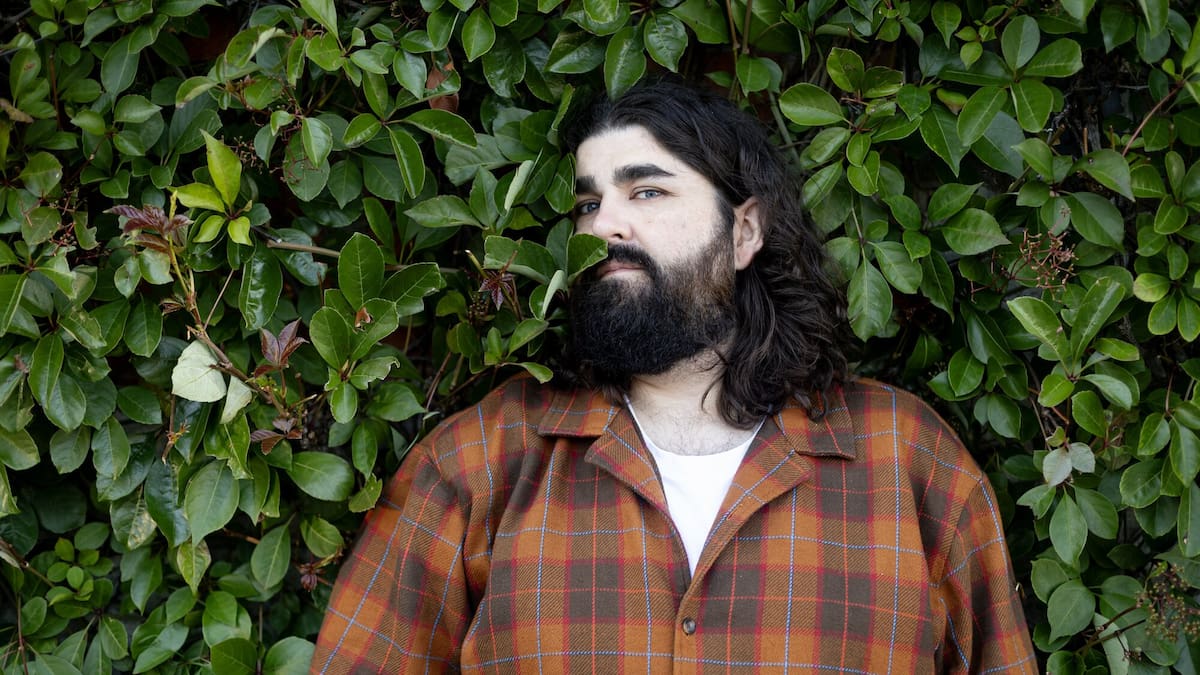
Rhys Mathewson. Photo / Dean Purcell
When he’d first gotten sober, he’d thought: “if you put enough days on the pile, eventually you’ll be like, ‘I never want it again’.” After that visit to the therapist, he knew he would have to reconcile himself to the idea he’d been wrong about that.
He came home, ordered “a shitload of Uber Eats”, then went out and ran into Jeremy Wells.
“When you’ve just gone ‘f**k I’m at the lowest point I’ve been in five years’, the first person you see to be like one of the loveliest blokes and also one of the most successful comedians in New Zealand: you can really feel the gap.”
He didn’t tell Wells what had happened. Too polite.
Mathewson had a gig booked at the Classic Comedy Club the next night, for which he had been workshopping material. On the way to the gig, he decided to throw it all away and start again. The show might still be comedy, but it would be completely unlike any comedy he had performed before. From now on, he decided, he was going to be honest.
It was 11.50pm on New Year’s Eve 2018 when he smoked his last joint. Marijuana had been his drug of choice for years, “from the moment I wake up until the moment I go to sleep” unless he had to go to work, and sometimes even then.
It had also offered an escape route from feelings like disappointment, sadness, anger and shame, numbing him to all of that. It had also made life an adventure. “If you’re really stoned,” he says, “you’re not just making a sandwich – you’re making the best sandwich.”
But during his last year of use, it lost its magic.
Rhys Mathewson says he had no forward momentum when he was a regular marijuana user. Photo / Dean Purcell
While he had some good things in his life, he says, they were things that happened to him rather than things he made happen. “I had no forward momentum,” he says. “I was very ineffective, I was very flaky, I was very distant to a lot of people, I think.
“I felt really sad and really trapped and I didn’t know how to get out and I felt really incapable of asking for help from anyone.”
Another big wake-up call came during a comedy gig during which he said “I’m not a big drinker” and a table of his comedy colleagues burst out laughing.
A big believer in New Year’s resolutions, he just thought, “I’m going to stop”, and he did.
Smoking that last joint, he felt very melancholic. He lay low for the next three months. If there was a party invite that said 6 ‘til late, he would turn up at 6 on the dot and leave by 6.45 so as not to be tempted.
His sleep cycle was “f****d”, he produced too much saliva and he had “the craziest dreams”. But he also saw immediate benefits. “Within a week, I felt so much more stable, emotionally”. No longer would he swing wildly between joyful and sulky.
But that doesn’t mean it has been easy. “I do miss it,” he says. “I miss it a lot. God, it would be good to do. I’m jealous of people who can still do it and fully function.”
Rhys Mathewson. Photo / Dean Purcell
If sitting with dozens of others in a darkened room listening to someone express the emotional and physical pain of addiction and relapse sounds like the opposite of comedy, that might be because comedy has evolved in recent years.
Mathewson describes it as a “movement towards authenticity”, possibly caused by the rise of internet culture in the mid-2000s and the fact that almost any joke you could think of about any given subject had already been published online.
“With the amount of comedy that was out there, it’s like, ‘How do I maintain the value of mine?’ And it’s to tell the things that only I can tell.”
Driving to the Classic the day after his therapist dropped the hammer on him, he realised those things were addiction and relapse and the emotional and existential rollercoaster that accompanied them.
“I think audiences can always sniff when the comedian’s leaving something out or they’d rather be somewhere else or something like that,” he says. “I had this thing that I was just constantly thinking about 24/7, and then to go on stage and go, ‘Who plays Lotto?’ You know? I couldn’t stomach it.”
He got up on stage and said he’d had a relapse and that was the moment his career began again.
At 19, Rhys Mathewson became the youngest winner of the Billy T award. Photo / Dean Purcell
Mathewson grew up on Auckland’s North Shore, the son of a pilot who flew the fabled Skyhawk fighter jets in the RNZAF and later became a captain at Air New Zealand. “There’s two kinds of kids who grow up in the Air Force,” he says. “Ones who really love planes and ones who couldn’t give a s**t about planes. I truly could not give a s**t about planes.”
He was a comedy prodigy and at 19 he became the youngest winner of the Billy T Award, which recognises the country’s outstanding emerging comic. He was one of New Zealand’s brightest young comedians with a massive future ahead of him. He moved to the UK to try to crack the big time. It was a disaster.
He would drive four hours to do “s**t gigs” at pubs in the middle of nowhere to tiny crowds that didn’t care. With 10 other comedians, he once performed a gig at the Edinburgh Fringe to a bar in which there were six patrons, none of whom had come for the comedy. By the time of his set all of them had left, along with the comedians who had already performed.
He says he didn’t have the emotional maturity to succeed in the United Kingdom. He wasn’t working hard enough, wasn’t forming the right relationships, wasn’t spending the hours writing the requisite emails to potential promoters. He was “just sitting in a flat, smoking weed”.
On a trip home to New Zealand for the comedy festival, he met now-wife Chelsea McEwan Millar. At the airport for his return flight to the UK, he cried in front of her and his mum, feeling that he was making a massive mistake. Then he got on the plane anyway.
After three months of “feeling like s**t”, he says a friend from back home told him “you need to go home”, so he did.
Rhys Mathewson with fellow comedians Irene Pink, Justine Smith and Dai Henwood. Photo / NZ Herald
He has now achieved everything there is to achieve in New Zealand comedy. He’s had hit shows, written for The Project and 7 Days and won the two biggest awards in NZ Comedy: the Billy T and Fred Awards.
After winning the Fred in 2016, for best New Zealand show at the NZ International Comedy Festival, he became “really depressed”.
He thought the Fred-winning show was not his best work and was disappointed to hear that people thought it was him at his peak. “It feels weird to catch the thing that you’re chasing and it hasn’t fixed everything. I’m still me.”
Several times during our chat he uses the word “depressed”, although he says he’s never been diagnosed with depression and thinks maybe he’s being too cavalier with the word.
Instead of numbing his feelings with drugs and alcohol, he now deals with them using techniques learned through therapy: “You have compassion for yourself and you know it’s normal and everyone feels like this and you’re allowed to feel like this and it’s all going to be okay and then you try not to focus on them, try to hold them lightly: it’s just a feeling; it’s not a gale force wind that’s going to bowl you over.”
And does that work?
“Yeah. Generally.”
The show he began performing after his relapse is called 10th Rodeo and he’s now been doing it for two years, developing and polishing it and garnering ever greater acclaim.
After he’d performed the show for a few months, he came to the realisation it’s actually not about a relapse, but about something much more relatable: mistakes.
“We’ve all made mistakes,” he says. “I’ve made a mistake. Let’s deal with the mistake. And show the people in real time what it’s like to deal with the mistake.”
By way of demonstration, he opens the show by trying, and failing, to flip a water bottle on to a stool. At the end of the show, after the journey through addiction, sobriety, relapse and recovery, he attempts it again. In 15 shows, he says, he’s landed it once.
Rhys Mathewson performs 10th Rodeo at Medici Court at Hamilton Gardens on Saturday, February 21, as part of the Hamilton Arts Festival