
Back to Article List
Jupiter’s largest moon, Ganymede, passes behind the planet’s disk in an occultation tonight. Watch as the satellite slowly disappears from view.
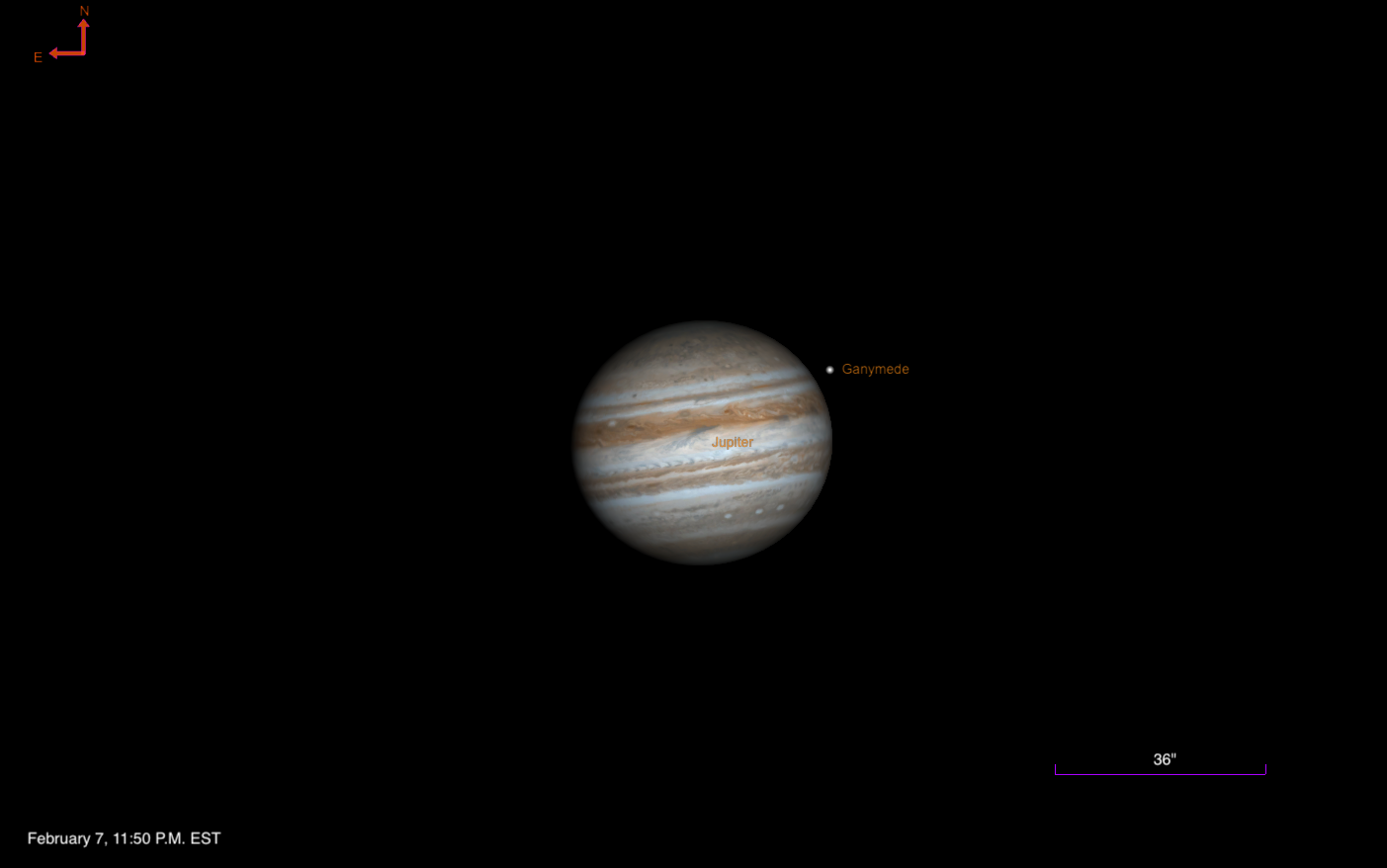
Ganymede is closing in on Jupiter for an occultation that begins just after midnight EST on February 7. Io, Europa, and Callisto all lie to the east, outside this field of view. Credit: Alison Klesman (via TheSkyX)
Looking for a sky event this week? Check out our full Sky This Week column.
February 6: Cancer’s other open cluster
Jupiter still dominates the constellation Gemini, visible all night and into the early-morning hours, setting only shortly before dawn begins to color the sky.
Jupiter is now highest in the southern sky around 10 P.M. local time; after that, it begins to sink slowly toward the western horizon, hanging beneath (and outshining) the bright stars Pollux and Castor. Through a telescope, all four of Jupiter’s Galilean moons are visible early this evening: Ganymede sits alone to the west, with the other three (Io, Europa, and Callisto, in that order from nearest to farthest from the planet) visible to the east.
But Ganymede is closing in on Jupiter’s northwestern limb and shortly after midnight in the Eastern time zone (12:02 A.M. EST), it disappears behind the planet in an occultation visible across the continental U.S. Because Ganymede is so large, the disappearance can take several minutes; make sure you have your telescope set up well beforehand to catch the show.
The moon takes more than three hours to cross behind the planet, but when it finally emerges, it remains hidden from view by Jupiter’s long, dark shadow. Ganymede doesn’t reappear until about 4:15 A.M. MST on February 8th, after the planet has set for the eastern half of the U.S. and when it is starting to sink low even in the Mountain time zone. The reappearance, which occurs some 20” from Jupiter’s northeastern limb, is best seen from the West Coast.
Sunrise: 7:02 A.M.
Sunset: 5:27 P.M.
Moonrise: 11:55 P.M.
Moonset: 9:37 A.M.
Moon Phase: Waning gibbous (63%)
*Times for sunrise, sunset, moonrise, and moonset are given in local time from 40° N 90° W. The Moon’s illumination is given at 10 P.M. local time from the same location.