
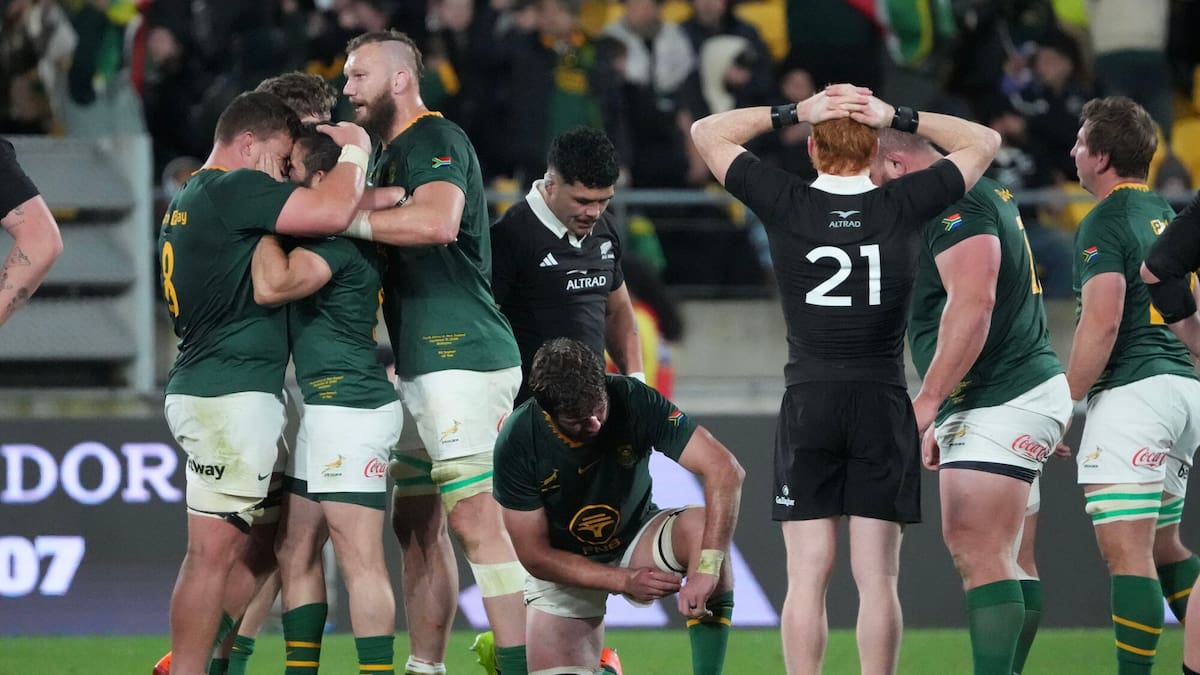
The first time the All Blacks won a test series in South Africa, in 1996, there was a ticker-tape parade for the team in Queen St. If they can emerge with a series victory in August, they’ll deserve a week of processions.
The rugby world divides
We can move on from a game of two halves. In 2026, it’s more case of a game of two hemispheres.
Now that South Africa is embedded in European club rugby, there are basically two ways the sport is being played.
The first, which has been hugely successful for the Springboks, involves sheer brute strength. It would especially help if there were no signs of the dreaded rolling maul, which to many of us is founded on a formation that is nothing more nor less than obstruction. (In passing, if you want to wreck Wayne Smith’s day, ask him what he thinks about rolling mauls.)
The second way? As if to emphasise the point, Super Rugby Pacific will be played under slightly different rules from those in the rest of the world. The aim here, and in Australia, is to make rugby more exciting by encouraging running with the ball and the winning of matches by scoring tries, preferably in the most daring, thrilling way possible.
The age-old argument over which is most important, winning or entertaining, has never felt more pertinent.
Many of us can easily relate to the argument that winning ugly will always be more satisfying than losing in style. I doubt the words “Well, we lost, but gee we played some fantastic footy” have ever sprung from the lips of a New Zealand or South African fan.
It is possible to combine the two, to win and excite, as the 2015 All Blacks showed in that year’s World Cup. You could also argue quite fairly that France consistently turn on displays that are edge-of-the-seat thrilling. They did it again in their 36-14 demolition of Ireland on Friday.
The downside is that France have never won the World Cup. The huge difference for a defeated French coach is that unlike a losing All Blacks coach, he doesn’t become a pariah who is sacked and shunned.
What Kiwi rugby fans want to see, leading through to next year’s World Cup in Australia, is a team that has players with the grunt and grit to knock down large, determined forwards like the Springboks (think Malcolm Marx), while also having thinkers with the tactical smarts to know when taking a chance and running is the best option.
Get well soon
Whether you’re a Highlanders fan or not, every Kiwi rugby supporter should be wishing Fabian Holland a fast and complete recovery from his pre-season shoulder injury. In what amounts to the blink of an eye in rugby terms, the 23-year-old lock has become a vital part of the All Blacks.
In Holland’s first year of international play last season, calling him to take the ball in the middle of the lineout on an All Blacks throw was always money in the bank. Barring injury, it can only be onwards and upwards from here, which is why his coaches at every level will be keeping their fingers crossed that no serious damage was done in the game against Moana Pasifika.
As kicking for field position becomes more of a feature of international games, commanding your own lineout is essential.
Welcome back
Richie Mo’unga has been the centre of attention when it comes to All Blacks returning from stints overseas. There hasn’t been quite the same spotlight on Leicester Fainga’anuku, back in Crusader colours after a season with Toulon in France.
But at 109kg, with the sort of taste for nose-to-nose combat his father showed as a prop for Tonga at the 1999 World Cup, Fainga’anuku is exactly the sort of three-quarter who could inspire the All Blacks as they take on what are bound to be some huge physical challenges this year.
Phil Gifford is a contributing sports writer for NZME. He is one of the most-respected voices in New Zealand sports journalism.