
“So essentially we’re flirting and will see who comes along,” Linley said.
“We used it on a couple of trips during the last Antarctic summer and got some cool animal sightings, but we didn’t see the big one, so we’re going to have another shot.”
Linley and Bolstad with a lifesize colossal squid, made by one of Bolstad’s colleagues at AUT, that travelled with them to Antarctica as a mascot last year. It was auctioned for charity at the end of the trip.
Sightings of the colossal squid, dead or alive, are extremely rare. A female that died after becoming entangled in fishing lines in the Ross Sea in 2007 is a popular exhibit at Te Papa in Wellington – one of only three large complete specimens that have been recovered and the only one on display.
Last year, there was a flurry of excitement when Bolstad, a professor at AUT and head of its Squid Squad, was called on to verify video footage of a young squid about 30cm long, south of South America.
The first confirmed live observation of the colossal squid, Mesonychoteuthis hamiltoni, in its natural habitat was captured in 2025 by a team on Schmidt Ocean Institute’s research vessel in waters off the South Sandwich Islands.
Adult colossals remain camera-shy and have never been filmed in their natural habitat. However, scientists believe they exist in large numbers in the Antarctic deep sea. Sperm whales, which are their primary predator, have been found with bellies full of them.
The squid’s presence has also been felt in the Ross Sea, where New Zealand operates a regulated fishery for Antarctic toothfish.
“There are places down there where toothfish fishers just don’t go any more, because their fish gets stolen by the colossal squid,” said Linley.
“So, there are actually loads of them. Considering it’s the size of a small car, it’s really good at staying hidden.”
More than 100 new animal species were discovered on this three-week expedition in the Bounty Trough, east of the South Island, in 2024. Photo / Rebekah Parsons-King
Colossal squid have the largest eyes in the animal kingdom and rely almost entirely on visual perception.
The 360-degree camera system Linley and Bolstad have designed is able to operate at extreme depths and uses a particular wavelength of red light invisible to the squid.
One of the problems with lowering any kind of equipment into the sea is that it can be mistaken for a predator, such as a sperm whale, which sets off flashes of bioluminescence when it descends.
“That’s what the squid will look out for, this blue comet coming into the deep, so we had to totally rethink the camera,” said Linley, who expects to collect more than 50 hours of video footage during the trip.
“There are no shackles or anything that rattles or bumps. It has a fin, so it doesn’t disturb the water as much as, say, a diving whale would. It’s been a really interesting design challenge.”
While the camera will look like a squid to a squid, its sonar response shouldn’t trigger any interest from a feeding whale.
“If the camera system comes back and it’s been chewed, that’s going to be really interesting footage.”
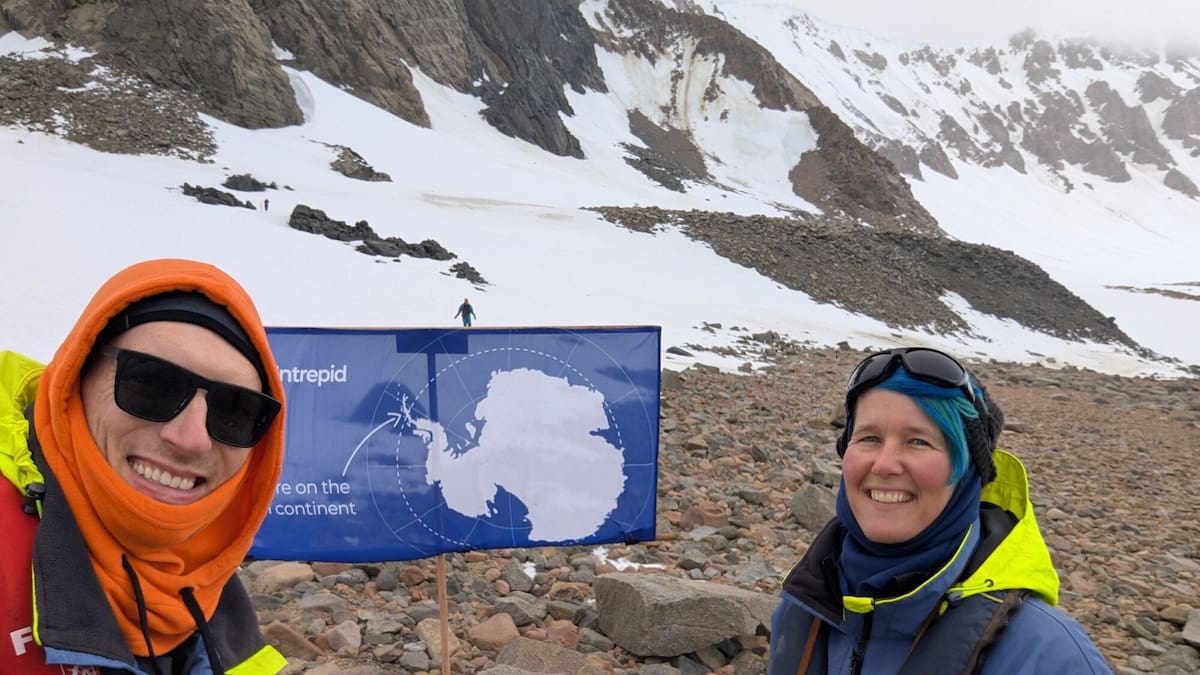
Te Papa curator and deep-sea specialist Thom Linley on an expedition to Antarctica last year.
Linley and Bolstad’s research has been funded by Pure Ocean, an international endowment fund based in France that supports innovative projects to increase our knowledge of the ocean and protect marine biodiversity.
They’re travelling with a tourist expedition as onboard experts and will also collect water samples along the way to test for environmental DNA. One area they’re particularly interested in exploring is where New Zealand species end and Antarctic and South American species begin – and whether there’s anything in between.
If successful, it will be the longest environmental DNA transect of Antarctica ever done, providing invaluable baseline data.
“This is a part of the world that’s undergoing such incredible change,” Linley said. “Can we make this a time series? Can we see how these species are moving their boundaries as the weather and the temperature change in these water bodies?”
Linley, who co-presents The Deep-Sea Podcast, is on a mission to change our perception of the ocean’s extreme depths. He said most of the fanged “monster fish” people tend to picture are so small they could fit into the palm of your hand.
“Why the animals look that way is actually really interesting. So we’re trying to take a much more science-forward approach that’s still full of wonder, because the deep sea is amazing. It’s so much more than a monster show.”