
By Rachel Lilburn and Warren Olson
On training grounds across New Zealand, a new generation of Football Ferns hopefuls are learning to move faster, think sharper and carry expectation earlier than any group before them.
Age-group internationals Emma Meadows (16), Isla Robson (16) and Katie Pugh (17) represent three pathways into the national system, yet their stories intersect through discipline, relocation, opportunity and international exposure.
Each has entered age-group environments during a period of rapid expansion for women’s football development, fuelled by the success of the 2023 FIFA Women’s World Cup co-hosted by New Zealand.
The result is a way forward shaped by professional standards before they reach senior football.
For Pugh, that acceleration began when she left Marlborough to pursue elite training opportunities in Wellington, entering the Wellington Phoenix academy environment and committing fully to national progression.
Her first national call-up remains vivid.
“I was very privileged to make my first New Zealand squad back in 2023. The first time I got the email to represent New Zealand at age-group level was a memorable moment,” Pugh said.
That moment quickly evolved into ambition.
“Since my first New Zealand tour in Tahiti, my goal to make the next age group team never left my mind,” she said.
Relocating to Wellington placed Pugh inside a daily professional training structure, exposing her to senior players, experienced coaches and high-performance expectations.
“I’m very privileged to have the opportunity to play with great players week in, week out and to have coaches with such quality,” she said. “I love being in an environment that will always challenge you to get the best out of yourself.”
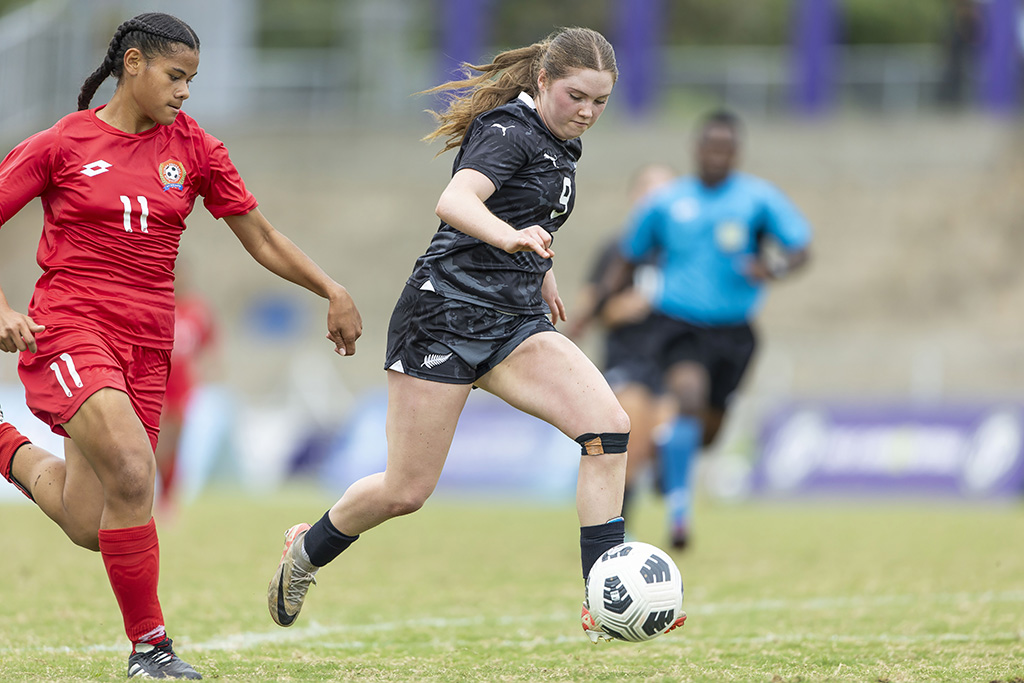 New Zealand’s Katie Pugh driving through the Tongan midfield at the 2024 OFC U-16 Women’s Championship in Fiji. Photo credit: OFC Media / Kirk Corrie / Phototek.
That preparation proved critical when she represented New Zealand at last year’s FIFA U-17 Women’s World Cup in Morocco.
Facing elite international opposition provided immediate clarity about the global standard.
“Every team we went up against had a lot of quality. Being able to play against elite players was a great experience,” Pugh said.
Robson announced herself during the Oceania U-16 qualifier series in Samoa.
After progressing through a six-month identification process, Robson entered her first international tournament knowing selection carried responsibility.
“When I came out wearing the New Zealand kit, I was really nervous because I knew how important playing for your country is,” Robson said.
Nerves quickly turned into impact. Robson delivered goals in decisive moments, including a hat-trick in the opening match and a vital header in the final, helping New Zealand qualify for the 2026 FIFA U-17 Women’s World Cup.
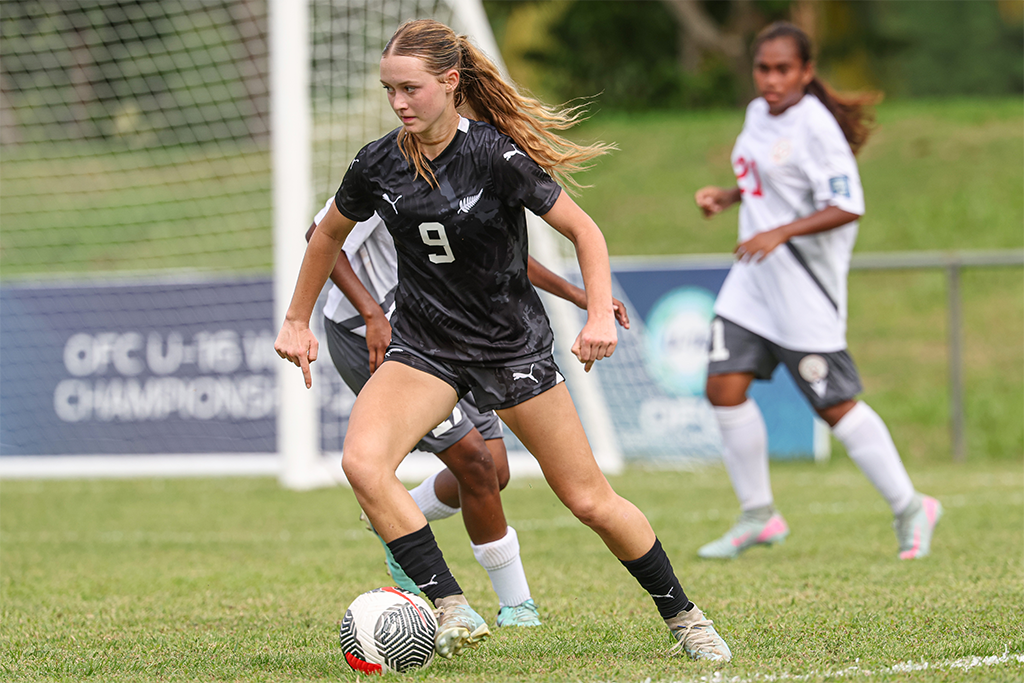 Isla Robson. Photo credit: OFC Media / Shane Wenzlick / Phototek.
Robson understands the scrutiny that comes with taking on attacking roles.
“Being a striker, finishing opportunities is a big expectation,” Robson said. “Over tournaments and important games, I have learned how to deal with the pressure and be confident I can contribute.”
Robson’s technical profile reflects a growing trend among young New Zealand players, with futsal increasingly shaping early development.
“It really helps me with my control, quick decision-making and passing accuracy,” she said.
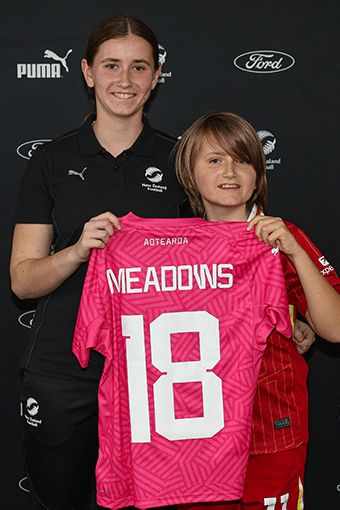 Emma Meadows. Photo: Shane Wenzlick / Phototek.
That technical base allowed her to adapt quickly to international tempo, while off-field connections strengthened the squad environment.
“We gelled really well off the pitch. Two weeks in Samoa made us all really close,” Robson said.
Goalkeeper Meadows represents another pathway into the national system, built less on single tournament moments and more on sustained domestic performance.
Meadows has progressed through regional development structures, earning recognition through consistent club form and adaptability.
Growing up as an outfield player, she usually played up front, and as a striker, she was known for her ability to play with both feet.
When she was 14, playing at the Weir Rose Bowl tournament, coach Brooke Macdonald put her in goal, and the rest, they say, is history.
Melville United women’s coach Tarena Ranui says: “Emma has amazing reflexes, is very good with her angles, and has been prepared to learn the art of goalkeeping, making her very valued.”
The modern youth international schedule brings opportunity, but also complexity. Travel, training and school commitments intersect daily.
Pugh believes perspective remains essential.
“For me, it’s important to have a balance so I can have a better mindset towards my football and studies,” she said.
“Giving myself some downtime allows me to reset and perform.”
Robson is already looking toward professional development pathways.
“One of my goals is hopefully being included in the women’s development programme at Auckland FC,” she said. “It provides a great opportunity to experience football in a professional-like environment.”
Together, Meadows, Robson and Pugh illustrate the depth now forming beneath the senior Football Ferns programme.
For Meadows, continued domestic performance remains the platform toward higher national selection.
The Melville United and Hamilton Girls High School player was selected to represent New Zealand at the 2025 FIFA U-17 Women’s World Cup in Morocco.
“Over the next few years, I hope to continue advancing through the New Zealand Football age group system and eventually make my way to the Ferns,” Meadows says.
“I also want to attend university in the United States on a scholarship, playing football and studying some form of health science or sports science.”
For Robson and Pugh, international qualification campaigns provide the next testing ground.
What unites the trio is timing.
They are developing inside a system that now expects international competitiveness, not simply participation.
Their careers remain in early chapters, yet the structure surrounding them suggests greater opportunity than previous generations experienced.
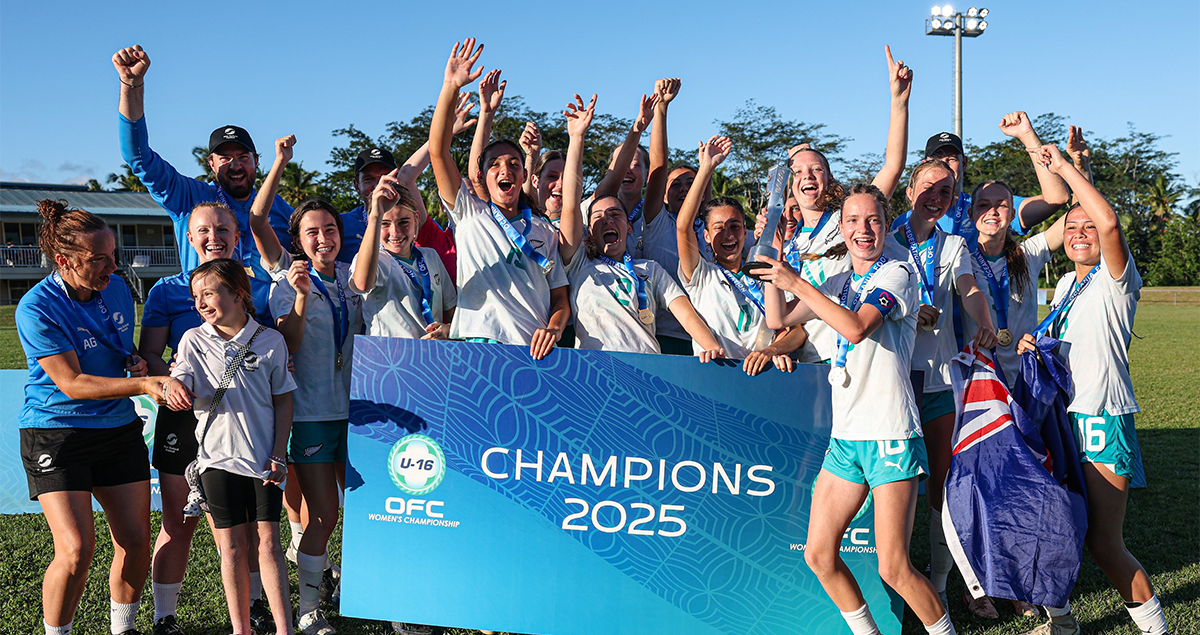 New Zealand have qualified for the 2027 FIFA U-17 Women’s World Cup in Morocco. Photo credit: OFC Media / Phototek.
For the rest of the decade, young women will target the now-annual FIFA U-17 Women’s World Cup tournaments, all to be staged in Morocco, as their chance to showcase their talents with a New Zealand side.
The tournament provides a critical pathway for emerging talent to experience elite international football before transitioning into senior national environments.
The 2026 FIFA U-17 Women’s World Cup will be the 10th edition of the tournament and is scheduled to take place in Morocco in October and November 2026. It will feature 24 national teams from six confederations, bringing together youth sides from Africa, Asia, Europe, Oceania, North America, and South America.
If progress continues, the next wave of Football Ferns may not announce itself suddenly.
It may arrive gradually, shaped by players like Meadows, Robson, Pugh, and others who are following the same age group pathway …
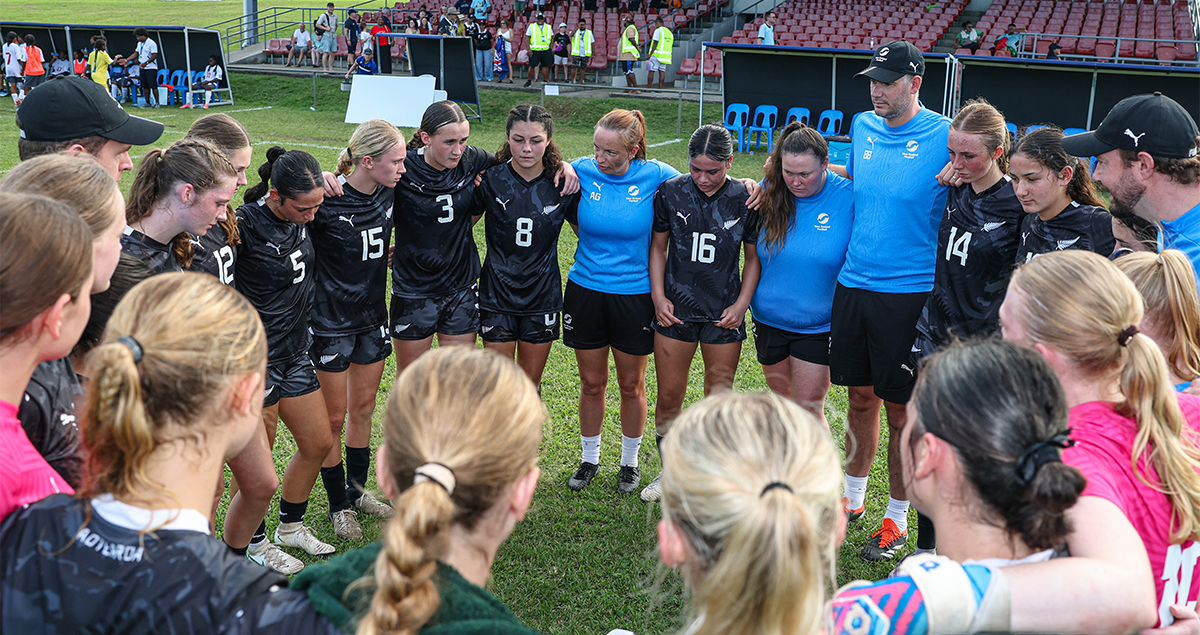
Main photo: The national U-16 women’s squad at an Oceania tournament last year. Photo credit: OFC Media / Phototek.
Rachel Lilburn
Hamilton-based Rachel Lilburn is the mother of a football-mad youngster, a team manager and volunteer. She writes for WaiBOP Football as well as contributing stories to Friends of Football.
Warren Olson

Warren Olson is a Wellington-based enthusiast for and long-time follower of women’s football. He follows futsal and the men’s and women’s National Leagues, and is a commentator for games streamed by FIFA+.
This story was first published on February 9, 2026.