
“We actually don’t have anything and so we’d have to make serious investments and that will require capital from domestic purposes and overseas purposes to do that. As to the construct of any deal, we’re not anywhere near that.”
The US Department of States’ Under-Secretary for Economic Affairs Jacob Helberg over the weekend said conversations with NZ “span everything from mineral extraction to midstream processing”.
Asked by the Herald what role the US could have with mineral extraction in NZ, Luxon said “We’re going to need support to actually undertake and kick off a sector”.
“It’s going to require extraction. It’s gonna require capital investment to do that. But exactly as to how that’s configured, those are conversations that are ahead of us.”
And could Donald Trump’s administration provide NZ with that capital investment for extraction?
“No, I’m not saying that. I don’t want to present it as a fait accompli.”
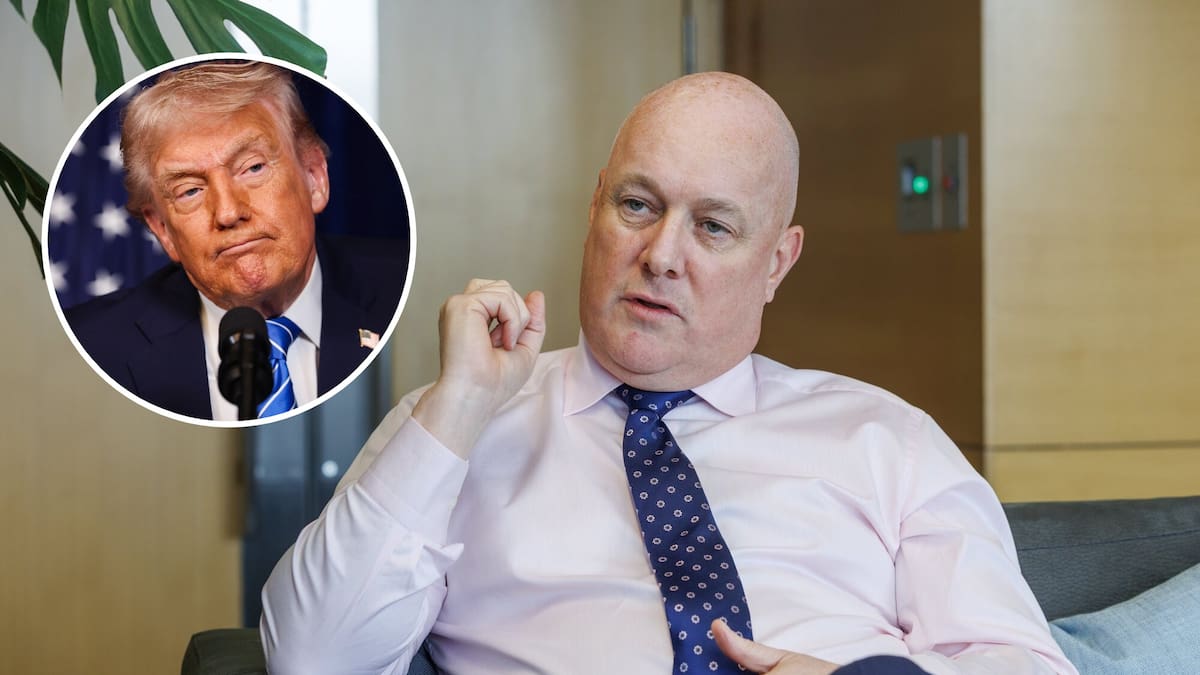
Prime Minister Christopher Luxon stressed no deal has been made. Photo / Mark Mitchell
Luxon said there were various ways to “unlock the sector here” and it would be developed “in our own brutal national interests”.
He said, “we do not have a deal on the table with all of that detail in it”.
“We have officials talking about it, understanding it, exploring what the Americans are looking for, how we could or could not help in that regard. We have a long way to go, a wee way to go. No Cabinet decisions have been made about this at all.”
The Prime Minister said NZ needs a critical mineral sector “because the future of the world is all about semiconductors and AI”.
“It’s also going to be about the clean transition to clean energy and a clean economy and that’s going to require EVs and solar panels. All of those source materials come from critical minerals and that requires mining here in NZ.”
How we got here:
2025: Demand for rare earth minerals continued to grow globally last year due to their importance to emerging technologies, like artificial intelligence, electric vehicles, and defence and security technologies.
The Government last January released a critical minerals list, highlighting 37 minerals deemed to be “essential to NZ’s economy and technological needs”. These range from aluminum to cobalt, from nickel to zinc.
“The list provides a basis for strategic actions to support secure mineral supply chains here and overseas, strengthen our relationships with international partners, and help ensure we achieve the Minerals Strategy for NZ to 2040 goal of doubling minerals exports to $3 billion by 2035.”
China’s dominance in this space is stark. According to the International Energy Agency, China is the leading refiner for 19 out of 20 important strategic minerals, with a reported market share of 70%.
This has geopolitical consequences, particularly for the US, which doesn’t want to be reliant on China for the technology of the future. Beijing tried to take advantage of its position by placing export controls on some elements and related technologies.
China is dominant in the critical minerals space. Photo / Getty Images
This angered Trump, who threatened to impose additional tariffs on China. But after a meeting between the US President and Chinese leader Xi Jinping in South Korea last October, China agreed to pull back.
To counter China’s dominance, the US began forming partnerships with other countries, like Australia, to lock down supply chains. It also developed other initiatives, like Pax Silica, to deepen countries’ co-operation.
In November, the Government announced NZ was joining the Minerals Security Partnership, a transnational grouping which Resource Minister Shane Jones said “puts NZ alongside the world’s largest economies and will help to attract funding to realise the potential of our minerals sector”.
January 14: Trump issued a formal proclamation after reviewing a report from his Secretary of Commerce about the effect of imports of processed critical minerals and their derivative products (PCMDPs) on national security.
It said the US is “too reliant on foreign sources of PCMDPs” and “lacks access to a sufficiently secure and reliable supply chain to PCMDPs”. This was called a “significant national security vulnerability”.
Trump directed his team “to enter into negotiations with trading partners to adjust the imports of PCMDPs so that such imports will not threaten to impair the national security of the US”.
The US President also highlighted that his Commerce Secretary believed it could be “appropriate to impose import restrictions, such as tariffs, if satisfactory agreements are not reached in a timely manner”.
January 19: Emeritus Professor of Law Jane Kelsey penned an article directing attention to Trump’s proclamation.
She questioned if NZ had been approached by the US and said if so, there should be a “full discussion about the implications”.
January 27: A group of claimants filed a memorandum at the Waitangi Tribunal raising concerns an agreement could “be finalised and signed without Māori, or anyone else in Aotearoa, being aware” and may ”breach the principles of rangatiratanga and kāwanatanga“.
Christopher Luxon was asked about the potential framework throughout last week. Photo / Alyse Wright
January 30: The Herald heard conversations were underway between NZ and the US and that an announcement was being worked towards.
The Ministry of Foreign Affairs and Trade confirmed discussions were happening, saying: “NZ is in discussions with the US regarding a non-binding critical minerals framework. Officials are going through a process of analysis, targeted consultation and providing advice to relevant ministers.”
The Herald and other media outlets published stories on work on the potential framework on the Friday afternoon. It is the front-page of that Saturday’s Weekend Herald.
February 2: The Prime Minister is asked about the NZ-US discussions by Mike Hosking on Newstalk ZB during his Monday morning media round.
Luxon said reporting had been “very speculative and ahead of itself” and “we haven’t made a Cabinet decision or had a fulsome discussion about it all”.
“But do we want to develop a critical minerals sector in NZ? Absolutely. Why? Because AI and superconductors are the future of the world and we should not be naïve to that and we should be understanding what resources we have here at home.
“But how we develop it, we’ll do it on our own brutal national interests. So we have conversations with the Americans, but nothing’s been agreed.”
On RNZ that morning, he was asked if NZ was doing a behind-closed-doors deal with the US.
“No, no,” Luxon said.
“The US has obviously been reaching out to over 40 countries on critical minerals. I saw some of the reporting over the weekend, I think it’s quite hypothetical and we have made no Cabinet decision yet. I think the commentary frankly is probably a bit frothy and a bit ahead of itself.”
Luxon eventually said, “we are part of conversations with lots of countries on issues like this”.
The Herald that afternoon reported that Bede Corry, Secretary of Foreign Affairs and Trade, would lead a delegation to the Critical Minerals Ministerial in Washington, DC that week.
It also reported the Chinese Embassy in NZ had “noted the relevant reports and are currently gathering futher (sic) information”. The Ministry of Business, Innovation and Employment (MBIE) also told the Herald of its involvement.
Bede Corry is the Secretary of Foreign Affairs and Trade and chief executive of the Ministry of Foreign Affairs and Trade.
February 3: Corry and US Deputy Secretary of State Christopher Landau released a statement after meeting in Washington DC saying they “committed to explore further opportunities to expand co-operation on critical minerals”.
February 4: David Seymour, the Deputy Prime Minister, is asked on Ryan Bridge TODAY about critical minerals.
“I’ve not seen the framework. I’ve seen a summary of it as we’ve discussed it through Cabinet … I don’t talk about what’s done in Cabinet, except for that minor slip-up.”
At a press conference later that afternoon, Luxon wouldn’t commit to publicly releasing the summary or to public consultation on a framework.
“We have got discussions going on, but there’s nothing as advanced as a signable contract or deal at this point in time.”
The Critical Minerals Ministerial was held in Washington DC, attended by NZ. The US agreed to 11 new critical mineral frameworks, including with the Cook Islands.
February 6: US Secretary of State Marco Rubio issued a statement marking Waitangi Day. It mentioned the two countries’ work “to develop secure and reliable critical minerals supply chains”.
The US’ Helberg confirmed conversations with NZ include “everything from mineral extraction to midstream processing”.
“They’re still very much in progress, and so we’re currently in the process of evaluating what the most economical and promising projects are in NZ.”
February 9: Luxon is asked by Hosking if he stood by his earlier comments suggesting the US discussions were at an early stage. The Prime Minister responded by saying officials have been talking for some time but no decisions had been made.
On RNZ, Luxon said the way the topic had been reported initially was “wrong”.
He held a press conference later in the day where he made the comments at the start of this story.
Jamie Ensor is the NZ Herald’s Chief Political Reporter, based in the Press Gallery at Parliament. He was previously a TV reporter and digital producer in the Newshub press gallery office. He was a finalist in 2025 for Political Journalist of the Year at the Voyager Media Awards.