
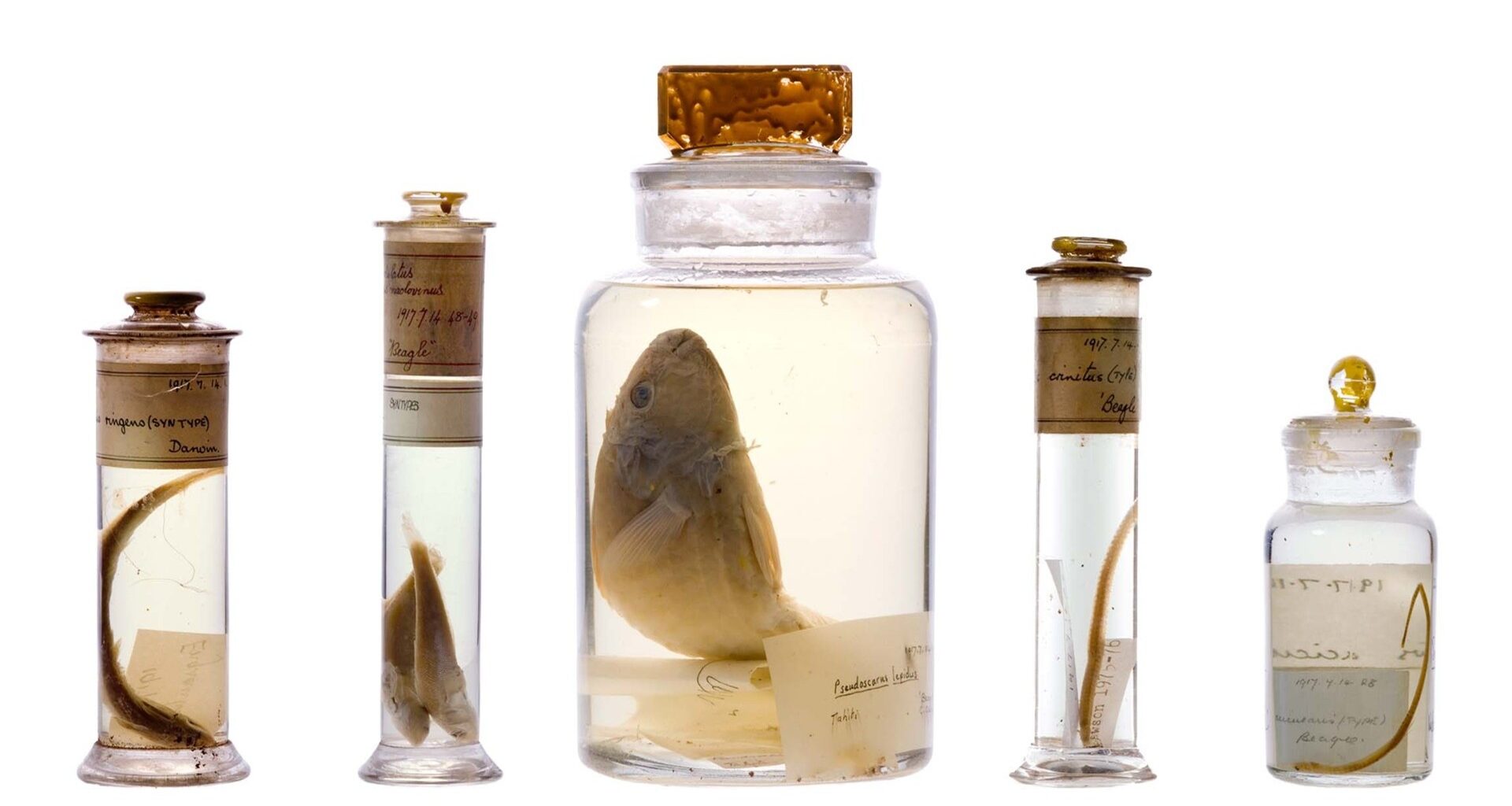
Lasers are now helping scientists peer inside some of the world’s most fragile scientific treasures without ever opening them.
Researchers have developed a laser-based scanning technique that can identify the preservation fluids inside sealed museum specimen jars, some of which date back nearly 200 years.
The breakthrough is especially significant for natural history museums, which collectively house more than 100 million fluid-preserved specimens worldwide.
Many of these jars contain unknown or poorly documented chemical mixtures that could be toxic to humans or harmful to the specimens themselves if disturbed.
The challenge is particularly relevant for collections linked to Charles Darwin. Specimens gathered during his voyage aboard the HMS Beagle continue to play a central role in evolutionary science, yet many were preserved using historical methods that varied widely in composition and safety.
Until now, identifying what liquid surrounds a specimen required opening the jar, risking evaporation, contamination, and irreversible damage.
The new approach eliminates that danger by allowing scientists to analyze the contents through the glass itself.
Lasers unlock sealed jars
The method relies on spatially offset Raman spectroscopy, or SORS, a portable laser-based technique that reads how light scatters after passing through a container and liquid.
By analyzing subtle shifts in the light’s energy, researchers can determine the chemical makeup of preservation fluids without direct contact.
Using handheld equipment inside museum storage rooms, the team analyzed 46 sealed specimens, including fish collected by Darwin, mammals, and various invertebrates.
The technique accurately identified the preservation fluids in nearly 80 percent of cases and partially identified 95 percent overall.
Different preservation patterns emerged across species. Mammals and reptiles were commonly treated with formalin before being stored in alcohol, while invertebrates were often preserved directly in formaldehyde or mixed solutions containing additives such as glycerol or propylene glycol.
The findings offer practical benefits for curators tasked with long-term collection care. Knowing what chemicals are present helps museums decide when intervention is necessary and reduces risks to conservation staff.
Protecting science and people
Some historic preservatives contain toxic or unstable compounds, including mercury-based solutions or picric acid, which can become explosive over time.
Labels, when present, are often inaccurate due to evaporation or contamination over decades.
“Until now, understanding what preservation fluid is in each jar meant opening them, which risks evaporation, contamination, and exposing specimens to environmental damage,” said Sara Mosca of the Science and Technology Facilities Council’s Central Laser Facility.
“This technique allows us to monitor and care for these invaluable specimens without compromising their integrity.”
Senior Conservator Chelsea McKibbin emphasized the broader significance of the work.
“The specimens used in this study represent 200 years of scientific collecting, including Darwin’s original samples that helped shape our understanding of evolution,” she said.
“Being able to analyse their preservation without opening their containers means we can maintain the integrity of these historical materials while ensuring they remain available for future generations.”
Beyond Darwin’s collection, the approach could be applied across museums worldwide, offering a safer way to manage aging wet collections and preserve irreplaceable biological records.
The study was published in ACS Omega.