
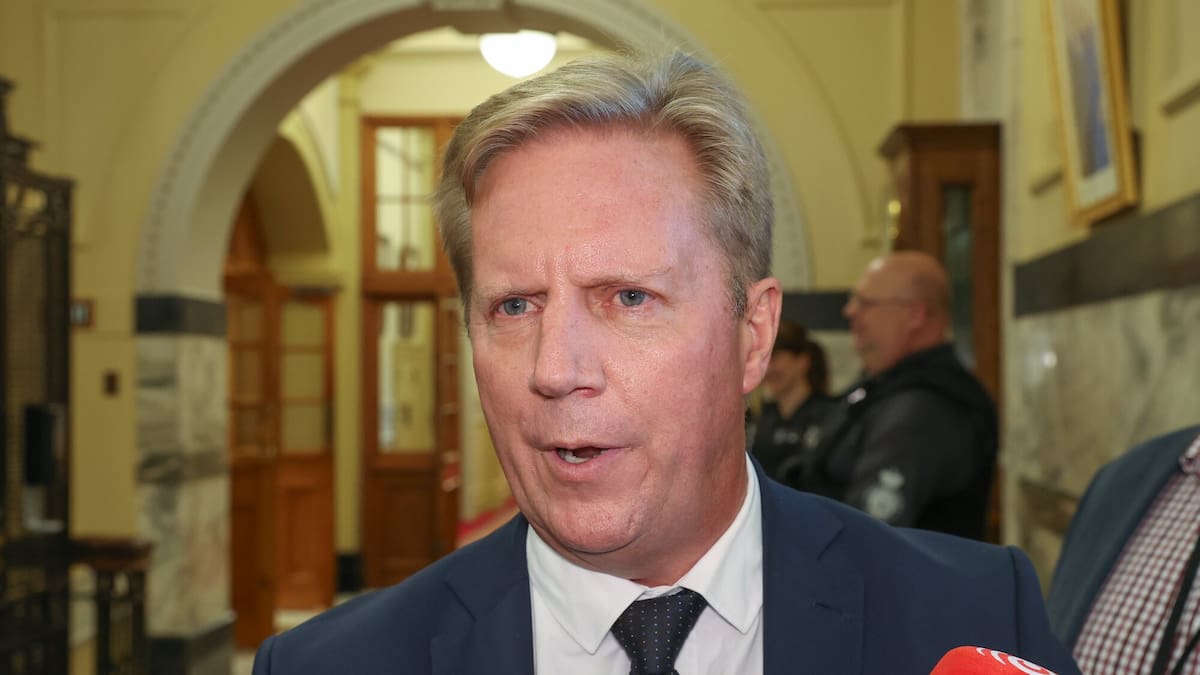
“Well, we are telling the truth and we’ve been very clear on the immigration components,” Luxon told RNZ’s Morning Report on Monday.
A spokesperson for Peters, speaking in his capacity as the leader of NZ First, said Peters stood by all his previous statements.
Labour leader Chris Hipkins had given conditional and tentative support for the deal, but alleged, also on Morning Report, that Luxon and Peters have “basically been calling each other liars” on the deal.
Hipkins said on Monday that his briefings on the agreement had shown up some discrepancies between what the Government had been saying – discrepancies he wanted clarified.
The full text of the agreement is not yet public and will not be for some time. As is the case with many trade agreements, it will remain secret while lawyers go over the final text.
As recently as last month, not even all the parties that comprise the Government had seen the full text of the agreement.
Trade Minister Todd McClay appearing to read from notes as he answers patsy questions last month on the Free Trade Agreement with India. Photo / Parliament TV
However, details of what the agreement actually says are becoming widely known. On Monday, McClay was asked, in light of more detail emerging about the agreement, whether he stood by remarks he made to Parliament on the deal.
Last Thursday, in a bid to shore up support for the deal, McClay had fellow National MP Tim van de Molen ask him a series of patsy questions in the House clarifying what the deal does and does not do.
McClay read his answers to those questions from written notes, suggesting the statement was pre-prepared.
Speaking about student visas, McClay told Parliament the agreement “does not restrict future governments from creating a cap should they wish to”.
The agreement would appear to include language that would entrench for future governments the uncapped nature of the current scheme for student visas issued to Indian nationals, with the only cap being the number of places tertiary institutions could provide.
In the past, this has proven to provide an avenue for migrant exploitation.
McClay would not repeat the claim that the agreement would not prohibit a future cap when asked by the Herald on Monday. He said there was no current cap on student numbers for any country and New Zealand would continue to be able to adjust some settings.
NZ First leader Winston Peters has been a critic of the deal. Photo / Jason Dorday
“Students must meet criteria set by the New Zealand Government to be issued with a visa. Under the FTA, we have retained the ability for current and future governments to alter or amend this criteria to limit or control student numbers,” he said.
Prior to his intervention in the House, McClay had made similar assertions to Parliament’s Foreign Affairs and Trade select committee, which is tasked with scrutinising the deal.
“If a future New Zealand government says actually we’re gonna limit the number of students coming in, they have the ability to do so … It doesn’t restrict the current [Government’s] or future governments’ ability to put restrictions upon student numbers coming to New Zealand,” McClay told the committee.
On Monday, Hipkins said that although he had not seen a copy of the FTA text himself, he had received some “more comprehensive briefing notes on it”.
He confessed that some of these briefing notes on what the agreement actually said appeared to contradict McClay’s statements.
“There are some big questions there about the potential implications, including whether a future government would be able to limit the number of international students coming in,” Hipkins said.
He also said it was unclear whether the multi-year 5000 cap on visas included the number of visas that would be issued for partners and dependent children.
When asked what he thought the agreement actually said, Hipkins replied, “I haven’t seen the actual agreement – I’ve seen a variety of briefing notes and at that point I would not be able to hand-on-heart give a definitive answer either way on [it].”
Hipkins said he was “looking for more clarity” on the issue.