
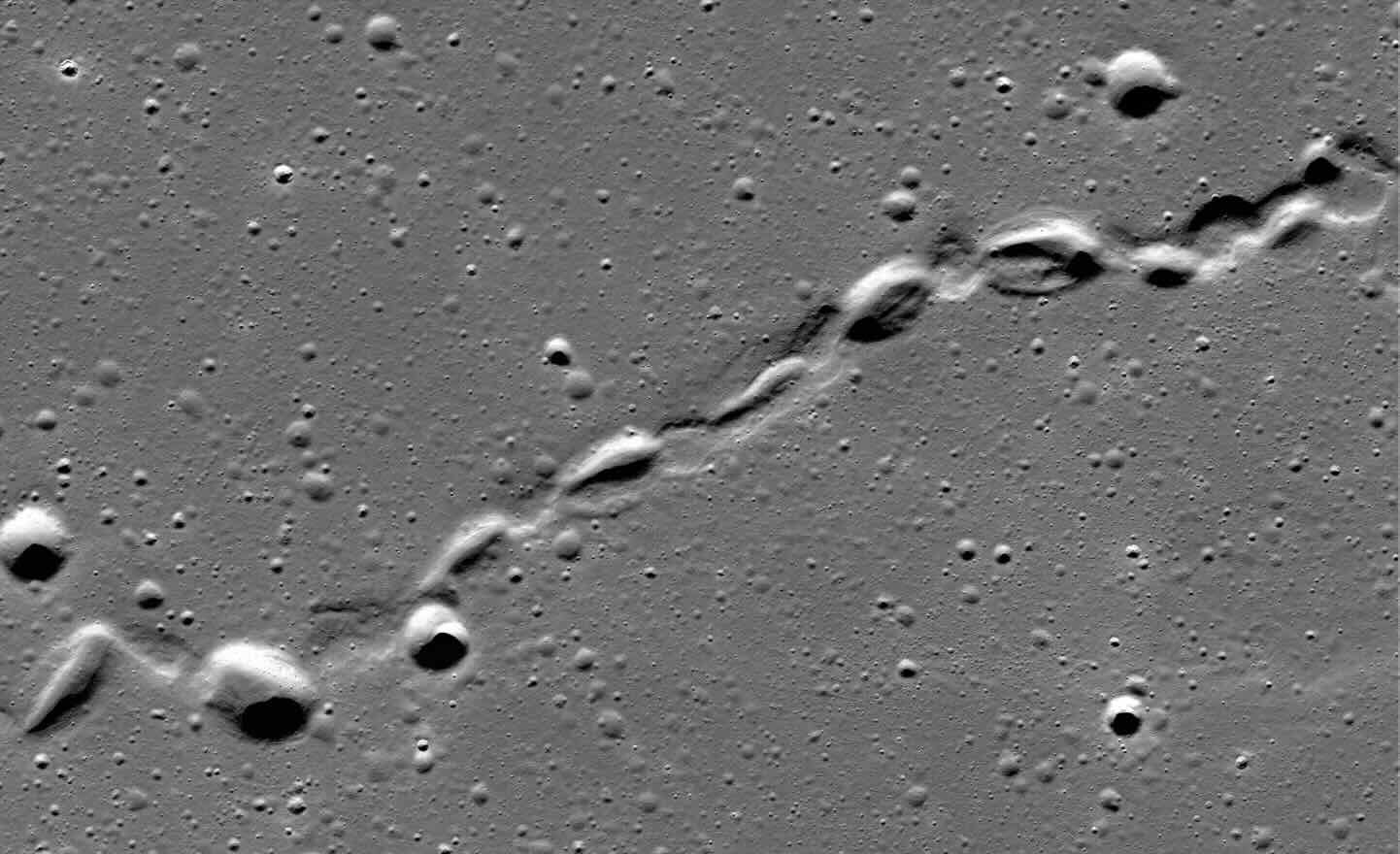
A bizarre-looking series of features on the Moon, captured in NASA imagery, appears to resemble the pathway of an enormous serpent slithering across the lunar surface.
At a glance, the peculiar “sinuous” feature could easily leave one with the impression that some large object had tumbled along the lunar landscape, leaving a long path of disturbances behind it.
Originally captured by cameras aboard the Lunar Reconnaissance Orbiter (LRO) in 2020, the snakey surface feature was discovered near Gruithuisen K crater at lunar coordinates 34.5°N, 43.5°W and initially prompted questions among scientists about what might have caused it.
“What is this strange feature consisting of ridges and elliptical and curved pits?” remarked Megan Henriksen, a project manager with Intuitive Machines and part of the team with NASA’s LRO Camera Science Operations Center in Phoenix, Arizona, in a posting on October 6, 2023.
![located near Gruithuisen K crater. NAC controlled mosaic containing images M1173350480L/R, M1173357586L/R [NASA/GSFC/Arizona State University].](https://www.newsbeep.com/nz/wp-content/uploads/2026/02/sinuous-lava-tubes-on-the-Moon.jpg) Above: The unusual series of features observed in LROC imagery located near Gruithuisen K crater (Image Credit: NASA/GSFC/Arizona State University).
Above: The unusual series of features observed in LROC imagery located near Gruithuisen K crater (Image Credit: NASA/GSFC/Arizona State University).
However, according to NASA officials, the solution to this oddball lunar discovery has nothing to do with mysterious surface activity and instead involves the Moon’s unique geology and subsurface features.
Answers Emerge from Below
The most likely explanation for the mysterious serpentine surface feature at Gruithuisen K involves ancient lunar volcanic activity.
Ancient eruptions of basaltic lava on the Moon have given rise to the formation of lava tubes, many of which have already been documented in various places on the Moon’s surface. As flowing lava cools and crusts, it provides insulation for the lava within, which eventually passes through once the primary eruption event subsides, leaving these long, tubular formations that gradually become buried over time—processes that are also well-characterized here on Earth.
Most evidence for the presence of lava tubes on the Moon appears in the form of what are known as “skylights,” which are areas above these ancient subsurface tunnels that collapse either due to the forces of gravity, or sometimes with the aid of seismic events, or even a well-placed meteor impact on the lunar surface.
In the case of the snaking surface features found near Gruithuisen K, lunar scientists believe that a lava tube located a short distance beneath the Moon’s surface resulted in an unusual “chain” of depressions as a series of collapses occurred along the tube over time.
“The large irregularly shaped crater-like formation at the upper left of the image is potentially the source vent for the lava flow,” Henriksen noted in 2023. “If there are lava tubes at Gruithuisen K, they could be as wide as 500 meters!”

The Future of Lunar Exploration
Establishing lunar bases within lava caves could also provide protection for astronauts in the coming decades. For instance, these caves could provide thermal insulation against the wide temperature fluctuations that occur there, in addition to shielding lunar scientists from the harmful effects of cosmic radiation.
Lunar outposts positioned within these caves may also help protect against meteorite impacts that have scoured the Moon’s surface, resulting in its characteristic pockmarked appearance.
So altogether, subsurface lava tubes on the Moon like those at Gruithuisen K are more than just a novelty for lunar enthusiasts: in the future, they may also be able to offer shelter to astronauts conducting long-term studies there, in addition to helping reveal important details about the Moon’s geology and volcanic history.
Additional information can be found on NASA’s LROC website.
Micah Hanks is the Editor-in-Chief and Co-Founder of The Debrief. A longtime reporter on science, defense, and technology with a focus on space and astronomy, he can be reached at micah@thedebrief.org. Follow him on X @MicahHanks, and at micahhanks.com.