
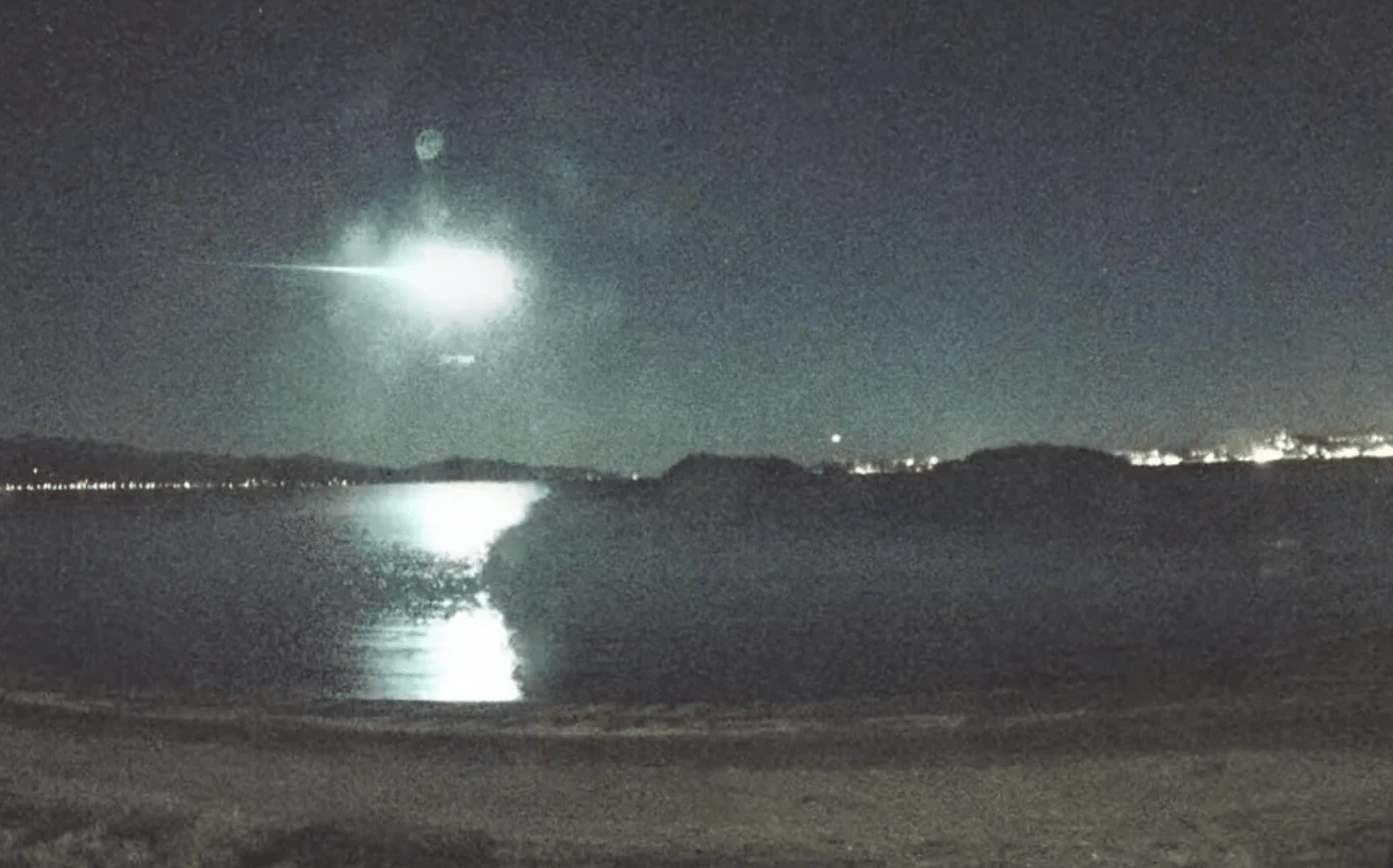
Picture this. You’re making a quiet start to the weekend when you notice a couple of texts and missed calls. They’re from a reporter. The reporter wants to talk about a “fireball”. That doesn’t sound good. Unless you’re an astronomer, in which case you reply, “Which fireball?”
Sure enough, a quick look online turns up videos of a spectacular event over Wellington, a bit before midnight on Friday, January 30.
Astro people get a fair number of calls about strange things in the sky, so I’ve developed a mental flowchart. The first step is, “Was it moving?” If it was sitting still, there’s a good chance it’s the planet Venus, which shines like a celestial Christmas-tree ornament on a good night.
Next on the list: “Okay, it was moving, but slowly – or a streak?”
Slow-moving objects in the sky have usually been put there by people. For example, in 2017 I got queries about what proved to be a giant Nasa balloon, launched from Wānaka, lit up by the setting sun as it sailed through the twilight sky.
Since it was described as a ‘fireball’, my next question was whether it was ‘space junk’ (also something we put there, but further up) or a ‘space rock’ (which, as many children know, but adults often forget, is technically a ‘meteor’). Space hardware and space rocks make similar streaks in the sky, but they come with different stories, so you need to know what you’re dealing with.
Only the largest pieces of space hardware make fiery re-entries, and even small items are actively tracked from the ground, so re-entries are usually predicted a few days in advance, even if their exact time and place is harder to pin down. But space rocks – which come from much further afield and don’t have names and serial numbers – arrive without notice.
This case was briefly complicated by a leftover Chinese rocket that was returning to Earth at about the same time that the Wellington fireball appeared. It was big enough to have sparked chatter in the media and it did come down close to New Zealand. The Chinese debris was too far south (and a couple of hours too late) to match the Wellington sighting, but a few early reports conflated the two.
Once we pin it down as a space rock everyone wants to know a few key things, starting with how big it was and how rare it is. It was likely less than 1m across. A couple of events like this happen every week, somewhere on the planet. But it’s not often you get to see one yourself – the last one I was asked about was a 2015 event of a similar size over the North Island.
So, what’s a space rock? And why did this one hit us? We know that solar systems like ours – sun and planets together – form from clouds of gas and dust, and space rocks are leftover material that didn’t coalesce into planets. But in addition to putting on a show this means that fireballs can deliver clues about how the solar system was assembled.
Which is why, alongside me, TV1 interviewed a spokesperson for Fireballs Aotearoa, part of a global ‘citizen science’ project tracking bright meteors. In the past few years, they’ve installed cameras across the country that are pointed at the sky. If some of these spot the same bright meteor streaking they can reconstruct the three-dimensional path of the object in question.
And this is fun. If you’re lucky, following the path to its endpoint reveals where to look for any leftovers that might have landed (that’s a ‘meteorite’). Likewise, following the path backwards reveals the rock’s trajectory through space.
This one came in from the east and disintegrated over the sea, 60km up so, alas, there was no point in searching for souvenirs.
Looking the other way, we learn that this rock’s elliptical orbit regularly took it a little beyond Jupiter and closer to the sun than Venus.
Most free-flying rocks in the inner solar system are corralled within the ‘asteroid belt’ between Mars and Jupiter, peacefully orbiting the Sun. However, those hitting the Earth, by their very nature, have strayed outside this zone. This one could have spent billions of years playing cosmic dodgeball with the four planets whose orbits it regularly crossed.
But on Friday night at 11.36pm New Zealand Daylight Savings Time, its luck ran out.
A few hours after the 6pm news on Saturday evening I stepped outside and caught sight of Jupiter, a hand’s-width from the full Moon. I’d just been on the telly talking about a seemingly random event, and here I was staring at the biggest planet in the solar system and a key player in the destiny of Friday’s fireball.
In the four-and-a-half billion years, or thereabouts, that travelling rock was sailing through space it could have made multiple passes of Jupiter’s cloud tops and our sibling worlds, Venus and Mars. But on Friday it made itself known to anyone in the middle of the country who was outside and looking up, including a family driving to Maccas for a late-night snack.
Connections between the sky and our daily lives mean that these stories never get old for me. The next one could come tomorrow or it may be a decade away, but I’m always happy to pick up the phone.
This article was originally published on Richard Easther’s blog, Excursion Set