
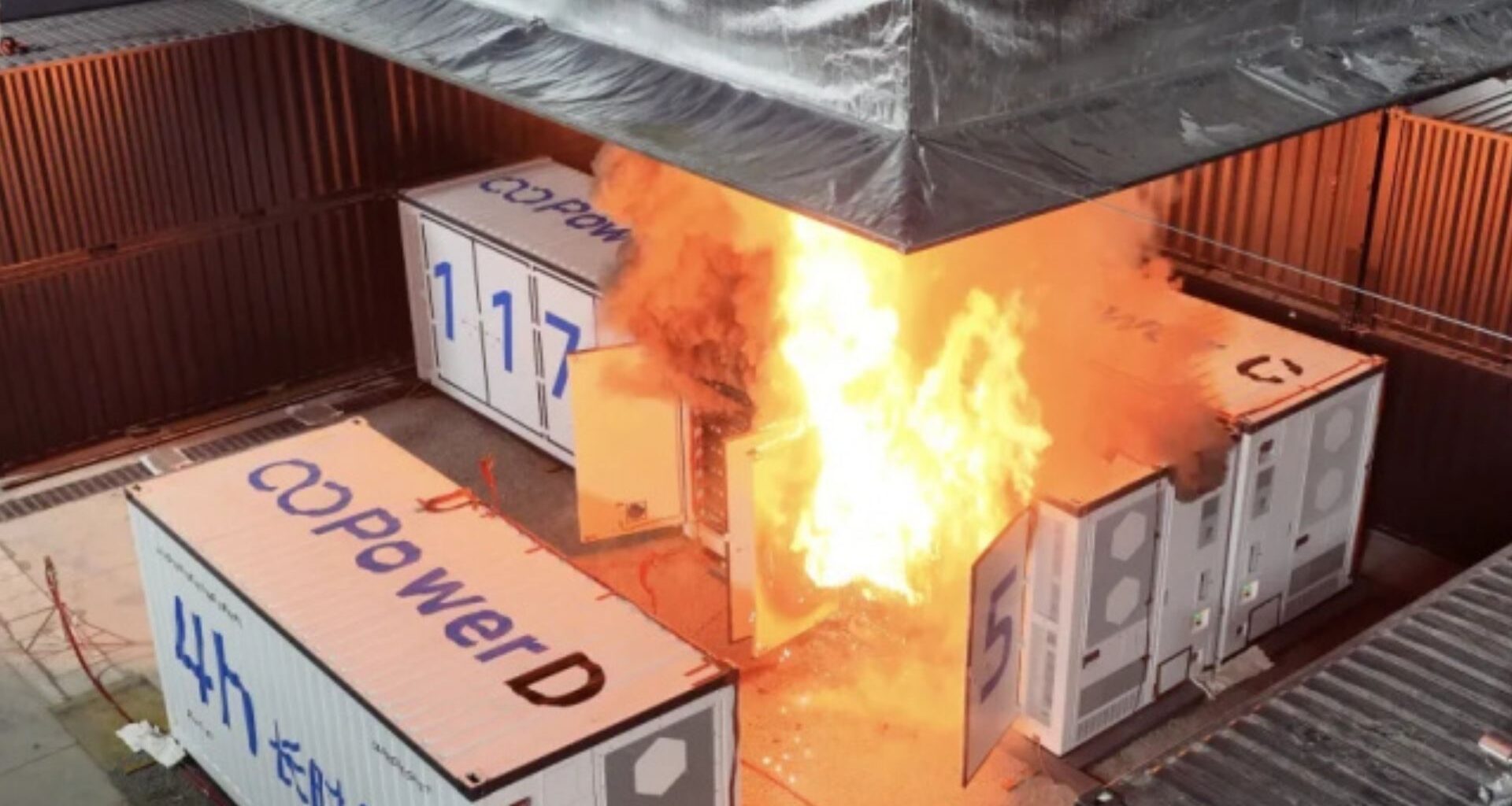
The Chinese energy firm HiTHIUM has completed a landmark safety trial for grid-scale batteries, advancing energy storage into a new validation tier.
The company conducted what it says is the world’s first open-door large-scale fire test on a 6.25 megawatt-hour, four-hour-long-duration energy storage system built with kiloampere-hour battery cells.
The test was conducted under full oversight by UL Solutions, U.S. Authorities Having Jurisdiction, and fire protection engineers, and followed the latest requirements of UL 9540A (2025) and NFPA 855 (2026).
The results point to a system that can remain stable and predictable even under extreme abuse, a key concern as storage installations grow larger across the United States.
Pushing fire testing into a harsher reality
The trial was designed to reflect worst-case, real-world failure scenarios rather than controlled lab conditions. The battery maker left the container doors fully open throughout the event, creating an open-door combustion environment with maximum oxygen supply and direct flame exposure.
Adjacent battery containers were placed back-to-back and side by side, with just 5.9 inches of separation, far tighter than typical field layouts.
The system was also charged to 100 percent state of charge, representing peak stored energy. All active fire suppression systems were switched off, forcing the design to rely entirely on passive and intrinsic safety features. This setup was built on a previous 5 MWh open-door fire test, but moved the validation to a higher energy level using the company’s ∞Power 6.25 MWh platform and its ∞Cell rated at 1,175 ampere-hours.
By increasing both cell size and total system capacity, the test directly confronted concerns that higher energy density could lead to faster escalation, violent failures, or cascading damage across containers.
Managing energy release without explosions
One of the central risks of ultra-large battery cells is the large amount of energy released during thermal runaway. To address this, the firm engineered a three-dimensional airflow channel with directional venting paths and a dual-pressure relief valve at the module level.
This approach allowed gases to exit rapidly and in a controlled direction during failure events. Based on the test observations, pressure did not reach explosive levels, and no debris was ejected. The controlled release demonstrated that even with 1,175 Ah cells, energy discharge could be managed without sudden mechanical rupture.
This outcome is significant for U.S. regulators and developers who are increasingly focused on blast risks and first-responder safety around large battery installations.
Stopping the fire spread between containers
Another major concern for utilities is thermal propagation from one battery system to the next. During the test, the burning container was exposed to open flames and intense radiant heat, while neighboring units sat just inches away.
Fire-resistant module covers, reinforced steel enclosures, and insulated multi-layer container walls worked together as physical barriers. The fire remained confined to a single battery system, and temperatures in cells housed in adjacent containers stayed below safety limits. No chain reaction or cross-container ignition occurred, even under sustained exposure.
This result supports the idea that dense site layouts can still be designed safely when passive protection is layered correctly.
Holding structural integrity under extreme heat
Long-duration fires can weaken steel structures and cause collapse, complicating firefighting and cleanup. To counter this, the ∞Power 6.25 MWh system used a high-strength steel frame, internal stiffeners, and dual-layer partitions.
After prolonged combustion, inspectors found no major deformation or structural failure in the affected container. The enclosure remained intact, suggesting that the system can tolerate prolonged thermal stress without compromising site stability.
Together, these findings mark a milestone for large-scale energy storage safety. As projects scale from 5 MWh to larger capacities, HiTHIUM’s testing provides data that could inform future codes and deployment practices, supporting the safer expansion of long-duration storage across the U.S. energy grid.