
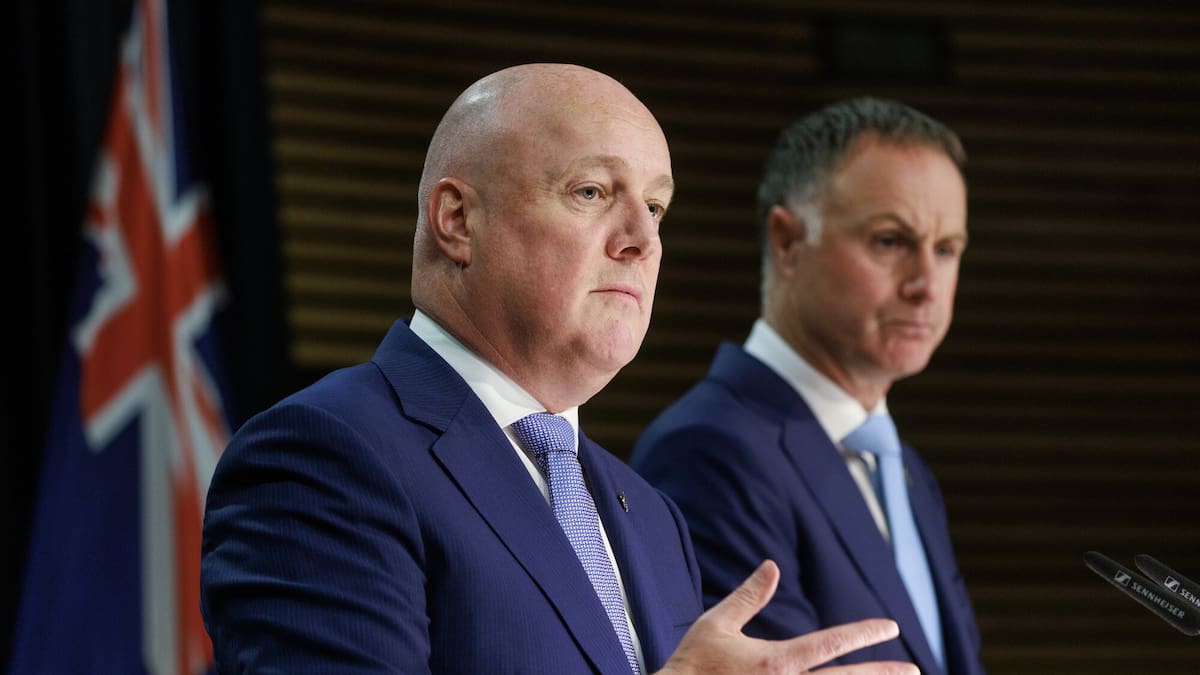
Meanwhile, the Parliamentary Commissioner for the Environment fears New Zealand will become dependent on imported LNG.
The Government’s rationale
The Government is going through a procurement process to have an LNG terminal established in Taranaki by 2028.
“The LNG import facility will provide a reliable backup fuel source, reducing the impact of dry-year risk on electricity pricing and stabilising electricity costs,” Minister for Energy Simon Watts said.
“It will also add another layer of resilience by giving New Zealand access to additional supply options if domestic gas supply tightens unexpectedly.”
Watts said importing more coal during a dry year wasn’t enough, so it made sense to enable companies to import LNG and turn it into electricity using existing plants that aren’t operating at capacity due to a lack of gas.
He said the Government would pay to set up an LNG import facility by levying the electricity sector.
Depending on contractual arrangements, Watts estimated the levy would be between $2 and $4 per megawatt hour (MWh) of electricity produced.
He said this cost would be more than offset by the terminal removing the risk premium (worth around $10/MWh) currently included in the price of electricity due to uncertainty around supply.
Accordingly, he argued the terminal would put downward pressure on electricity prices for consumers.
Sector looking for certainty and bipartisanship
Speaking to Newstalk ZB, Contact Energy chief executive Mike Fuge agreed the certainty around having access to gas would put downward pressure on prices.
However, he said the project really needed bipartisan political support.
Labour leader Chris Hipkins was unsupportive of the terminal but wouldn’t unveil the energy policy his party would take to the election.
He didn’t rule out tearing up the agreement the Government hoped to reach by the middle of the year to have the terminal built, if elected to govern.
Hipkins also took aim at the Government for paying for the terminal by “taxing” consumers.
However, Watts said the Electricity Authority would monitor prices, ensuring savings from the terminal removing risk from the sector were in fact passed on to consumers.
Gentailers wary of costs
Fuge believed the cost of establishing the terminal should be spread more widely – including to all gas users – rather than just falling on the electricity sector.
Frontier Economics, in May, warned the Government: “It would make no economic sense to develop an LNG import terminal to meet just dry-year risk, as the large fixed costs would be spread over a relatively small amount of output.
“If an LNG terminal is contemplated as a last resort to provide NZ with a secure energy system, this should be considered as part of a wider gas supply strategy …”
Genesis chief executive Malcom Johns told the Herald Genesis had been “actively assessing” the potential role of LNG as a part of its broader fuel strategy for more than two years.
“Any involvement by Genesis would be based on commercial discipline and a clear focus on managing energy costs for New Zealanders,” he said.
Johns said LNG “could be complementary to our existing flexible generation and gas portfolio, particularly as the market develops future electricity security products and firming arrangements”.
Simon Upton wary
However, Parliamentary Commissioner for the Environment Simon Upton feared electricity companies could start relying on LNG.
“If the rationale for using LNG is to provide dry-year risk insurance, then it is important that LNG use is confined to addressing that problem and only for as long as is needed to develop a more durable solution,” he told the Herald.
“If the availability of LNG is used … [for] thermal firming at peak demand or industrial use of gas, we risk a new path [of] dependency on fossil fuel.”
Upton – a former National Party minister – noted relying on LNG would be costly and bad for the environment.
“From an emissions perspective, it isn’t clear that LNG is any better than coal when you look at the whole life cycle, including liquefication and transport,” he said.
Upton also raised his concerns in a letter he sent to Watts in November.
In it, he said the Government should consider “electricity market conditions of today are unlikely to be representative of the future”.
“For one thing, much of the uncertainty, which has hampered investment in new generation (will Tiwai close, for example), has been resolved.
“For another, the reality of domestic gas prices has led market participants to insure themselves (via the Huntly strategic reserve proposal – a proposal that LNG could be seen as competing with) as well as seek out alternatives (for example, wood pellet manufacturing and new diesel generation).
“The current growth in supply of renewables is promising; if it outstrips the growth in demand for energy, the required scale of any dry year solution will be reduced.”
Jenée Tibshraeny is the Herald’s Wellington business editor, based in the Parliamentary Press Gallery. She specialises in government and Reserve Bank policymaking, economics and banking.
Stay ahead with the latest market moves, corporate updates, and economic insights by subscribing to our Business newsletter – your essential weekly round-up of all the business news you need.