
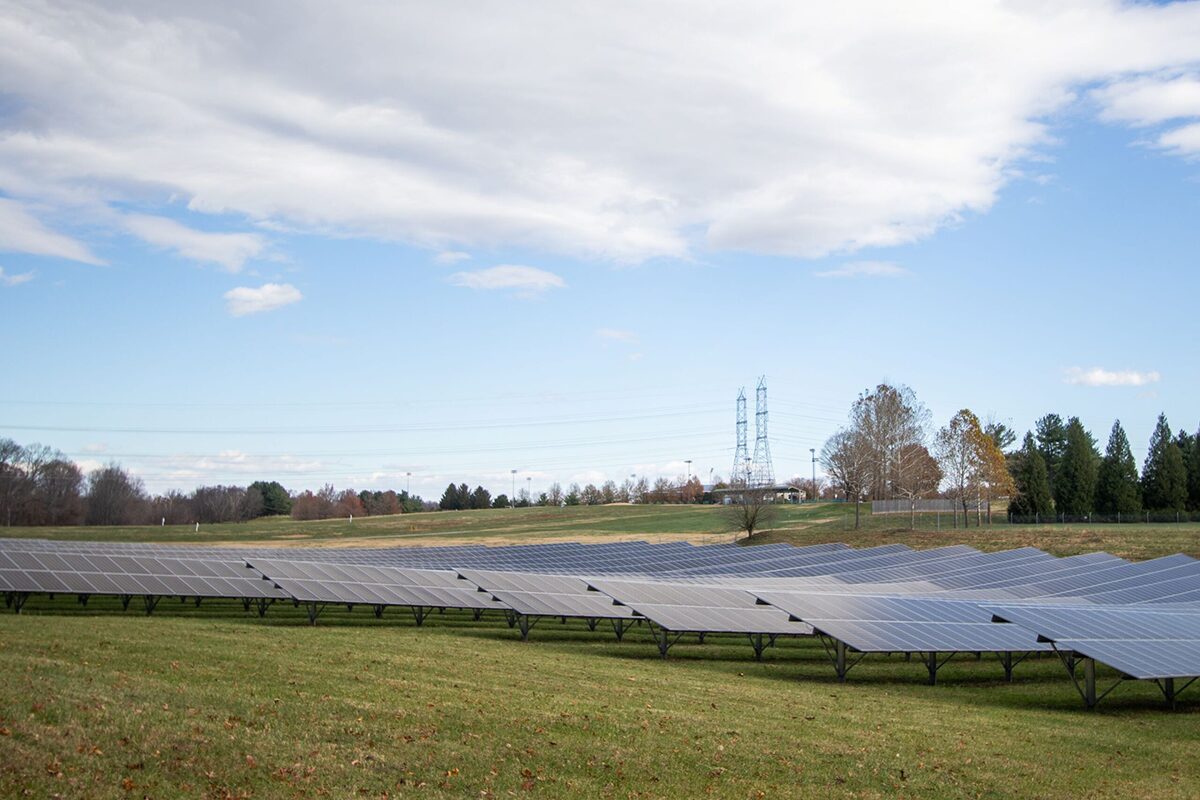
As the sun emerges from behind the clouds above a former farm in Germantown, Maryland, rows of solar panels begin to hum. The soft buzz is barely audible over the sounds of children and coaches shouting on soccer fields in the distance.
Nestled in a grassy valley at the Maryland SoccerPlex, the nearly 6-acre solar field helps provide power and energy to dozens of Montgomery Parks facilities.
There are 181 of these solar farms in Maryland, according to data from Cleanview, a clean energy tracking platform. Together, they have a total operating capacity of more than 800 megawatts — about 45% as much as the Calvert Cliffs Nuclear Power Plant, the state’s biggest source of electricity. These solar farms provide energy to thousands of homes.
Climate experts and activists said these farms are necessary for Maryland to meet its aggressive renewable energy goals, including reaching net-zero carbon emissions in the near future.
“They’re never going to reach those goals by people putting panels on their roof, because just not enough people can put panels on their roof,” said Tony Napolitano, the CEO and owner of U.S. Community Solar.
However, Maryland has had to balance its need for reliable and renewable energy with federal attacks on solar and complaints from farmers about land usage.
The state of solar in Maryland
As of earlier this year, nearly 7% of Maryland’s electricity came from solar. That is enough energy to power more than 300,000 homes, according to the Solar Energy Industries Association.
Consumers may think most of this energy comes from solar panels attached to the roofs of individual homes and businesses. But utility-scale solar projects, also known as solar farms, play a huge role in providing clean energy.
The Solar Energy Industries Association defines utility-scale solar projects as ones that generate at least one megawatt of energy. Some of these bigger projects are owned by large utility companies, while others are part of community solar programs.
Community solar programs remove some of the barriers to capitalizing on solar by allowing households and businesses to subscribe to a shared power source without installing panels directly on their roofs or properties.
“If you leverage economies of scale, like building a solar farm on unused farmland or an old landfill or other areas that are not in use, then you can have thousands of people do the same thing as putting solar on their roof, but it’s way easier and way faster,” Napolitano said.
U.S. Community Solar has an office in Maryland that works to connect consumers with community solar programs.
Bernie Vogel, one of these consumers, owns a restaurant in Carroll County, but does not own the building his restaurant leases. He does everything he can to run a sustainable business, but knew he could not install solar panels on a building he rented.
Vogel said subscribing to a community solar farm was a more practical option. He knows this won’t solve all of the world’s energy problems, but he said every individual step helps.
“It’s not the home runs that win ballgames,” he said. “I’m not here to swing it over the fence. I just want to get on base.”
Reaching renewable energy goals
State leaders said expanding solar energy is needed to help Maryland achieve its ambitious goal of reaching net-zero carbon emissions by 2035.
Solar can help reduce air pollution and greenhouse gas emissions, and is crucial in helping the state move away from fossil fuel-based sources of energy, according to the Maryland Department of the Environment
It will be impossible for Maryland to reach its energy goals without utility-scale solar, Napolitano said.
“These goals are really aggressive,” he said.
It’s crucial to deploy diversified types of solar, especially because utility-scale solar can be more affordable than rooftop solar, said Maryland Sierra Club Executive Director Josh Tulkin.
“If you combine solar with battery storage, then you have both cheap renewable energy and reliability,” he said. “It’s something we strongly support.”
Maryland could soon face a shortage of energy, said State Sen. Brian Feldman, D-Montgomery County. Already, he said, the state has to import a lot of its energy from out of state.
This looming energy crisis pushed Feldman to take action in the Maryland General Assembly to smooth the regulatory processes for renewable energy projects. Localities across Maryland have set strict standards that have prohibited some solar projects, Feldman said.
During last year’s legislative session, the General Assembly passed Feldman’s bill to standardize permitting and regulation of solar projects. The Renewable Energy Certainty Act will develop standardized regulations for solar farms and overrule some local jurisdictions.
“Every local jurisdiction in the state cannot just use local zoning to make sure there’s no energy projects in their county,” Feldman said.
Overcoming the opposition
State lawmakers have had to walk a fine line between expanding solar and appeasing farmers who have an abundance of concerns about solar projects being built on agricultural land.
Last spring, the Farmers Alliance for Rural Maryland fought Feldman’s bill.
“The so-called ‘Renewable Energy Certainty Act’ was rushed through the legislature, putting solar developers ahead of local communities and stripping counties of their zoning authority over large-scale energy projects,” said the alliance’s petition against the bill.
In order to address the concerns of the state’s farmers, lawmakers added a cap to the bill that limits how much the state can override local zoning decisions. Feldman said it’s important to not overdo solar development, but it’s also important to note no farmer is forced to sell their land or lease land to a solar developer.
Paul Goeringer, a principal faculty specialist and extension specialist in the University of Maryland’s Department of Agricultural and Resource Economics, works to help farmers understand solar development and looks into how this development has impacted farmland.
“I think the biggest concerns have been a lot of areas related to taking farmland out of production,” he said. “It is a balancing act of trying to find the prime spots to put it that help but also maintaining farmland.”
Napolitano, the owner and CEO of U.S. Community Solar, said farmers are often interested in installing solar on their own property if they have an unused plot of land.
“They can have a solar farm there for 20 years and get paid a steady income that they can count on for that time,” he said. “For rural communities, community solar can be a big boon for them. It can support local farms. It can help the local economy. Also, it just brings investment.”
Trouble out of D.C.
Beyond Maryland, the solar industry is facing threats from President Donald Trump and his administration. The president has canceled some solar projects and worked with Republicans to end federal solar credits through his signature One Big Beautiful Bill Act.
This summer, the Trump administration announced U.S. Secretary of the Interior Doug Burgum must personally approve permits for solar projects. Dozens of solar companies have urged lawmakers to block the policy, saying it could jeopardize hundreds of projects.
In August, U.S. Secretary of Agriculture Brooke Rollins announced her department will no longer allow solar panels subsidized by the federal government to be built on farmland.
“Subsidized solar farms have made it more difficult for farmers to access farmland by making it more expensive and less available,” Rollins said in a news release announcing the change.
Goeringer said Maryland hasn’t yet seen an impact from tax credits being taken away, but this will likely slow down the development of large solar projects in the coming years.
These are just a few of the steps the Trump administration has taken to slow or roll back solar projects.
Diana Furchtgott-Roth, former director of the Center for Energy, Climate and Environment at the conservative Heritage Foundation, said the country has been investing too much in solar and wind development, which has driven up electricity prices and left behind other energy sources.
“We are facing instability and a weakening of the electricity grid,” she said. “I’m in favor of any energy source as long as it doesn’t have subsidies.”
She said Maryland should be focusing on the least expensive sources of power to try and lower costs for residents.
Looking to the future
It’s too early to assess the impact of the Renewable Energy Certainty Act, Feldman said, but it’s likely additional amendments will be made to the bill during the current legislative session as the state hears more from stakeholders.
Tulkin, the Maryland Sierra Club executive director, said as the bill is implemented, the state needs to consider the views of county governments while prohibiting arbitrary delays and denials that could block solar farm construction.
As the demand for energy quickly rises, it’s crucial the state uses diverse sources of energy, Feldman said.
“I think it’s an all hands on deck situation,” he said. “New nuclear, new natural gas projects, solar, wind, geothermal. I think everything needs to be on the table.”
Napolitano said Maryland is moving in the right direction and he hopes to see more people take advantage of community solar.
“My hope is that it just keeps going the way it’s going,” he said. “I just want to see more people take advantage of [it] and I want to see Maryland reach its renewable energy goals.”
This article was orginally published in Capital News Service.