
Like the lives of the infected themselves, this episode of The Beauty has a clear dividing line between the before and the after. Half of the episode takes place in the present, as Cooper and Jordan reunite and Antonio and Jeremy execute more unauthorized beneficiaries of the rejuvenating drug-virus’s powers. The other half takes place three years earlier, as we meet the man our corporate head honcho used to be before he became Ashton Kutcher.
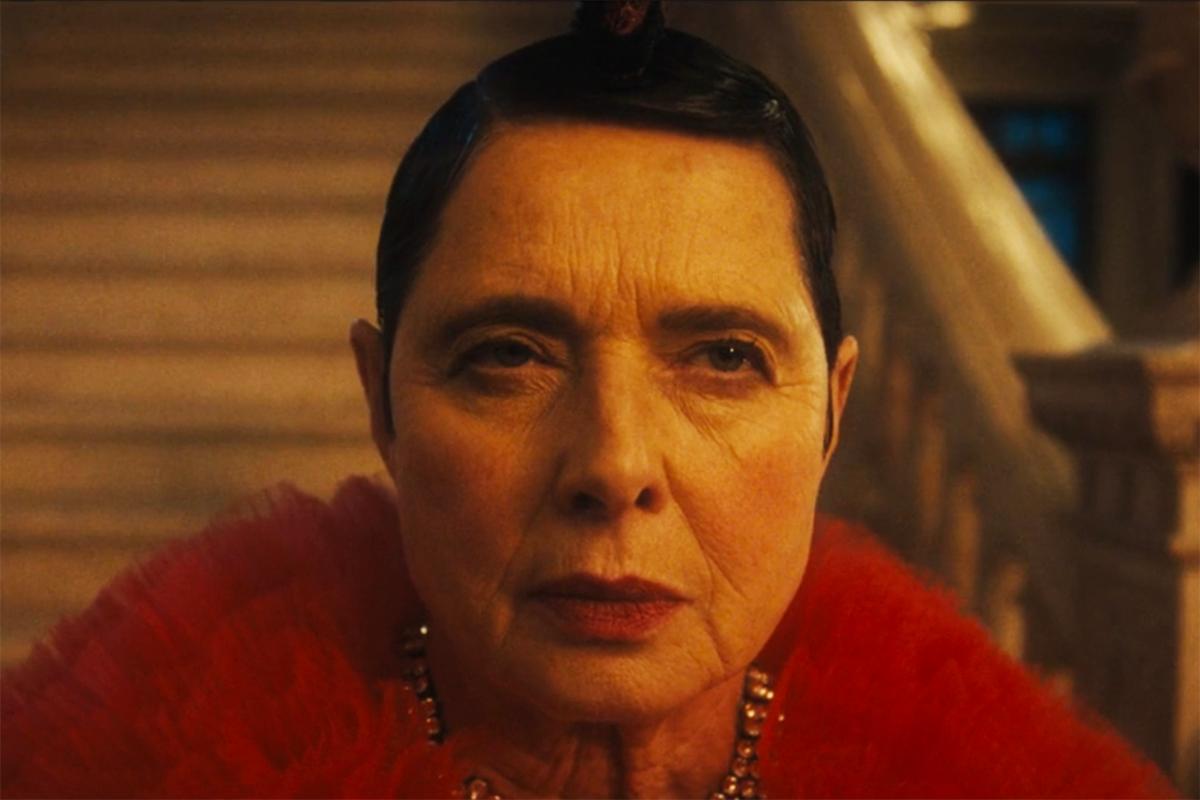
To my surprise and delight, he used to be Vincent D’Onofrio. The great character actor shows up as Byron Forst, which turns out to be the real name of Kutcher’s character. He’s a fast-talking sixtysomething slimeball who fucks his assistants, verbally spars with his unhappy wife (Isabella Rossellini, tricked out like a member of the Exploited wearing a high-fashion duvet), and goes to Burning Man.
If you’re used to D’Onofrio playing rich and powerful men the way he plays Wilson Fisk on Disney+’s Daredevil: Born Again and related shows, this performance is an absolute scream. Byron couldn’t be further away from Fisk, who moves glacially, stands regally, and speaks with a throat full of hot gravel. Byron slouches, slinks, even capers at one point. His obnoxious behavior is much closer to the childlike antics of immature Nazi billionaire Elon Musk than he is to the Kingpin, which is the right choice for the show.
So is what happens immediately after he and his fellow billionaires, including Peter Gallagher with a cane and Billy Eichner in a ten-gallon hat, are injected while wearing David Cronenberg hospital gowns in a white chamber reminiscent of the control room from Alien. Rather than allow any of the other oligarchs to benefit from this new technology, Byron guns them down, then has his security team murder the help, then murders his security team.
The only survivor is Ray (Rob Yang), the Nobel Prize–winning genius (back when winning a Nobel Prize meant something) who designed the drug. Byron takes the man into his direct employ/control, and the rest is history.
In the present, the newly Beauty-fied Jordan convinces Cooper she is who she says she is by repeating her nickname for his dick: Provigil, an anti-narcolepsy drug, that “brings me back to life.” (I mean this sincerely: Stay classless, The Beauty.) At dinner, she explains how after fleeing the hotel in a panic after transforming, she initially enjoyed the attention her youthful new body and face received, until increasingly unpleasant interactions with men made her feel objectified and stupid. Cooper assures her she was beautiful long before the drug got in her system.
I’d like to see that explored a bit more, to be honest. Rebecca Hall, the actor who plays original-version Jordan, is in fact stunning, and the character is not even 40 yet. Ashton Kutcher, the transformed version of Byron, is 47 years old. He can absolutely play younger, but so can Hall, so what gives?
At the risk of shooting the show bail, I think the double standard is deliberate. Men made this drug, mostly for a male userbase, entirely for a patriarchal world. For these guys, and for a lot of people in fact, it’s okay to be a handsome 47-year-old man in a way it’s not okay to be a beautiful 40-year-old woman. Men online will speak of “the wall,” some completely mythical barrier women hit as they age after which their looks evaporate, as if it’s an incontrovertible fact of life. Would a scientist willing to take these bastards’ money be any different?
Anyway, Jordan is ready to fall in love with Cooper all over again, but he calls off her attempt to kiss him until they know exactly what it is they’re dealing with. That’s a good call: Antonio and Jeremy are out there murdering anyone infected who’ve swapped fluids, putting the clientele of an entire New York sex club on their hit list. They wind up finding patient zero for that outbreak and staging his artsily mutilated corpse in Cooper’s bed, presumably to frame him for all of Antonio’s elaborate killings. They also listen to Christopher Cross’s “Ride Like the Wind,” which feels worth noting simply because it’s a very good song.
I remain impressed by The Beauty’s ability to find different notes to harmonize with its batshit melody. Evan Peters humanized Jeffrey Dahmer, so he has little trouble making Cooper empathetic despite, or because of, his sex-first view of humanity. His care for Jordan is obvious, so much so that he still connects with her on a deep level even in her improbable new body. As the new Jordan, Jessica Alexander does fine work blending her performance with Hall’s, making it feel like it’s the same person in there somewhere.
The Beauty’s villains are all comedic characters, and they’re all very funny. Anthony Ramos’s casual, “just because I’m killing you doesn’t mean we can’t be friends” vibe as Antonio the assassin; D’Onofrio and Kutcher’s antisocial glee as Byron; and especially Rossellini’s DGAF attitude as Byron’s wife and nemesis, Franny. She sneers at his achievements: “Self-driving software that can’t tell the difference between a person and a mailbox, or an algorithm that drives teen girls to eating disorders.” Sounds like some guys we know, all of them major donors to Donald Trump’s Jeffrey Epstein Memorial Ballroom.
But more poignant and pointed than that are her comments about her own life. Once, she says, she chased illusory standards of beauty with all the dieting and surgery money could buy, in hopes of attracting a mate wo could help her achieve her dreams. Now those dreams have become “my golden prison.” Lighting Caravaggio’s painting Judith Beheading Holofernes on fire, she proclaims “Once I learned that beauty is the answer to nothing, I became the happiest I’ve ever been.”
Bryon’s insults bounce right off her, because she no longer concedes the premise that looks are something to insult someone about. Now we know why she’s still a normal person while Byron runs around as Byron 2.0: She’s miserable, she’s full of hatred, she’s not a nice person, but she isn’t vain or shallow or grasping, not anymore. Whatever her problems, Franny can sense that Byron’s self-loathing and his loathing of everyone else on the planet go hand in hand.
Sean T. Collins (@seantcollins.com on Bluesky and theseantcollins on Patreon) has written about television for The New York Times, Vulture, Rolling Stone, and elsewhere. He is the author of Pain Don’t Hurt: Meditations on Road House. He lives with his family on Long Island.